Scientists confirm crab's memory of pain
March 27, 2009 A hermit crab

Enlarge

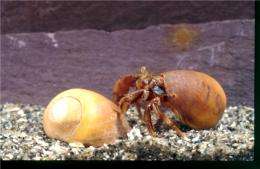
A hermit crab.

New research published by a Queen’s University Belfast academic has shown that crabs not only suffer pain but that they retain a memory of it.

The study, which looked at the reactions of hermit to small electric shocks, was carried out by Professor Bob Elwood and Mirjam Appel from the School of Biological Sciences at Queen’s and has been published in the journal Animal Behaviour.

Professor Elwood, who previously carried out a study showing that prawns endure pain, said his research highlighted the need to investigate how crustaceans used in food industries are treated. 

Hermit crabs have no of their own so inhabit other structures, usually empty mollusc shells.

Wires were attached to shells to deliver the small shocks to the abdomen of the some of the crabs within the shells.

The only crabs to get out of their shells were those which had received shocks, indicating that the experience is unpleasant for them. This shows that central neuronal processing occurs rather than the response merely being a reflex.

Hermit crabs are known to prefer some species of shells more strongly than others and it was found that that they were more likely to come out of the shells they least preferred.

The main aim of the experiment, however, was to deliver a shock just under the threshold that causes crabs to move out of the shell, to see what happened when a new shell was then offered.

Crabs that had been shocked but had remained in their shell appeared to remember the experience of the shock because they quickly moved towards the new shell, investigated it briefly and were more likely to change to the new shell compared to those that had not been shocked.

Professor Elwood said: “There has been a long debate about whether crustaceans including crabs, prawns and lobsters feel pain.

“We know from previous research that they can detect harmful and withdraw from the source of the stimuli but that could be a simple reflex without the inner ‘feeling’ of unpleasantness that we associate with pain.

“This research demonstrates that it is not a simple reflex but that crabs trade-off their need for a quality shell with the need to avoid the harmful stimulus.

“Such trade-offs are seen in vertebrates in which the response to pain is controlled with respect to other requirements.

“Humans, for example, may hold on a hot plate that contains food whereas they may drop an empty plate, showing that we take into account differing motivational requirements when responding to pain.

“Trade-offs of this type have not been previously demonstrated in crustaceans. The results are consistent with the idea of pain being experienced by these animals.”

Previous work at Queen’s University found that prawns show prolonged rubbing when an antenna was treated with weak acetic acid but this rubbing was reduced by local anaesthetic.

The findings are both studies are consistent with observations of pain in mammals.

But Professor Elwood says that in contrast to mammals, little protection is given to the millions of crustaceans that are used in the fishing and food industries each day.

He added: “More research is needed in this area where a potentially very large problem is being ignored.

“Legislation to protect crustaceans has been proposed but it is likely to cover only scientific research.

“Millions of crustacean are caught or reared in aquaculture for the food industry.

“There is no protection for these animals (with the possible exception of certain states in Australia) as the presumption is that they cannot experience pain.

“With vertebrates we are asked to err on the side of caution and I believe this is the approach to take with these crustaceans.”

More information: Animal Behaviour Journal, doi:10.1016/j.anbehav.2009.01.028

Provided by Queen’s University Belfast


print this article email this article download pdf blog this article bookmark this article     Stumble it Digg this share on Facebook retweet share on Reddit add to delicious
Rate this story - 5 /5 (6 votes)

Rank Filter

Move the slider to adjust rank threshold, so that you can hide some of the comments.


Display comments: newest first

  • tkjtkj - Mar 27, 2009
    • Rank: 5 / 5 (3)
    As a person who dedicated his professional life to the amelioration of pain i do sympathize with the point of the article. I also sympathize with the newborn human male who is forced to endure circumcision totally without benefit of anesthesia. Should we not attend to this example of blatant disregard for the well-being of our own infants? If we can not do that, than little hope exists for finding methods of handling crustacae so as not to cause them to endure needless suffering.

    Long ago I described a method of effectively circumcising baby boys that is without pain, bloodless, and safe. I did this to one patient at age 13 and followed his progress over many years. I can attest to the method's affectiveness although "one case does not an investigation make"!

    I demonstrated this technique to several people and have yet to find that it is being done. I have concluded that the innertia of our medical care non-system, perhaps coupled with our society's preference for scalpel-related cures, has had a role in perpetuating the 'standard' circ methodology despite unnecessary suffering endured by our children, and, of course, the needless expense. It's even said, as was said about crustacae here, that " are not able to feel the pain." So, are we forced to believe that the screaming of the newborn under the knife must be due to some primal need to excercise his respiratory system??

    tkjtkj@gmail.com
  • vlam67 - Mar 27, 2009
    • Rank: 5 / 5 (1)
    tkikj,
    take a number and join the queue of "complainers". This world is patently unfair, you should know it, as the governance systems humans had in place are emphatically for the sole purpose of maintaining benefits and power and the status quo of the alpha-males of the whole shebang that is the mud ball called Earth. Take a deep breath, do yoga, or whatever to stop busting your brain' blood vessels. Nothing short of a mega meteorite to wipe out the whole mess will do any change. But, come to think of it, the dinosaurs was the apex of evolution in bygone age, and lasted for hundred of millions of years, without improving themselves before they were wiped out. Perhaps they too were religious and thought it was just the will of [their] God(s) and didn't do a thing to the contrary. Pissing up wind has been a chalenging pastime for untold bright sparks since amino acids replicate themeselves, and the results have been less than encouraging. I wish you luck in your Don Quixotean quest.

March 27, 2009 all stories

Comments: 2

5 /5 (6 votes)
  • Stumble this up

  • Digg this

  • share this

  • hide
  • Related Stories

  • Chinese takeaway in the Wadden Sea
    created Sep 25, 2007 | popularity not rated yet | comments 0
  • Furry-clawed Asian crabs found in Delaware and Chesapeake Bays
    created Jun 04, 2007 | popularity not rated yet | comments 0
  • New 150 million-year-old crab species discovered
    created Oct 17, 2007 | popularity not rated yet | comments 0
  • Shell-breaking crabs lived 20 million years earlier than thought
    created Apr 22, 2008 | popularity not rated yet | comments 0
  • Global warming threatens Antarctic sea life
    created Feb 05, 2009 | popularity not rated yet | comments 0


  • hide
  • Relevant PhysicsForums posts

  • Questions about deep sea marine life.
    created 3 hours ago
  • Why is ATP synthesis reversible on the F1 subunit??? What is the point of this?
    created 22 hours ago
  • Is it possile for ebola to mutate into an airborne virus?
    created Nov 14, 2009
  • marine species under pressure 60 PSI
    created Nov 13, 2009
  • Konrad Lorenz oand selection
    created Nov 12, 2009
  • Does this serial dilution question make sense?
    created Nov 11, 2009
  • More from Physics Forums - Biology

Other News

Jellyfish swarm northward in warming world (AP)

Jellyfish swarm northward in warming world

Biology / Ecology

created 8 hours ago | popularity 3.9 / 5 (8) | comments 2

(AP) -- A blood-orange blob the size of a small refrigerator emerged from the dark waters, its venomous tentacles trapped in a fishing net. Within minutes, hundreds more were being hauled up, a pulsating ...


Federal agencies not taking chances to keep carp from invading Great Lakes

Biology / Ecology

created 11 hours ago | popularity not rated yet | comments 0

A group of federal agencies criticized in the past for failing to move quickly to stop Asian carp from entering the Great Lakes announced Friday that they're taking every precaution to keep them out, even poisoning thousands ...


Salmon migration mystery explored on Idaho's Clearwater River

Salmon migration mystery explored on Idaho's Clearwater River

Biology / Ecology

created 15 hours ago | popularity not rated yet | comments 0

(PhysOrg.com) -- Temperature differences and slow-moving water at the confluence of the Clearwater and Snake rivers in Idaho might delay the migration of threatened juvenile salmon and allow them to grow larger ...


Ancient penguin DNA raises doubts about accuracy of genetic dating techniques

Ancient penguin DNA raises doubts about accuracy of genetic dating techniques

Biology / Evolution

created Nov 10, 2009 | popularity 4.7 / 5 (23) | comments 13

Penguins that died 44,000 years ago in Antarctica have provided extraordinary frozen DNA samples that challenge the accuracy of traditional genetic aging measurements, and suggest those approaches have been ...


Rasberry crazy ant

Rapacious Rasberry ants march north

Biology / Plants & Animals

created Nov 13, 2009 | popularity 4.3 / 5 (7) | comments 10

Poor Texas. First it was killer bees, then fire ants. Now, it's the Rasberry ants.