Americans spend eight hours a day on screens
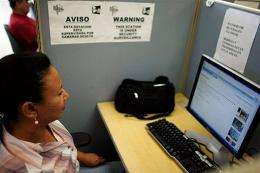
March 27, 2009 Nelly Dubon uses a computer to access her yahoo email account on March 6, 2009 in Miami, Florida

Enlarge

Nelly Dubon uses a computer to access her yahoo email account on March 6, 2009 in Miami, Florida. Adult Americans spend an average of more than eight hours a day in front of screens -- televisions, computer monitors, cellphones or other devices, according to a new study.

Adult Americans spend an average of more than eight hours a day in front of screens -- televisions, computer monitors, cellphones or other devices, according to a new study.

The study also found that live in the home continues to attract the greatest amount of viewing time with the average American spending slightly more than five hours a day in front of the tube.

The figure drops to 210 minutes a day of average TV viewing time among 18-24 year olds but rises to 420 minutes a day among those aged 65 and older.

The "Video Consumer Mapping" study was conducted by Ball State University's Center for Media Design (CMD) and Sequent Partners for the Nielsen-funded Council for Research Excellence (CRE).

For the year-long study, observers recorded the exposure of 350 subjects to four categories of screens: traditional television, computers, mobile devices and other screens such as store displays, movie screens and even GPS navigation units.

The study found the average amount of screen time for all age groups was "strikingly similar" at more than eight-and-a-half hours although the type of devices and duration used by the respective groups throughout the day varied.

It found that people aged 45 to 54 averaged the most daily screen time at just over nine-and-a-half hours.

The study did not include anyone under the age of 18.

Among other finds:

-- computer video consumption tends to be quite small with an average time of just over two minutes a day.

-- Adults spend an average of 6.5 minutes a day with with the number rising to 26 minutes a day among those aged 18-24

-- Adults spend an average 142 minutes a day in front of computer screens

-- Adults spend an average 20 minutes a day engaged with mobile devices with the highest usage -- 43 minutes a day -- among the 18-24 age group

"What differentiates this study from all other attempts to measure video exposure at the consumer level is its scale, the range of media covered and the fact that it is focused on consumers first and the media second," said Mike Bloxham, director of insight and research for Ball State's CMD.

"It?s not a study about TV or the Web or any other medium -- it?s about how, where, how often and for how long consumers are exposed to all media."

(c) 2009 AFP


print this article email this article download pdf blog this article bookmark this article     Stumble it Digg this share on Facebook retweet share on Reddit add to delicious
Rate this story - 5 /5 (1 vote)

Rank Filter

Move the slider to adjust rank threshold, so that you can hide some of the comments.


Display comments: newest first

  • Royale - Mar 27, 2009
    • Rank: not rated yet
    And for us IT guys about 6.5 hours a day is in front of a computer screen. Then the TV at home. (DVR of course, when you get used to no browser ads you tend to not want to see commercials). I simply refuse to use the computer at home, even though I built a nice one, because it's just too much. Anyone else agree here?

March 27, 2009 all stories

Comments: 1

5 /5 (1 vote)
  • Stumble this up

  • Digg this

  • share this

  • hide
  • Related Stories

  • Children with TVs in their room sleep less
    created Sep 02, 2008 | popularity not rated yet | comments 0
  • Most children younger than 2 years watch TV despite warnings
    created May 07, 2007 | popularity not rated yet | comments 0
  • Many teens spend 30 hours a week on 'screen time' during high school
    created Mar 12, 2008 | popularity not rated yet | comments 0
  • Study says obesity not tied to TV
    created Mar 24, 2007 | popularity not rated yet | comments 0
  • New study raises concerns about screen time among urban children with asthma
    created Feb 04, 2009 | popularity not rated yet | comments 0


  • hide
  • Relevant PhysicsForums posts

Other News

Now hear this: Mouse study sheds light on hearing loss in older adults

Medicine & Health / Genetics

created 35 minutes ago | popularity not rated yet | comments 0

(PhysOrg.com) -- Becoming "hard of hearing" is a standard but unfortunate part of aging: A syndrome called age-related hearing loss affects about 40 percent of people over 65 in the United States, and will afflict an estimated ...


Advance growing animal penile erectile tissue in lab may benefit patients

Medicine & Health / Research

created 35 minutes ago | popularity not rated yet | comments 0

In an advance that could one day enable surgeons to reconstruct and restore function to damaged or diseased penile tissue in humans, researchers at Wake Forest University Baptist Medical Center's Institute for Regenerative ...


Hundreds of genes distinguish patients likely to survive advanced melanoma

Medicine & Health / Cancer

created 15 minutes ago | popularity not rated yet | comments 0

Although the chances of surviving advanced melanoma aren't very good with current therapies, some patients can live for years with cancer that has spread beyond the skin to other organs. Now it may be possible to identify ...


Teenage obesity linked to increased risk of MS

Medicine & Health / Neuroscience

created 45 minutes ago | popularity not rated yet | comments 0

Teenage women who are obese may be more than twice as likely to develop multiple sclerosis (MS) as adults compared to female teens who are not obese, according to a study published in the November 10, 2009, print issue of ...


Children with autism more likely to have handwriting problems

Medicine & Health / Neuroscience

created 35 minutes ago | popularity not rated yet | comments 0

Children with autism may have lower quality handwriting and trouble forming letters compared to children without autism, according to a study published in the November 10, 2009, print issue of Neurology, the medical journa ...