New method applies pesticides in nanofibers to keep chemicals on target
March 27, 2009 By Sheri Hall New method applies pesticides in nanofibers to keep chemicals on target

Enlarge

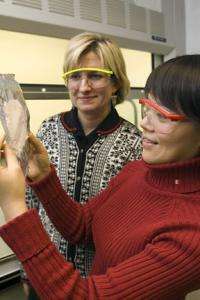
Margaret Frey, left, associate professor of fiber science and apparel design, and research associate Chunhui Xiang have developed a method to deliver pesticides via nanofibers.

(PhysOrg.com) -- To prevent pesticides from drifting away and potentially posing risks to the environment, Cornell researchers have devised a solution: Apply the pesticides by encapsulating them in biodegradable nanofibers, which keeps then intact until needed and minimizes loss to drift or being washed away from the plants they are intended to protect.

"Our technology will decrease the amount of applied, which is good for the environment," said research associate Chunhui Xiang, Ph.D. '08, who worked on the new technology with Margaret Frey, associate professor of fiber science and apparel design in the College of Human Ecology, as well as Cornell experts in horticultural sciences and entomology. "All the materials are biodegradable and from renewable resources."

The new technology also extends how long the pesticides remain effective and improves the safety of applications. As the fiber biodegrades, the chemicals are slowly released into the soil.

Xiang, who was named the outstanding student of the American Chemical Society Division for and Renewable Materials last year, presented the material at the American Chemical Society annual meeting, March 22-26, in Salt Lake City.

"The chemical is protected, so it won't degrade from being exposed to air and water," Frey said. "It also keeps the chemical where it needs to be and allows it to time-release."

The delivery system is created by electrospinning solutions of cellulose, the pesticide and PLA -- a polymer derived from cornstarch.

For the initial trials, Xiang measured chemical delivery in the laboratory over a 16-week period. The individual fibers tested had a diameter more than 100 times finer than a human hair and could hold up to 50 percent of their weight in agricultural chemicals. The results showed that the chemical was released gradually over the entire four-month period, and that the rate of release could be adjusted by changing the composition of the fiber. The chemical itself did not degrade.

To find out if pesticides delivered this way could really work, professor Michael Hoffmann's entomology group planted 4-by-4 millimeter squares of pesticide-loaded fabrics with pole bean seeds in greenhouses on campus. Pesticide delivered from the fabric effectively controlled white flies on the bean plants.

Meanwhile, professor Alan Taylor's group in horticultural science is investigating use of these fibers to deliver pesticides with seed coating technologies. The team is also considering this system for direct application to plant leaves or stalks.

"It's the tip of the iceberg," Frey said.

This research is funded in part by federal Hatch funds, administered by the Cornell University Agricultural Experiment Station.

Provided by Cornell University (news : web)


print this article email this article download pdf blog this article bookmark this article     Stumble it Digg this share on Facebook retweet share on Reddit add to delicious
Rate this story - 4 /5 (1 vote)


March 27, 2009 all stories

Comments: 0

4 /5 (1 vote)
  • Stumble this up

  • Digg this

  • share this

  • hide
  • Related Stories

  • Pesticides need sunscreen to beat the heat
    created Dec 18, 2006 | popularity not rated yet | comments 0
  • Biodegradable napkin could quickly detect biohazards
    created Sep 11, 2006 | popularity not rated yet | comments 0
  • Study: Pesticides found in wine
    created Apr 04, 2008 | popularity not rated yet | comments 0
  • Low level herbicide use can damage potato reproduction
    created Jan 07, 2009 | popularity not rated yet | comments 0
  • Pesticides present in most U.S. streams
    created Mar 04, 2006 | popularity not rated yet | comments 0


  • hide
  • Relevant PhysicsForums posts

  • Zinc Oxide reduction
    created 8 hours ago
  • depolymerization of HDPE
    created Nov 08, 2009
  • Question, whats the best chemistry software for a college student?
    created Nov 08, 2009
  • Why only opposite spin electrons in an orbital ?
    created Nov 08, 2009
  • More from Physics Forums - Chemistry

Other News

Toward home-brewed electricity with 'personalized solar energy'

Toward home-brewed electricity with 'personalized solar energy'

Chemistry / Materials Science

created Nov 04, 2009 | popularity 3.4 / 5 (9) | comments 4

New scientific discoveries are moving society toward the era of "personalized solar energy," in which the focus of electricity production shifts from huge central generating stations to individuals in their ...


Scientists Reproduce a Building Block of Life in Laboratory

Scientists Reproduce a Building Block of Life in Laboratory

Chemistry / Biochemistry

created Nov 06, 2009 | popularity 4.8 / 5 (23) | comments 0

(PhysOrg.com) -- NASA scientists studying the origin of life have reproduced uracil, a key component of our hereditary material, in the laboratory.


Newly Discovered Fat Molecule: An Undersea Killer with an Upside

Newly Discovered Fat Molecule: An Undersea Killer with an Upside

Chemistry / Biochemistry

created Nov 05, 2009 | popularity 4.8 / 5 (10) | comments 0

(PhysOrg.com) -- A chemical culprit responsible for the rapid, mysterious death of phytoplankton in the North Atlantic Ocean has been found by collaborating scientists at Rutgers University and the Woods Hole ...


CU-Boulder map of human bacterial diversity shows wide interpersonal differences

Map of Human Bacterial Diversity Shows Wide Interpersonal Differences

Chemistry / Biochemistry

created Nov 05, 2009 | popularity 4.7 / 5 (11) | comments 0

(PhysOrg.com) -- A University of Colorado at Boulder team has developed the first atlas of bacterial diversity across the human body, charting wide variations in microbe populations that live in different ...


Mimicking nature, scientists can now extend redox potentials

Mimicking nature, scientists can now extend redox potentials

Chemistry / Biochemistry

created Nov 04, 2009 | popularity 4.8 / 5 (5) | comments 0

(PhysOrg.com) -- New insight into how nature handles some fundamental processes is guiding researchers in the design of tailor-made proteins for applications such as artificial photosynthetic centers, long-range ...