Shuttle Discovery on track for afternoon landing
March 28, 2009 By MARCIA DUNN , AP Aerospace Writer
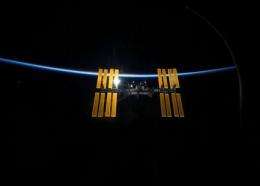
In this image provided by NASA the International Space Station is backdropped by the blackness of space and the thin line of Earth's atmosphere as seen from Space Shuttle Discovery as the two spacecraft begin their relative separation Wednesday March 25, 2009. Discovery and its crew of seven were due back Saturday afternoon, ending a nearly two-week mission that left the international space station fully powered with a new set of solar wings. (AP Photo/NASA)
(AP) -- Shuttle Discovery and its crew of seven aimed for a Saturday afternoon touchdown at NASA's spaceport to wrap up a successful space station construction mission.
At midmorning, Mission Control said favorable weather was expected. But experts were keeping close watch on the clouds and wind.
The seven astronauts are winding up a 13-day mission highlighted by the successful installation and unfurling of the space station's last pair of solar wings. The $300 million addition brought the orbiting outpost up to full power, a vital part of NASA's plan to double the space station population and boost the amount of science work in a few months.
Discovery is bringing back former space station resident Sandra Magnus. Saturday marked her 134th day in orbit; she was launched back in mid-November.
The shuttle also is ferrying five months' worth of science samples from the space station, mostly blood, urine and saliva collected by its crew members. As many vials as possible were stuffed into the shuttle freezer, with the rest put in ice packs.
Also coming back for NASA scientists: four to five liters of recycled water that had been the astronauts' own urine and sweat. The water was produced after Discovery delivered a new urine processor that fixed the recycling machine.
NASA hopes to have the water samples tested within a month. If the toxicology results are good, the three space station residents will be given the all-clear to start drinking the recycled water up there.
The space station, meanwhile, got more guests Saturday with the arrival of a Russian Soyuz capsule, just three days after Discovery's departure.
Two of the newcomers - an American and a Russian - will swap places with commander Mike Fincke and cosmonaut Yuri Lonchakov, who have been in orbit six months.
Billionaire space tourist Charles Simonyi, a former Microsoft executive, also flew up on the Soyuz for a 1 1/2-week visit.
---
On the Net:
NASA: http://spaceflight.nasa.gov
©2009 The Associated Press. All rights reserved. This material may not be published, broadcast, rewritten or redistributed.
-
Shuttle undocks from space station after 8 days
Mar 25, 2009 |
not rated yet |
0
-
Shuttle, space station crews part after 8 days
Mar 25, 2009 |
not rated yet |
0
-
Shuttle Discovery zooms toward space station
Mar 17, 2009 |
not rated yet |
0
-
Astronauts get shuttle ready to come home Saturday
Mar 27, 2009 |
not rated yet |
0
-
NASA fuels Discovery for mission to space station
Mar 15, 2009 |
not rated yet |
0
-
Fast photon control brings quantum photonic technologies closer
1 minute ago |
not rated yet |
0
-
Engineers build first sub-10-nm carbon nanotube transistor
Feb 01, 2012 |
4.9 / 5 (33) |
30
-
Something old, something new: Evolution and the structural divergence of duplicate genes
Jan 31, 2012 |
4.6 / 5 (7) |
1
-
The hidden nanoworld of ice crystals: Revealing the dynamic behavior of quasi-liquid layers
Jan 30, 2012 |
5 / 5 (5) |
1
-
Stock market network reveals investor clustering
Jan 27, 2012 |
3.9 / 5 (23) |
8
-
Is Venus Slowing Down?
1 hour ago
-
Never ending outer space.....
Feb 11, 2012
-
Neutron Star fragments?
Feb 11, 2012
-
stationary or not?
Feb 11, 2012
-
Scale of the Universe
Feb 10, 2012
-
Titan's lack of impact craters
Feb 09, 2012
- More from Physics Forums - General Astronomy
More news stories
Transforming galaxies
(PhysOrg.com) -- Many of the Universe's galaxies are like our own, displaying beautiful spiral arms wrapping around a bright nucleus. Examples in this stunning image, taken with the Wide Field Camera 3 on ...
48 minutes ago |
5 / 5 (1) |
0
|
A continent ablaze in auroral and manmade light
The North American continent is literally set ablaze in a confluence of Auroral and Manmade light captured in spectacular new videos snapped by the astronauts serving aboard the International Space Station ...
Space & Earth / Space Exploration
41 minutes ago |
not rated yet |
0
A better picture of clouds
Some of us look at clouds and see animal shapes. Scientists are looking beyond. For the first time, a team of scientists led by Pacific Northwest National Laboratory used actual measurements of clouds and ...
Space & Earth / Earth Sciences
43 minutes ago |
not rated yet |
0
Scientists drill two miles down to ancient Lake Vostok
(PhysOrg.com) -- Russian scientists last week finished penetrating more than two miles through the Antarctic ice sheet to Lake Vostok, a huge freshwater lake that has been buried under the ice for millions ...
Space & Earth / Earth Sciences
32 minutes ago |
5 / 5 (1) |
0
Earth-facing sunspot doubles in size
The latest sunspot region to traverse the face of the Sun has nearly doubled in size as it aims Earthward, as seen in the animation above from NASAs Solar Dynamics Observatory. (Click image to play the ...
Space & Earth / Space Exploration
1 hour ago |
not rated yet |
0
'Smart' microcapsules in a single step
(PhysOrg.com) -- A new, single-step method of fabricating microcapsules, which have potential commercial applications in industries including medicine, agriculture and diagnostics, has been developed by researchers ...
New ability to regrow blood vessels holds promise for treatment of heart disease
(Medical Xpress) -- University of Texas at Austin researchers have demonstrated a new and more effective method for regrowing blood vessels in the heart and limbs a research advancement that could have ...
Ethanol mandate not the best option
Many people are willing to pay a premium for ethanol, but not enough to justify the government mandate for the corn-based fuel, a Michigan State University economist argues.
Nanostructured electrodes for rechargeable sodium-Ion batteries
Highly efficient 3V cathodes for rechargeable sodium-ion batteries have been developed by users from Argonne National Laboratory's Materials Science, Chemical Sciences & Engineering, and X-ray Sciences Divisions, ...
New tumor suppressor gene identified
A recent study published in Clinical Cancer Research suggests that the protein hVps37A suppresses tumor growth in ovarian cancer. The work, which was funded by the Austrian Science Fund FWF, shows, for th ...
A lost world? How zooarchaeology can inform biodiversity conservation
A new study of tropical forests will provide a 50,000-year perspective on how animal biodiversity has changed, explored through an archaeological investigation of animal bones.