California politician wants to censor online maps
March 28, 2009 An elected California official wants the state to blur images of schools, hospitals and government buildings

Enlarge

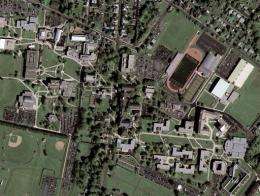
A photograph issued by online mapping firm GeoEye-1. An elected California official wants the state known for Internet technology to blur images of schools, hospitals, government buildings and houses of worship in online maps.

An elected California official wants the state known for Internet technology to blur images of schools, hospitals, government buildings and houses of worship in online maps.

Southern California assemblyman Joel Anderson, a Republican, is backing a bill that would call for Internet mapping services to obscure such images or face daily fines of 250,000 dollars.

"Sensitive areas that could be potential soft targets for terrorists or hate crime perpetrators should not be available on the internet at a level of detail that poses a serious security risk," Anderson said Friday in an email to AFP.

He cited reports that pictures of former prime minister Tony Blair's home in London were recently removed from a feature in that provides users with 360-degree images of locations.

Anderson also said that Street View pictures of the House of Commons and other British government buildings were "blacked out."

Google has said publically that it does not take it on itself to edit images at its free online mapping service but that it does delete or obscure pictures at requests from property owners or officials running government facilities.

"In the United Kingdom, Google blacked out key government buildings from their Street View service," Anderson said.

"I have proposed a bill, AB 255, that would require all Internet mapping sites to take the same precautions with California government buildings, places of worship, schools and hospitals."

The bill, which Anderson introduced in February, would make it state law for online mapping services to blur images of designated "sensitive" locations, whether the pictures were taken at street level, from the air, or by satellites.

Anderson concedes that his fledgling bill needs to be refined, but argues that it is part of a growing international trend by governments to curb risks of terrorists using online mapping services to plan attacks.

The official maintains that he is not opposed to online maps, but believes only those up to evil deeds are interested in details such as positioning of entrances, windows and air ducts.

(c) 2009 AFP


print this article email this article download pdf blog this article bookmark this article     Stumble it Digg this share on Facebook retweet share on Reddit add to delicious
Rate this story - 3 /5 (5 votes)

Rank Filter

Move the slider to adjust rank threshold, so that you can hide some of the comments.


Display comments: newest first

  • joex - Mar 28, 2009
    • Rank: 4 / 5 (4)
    Should probably remove listings in phone books for these places too. And addresses, wherever those may be printed. Sure, it might be hard finding your government offices and schools but atleast the children will be safe from these terrorists.
  • mforbes21 - Mar 29, 2009
    • Rank: 5 / 5 (2)
    Should also make sure that all online photo galleries, such as Flickr, Picasaweb, etc, have to blur photos of these places.

    Give me a break, this isn't about making us safer, it's about making us -feel- safer.
  • jonnyboy - Mar 29, 2009
    • Rank: 1 / 5 (1)
    Is it possible for us to force California to secede from the union and go their own way?
  • laserdaveb - Mar 29, 2009
    • Rank: not rated yet
    nah...just guvernate it!
  • Arikin - Mar 29, 2009
    • Rank: not rated yet
    Don't forget the paper maps sold everywhere.

    Maybe the 360 degree street views I can understand a little. But blurring a top view of the these?

    Fine just search google maps for blurred areas and then go check it out. It is most likely a soft target. Individual life is cheap to terrorists so they would have a guy sit and film/record the target. LIKE THEY HAVE DONE IN THE PAST.

    Please don't let politicians try to do terrorist profiling.
  • theEXxman - Mar 29, 2009
    • Rank: not rated yet
    I was born at Lackland AFB. What if I wanted to look at my place of birth. So is that going to make me a terrorist because of that. I lived at Scott AFB in the 80's too, and Nellis and....
  • docshub - Mar 30, 2009
    • Rank: not rated yet
    How typical of California. There are at least 50 other ways for anyone to get the same information. Maybe if the politicians spent more time on important and positive things, the state would not be in the predicament it is. This is not about safety, it is about politics. Quit the censorship for headlines.
  • holoman - Mar 30, 2009
    • Rank: 5 / 5 (1)
    Too late the barn doors open and the data is
    already out there.

    To stop it now is only going to hurt the good guys.

March 28, 2009 all stories

Comments: 8

3 /5 (5 votes)
  • Stumble this up

  • Digg this

  • share this

  • hide
  • Related Stories

  • Google removes street images over privacy complaints
    created Mar 20, 2009 | popularity not rated yet | comments 0
  • India says no to Google Earth's peering
    created Mar 10, 2006 | popularity not rated yet | comments 0
  • Google Maps combines with Google Local
    created Oct 07, 2005 | popularity not rated yet | comments 0
  • 'WiFi before you fly'
    created Oct 28, 2005 | popularity not rated yet | comments 0
  • Yellowpages to launch new mapping system
    created Apr 21, 2006 | popularity not rated yet | comments 0


  • hide
  • Relevant PhysicsForums posts

Other News

The New York Times headquarters in New York City

New York Times publishes 'crowd-funded' article

Technology / Internet

created 1hour ago | popularity not rated yet | comments 0

The science section of The New York Times contained an unusual article on Tuesday. The story about a huge floating garbage patch in the Pacific Ocean was not written by a Times reporter but by a freelance ...


New 'finFETS' promising for smaller transistors, more powerful chips

New 'finFETs' promising for smaller transistors, more powerful chips

Technology / Semiconductors

created 15 hours ago | popularity 4.9 / 5 (10) | comments 2

(PhysOrg.com) -- Purdue University researchers are making progress in developing a new type of transistor that uses a finlike structure instead of the conventional flat design, possibly enabling engineers ...


New search technique for images and videos has broad applications

New search technique for images and videos has broad applications

Technology / Computer Sciences

created 13 hours ago | popularity 5 / 5 (5) | comments 0

(PhysOrg.com) -- Engineers at the University of California, Santa Cruz, have developed a powerful new approach to a fundamental problem in computer vision: how to program a computer to recognize or categorize ...


Hydrogen milestone moves energy independence one step forward

Hydrogen milestone moves energy independence one step forward

Technology / Energy

created 13 hours ago | popularity 3.9 / 5 (7) | comments 1

(PhysOrg.com) -- Big things often come in small packages. That's certainly the case with the potential created by recent successes in hydrogen research at Idaho National Laboratory.


Google says its news approach is "fully consistent with copyright law"

Google says Murdoch stories can be taken off

Technology / Internet

created 16 hours ago | popularity 1 / 5 (2) | comments 2

Google said on Tuesday, in response to threats by Rupert Murdoch to ban the search engine from listing content from his news empire, that any company could ask to have stories taken off. ...