Russian ship with tourist docks with space station
March 28, 2009
The International Space Station

Enlarge

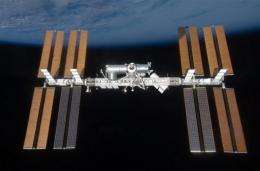
The International Space Station on March 25, 2009. A Russian Soyuz capsule carrying second-time space tourist Charles Simonyi along with a US and a Russian astronaut docked Saturday at the International Space Station, media reports quoted the control centre near Moscow as saying.

A Russian Soyuz capsule carrying second-time space tourist Charles Simonyi docked Saturday at the International Space Station, media reports quoted the control centre near Moscow as saying.

Officials said the crew, a US astronaut and a Russian cosmonaut, had overridden the spacecraft's automatic pilots to dock manually after a glitch in an engine caused the Soyuz's computer to stop the process.

"One of the engines had a fault which the computer considered was serious and it began to move the Soyuz away from the ISS at a rate of one metre per second," mission control official Vladimir Sovlov told RIA-Novosti news agency.

"We decided not to allow that and asked the crew to intervene. The commander judged the engine was working normally and we authorised him to approach in manual mode, which was carried out successfully."

The crew checked to ensure there were no leaks in the airlock between the capsule and the space station before the crews of the two vessels joined up, spokesman Valery Lyndin told Interfax news agency.

Simonyi and the Soyuz crew of Russian Gennady Padalka and American Michael Barratt entered the ISS around 1630 GMT, a little over three hours after docking, Russian agencies reported the Moscow control centre as saying.

They were greeted by US astronaut Michael Fincke and Russian cosmonaut Yuri Lonchakov. Padalka will take over as the space station's commander, while Barratt becomes the flight engineer.

US software pioneer Simonyi, 60, is the first person to travel twice into space as a tourist, having paid 35 million dollars (28 million euros) for the voyage. He paid 25 million dollars the first time around.

He previously travelled to the space station in April 2007, becoming one of a select group of wealthy civilians, most of them from the United States, to have pioneered .

This time around, he will spend 12 days on board before coming back down to Earth with Fincke and Lonchakov on April 7.

The launch comes as Moscow is doubling the number of manned space launches to meet the needs of the expanding space station, with a second launch due in May.

The head of Russian space agency Rosksomos, Anatoly Perminov, said that for a period it could be the last time a space tourist would be taken on board, but had high praise for Russian-US space cooperation.

Simonyi's trip to space was the seventh by a space tourist since the programme was launched by Roskosmos and US firm Space Adventures in 2001.

But there are plans to raise the number of crew for the ISS from three to six from May, meaning there will no longer be a spare seat for a tourist on future missions.

(c) 2009 AFP


Rank not rated yet
Related Stories
Relevant PhysicsForums posts
  • Titan's lack of impact craters
    createdFeb 09, 2012
  • Real pictures of black hole eating a star?
    createdFeb 08, 2012
  • Hypothetical way to travel faster than light, but not technically exceed lightspeed
    createdFeb 06, 2012
  • How do scientists monitor the Sun's activity?
    createdFeb 05, 2012
  • Search patterns in observational studies
    createdFeb 05, 2012
  • Derivation of Pogson's law
    createdFeb 03, 2012
  • More from Physics Forums - General Astronomy

More news stories

Humans may have helped the decline of African rainforests 3000 years ago

(PhysOrg.com) -- Large areas of rainforests in Central Africa mysteriously disappeared over three thousand years ago, to be replaced by savannas. The prevailing theory has been that the cause was a change ...

Space & Earth / Environment

created 11 hours ago | popularity 4.2 / 5 (5) | comments 10 | with audio podcast report

Could Venus be shifting gear?

(PhysOrg.com) -- ESA’s Venus Express spacecraft has discovered that our cloud-covered neighbour spins a little slower than previously measured. Peering through the dense atmosphere in the infrared, the ...

Space & Earth / Space Exploration

created 7 hours ago | popularity 5 / 5 (5) | comments 7 | with audio podcast

Mars Science Laboratory computer issue resolved

(PhysOrg.com) -- Engineers have found the root cause of a computer reset that occurred two months ago on NASA's Mars Science Laboratory and have determined how to correct it.

Space & Earth / Space Exploration

created 8 hours ago | popularity 5 / 5 (5) | comments 3 | with audio podcast

Clam fields found at deep, low-temperature Mariana vents

(PhysOrg.com) -- Scientists have marveled at the unusual life forms thriving at high temperature hydrothermal vents of the deep ocean.

Space & Earth / Earth Sciences

created 8 hours ago | popularity not rated yet | comments 0 | with audio podcast

NASA budget will axe Mars deal with Europe: scientists

US President Barack Obama's budget proposal to be submitted next week for 2013 will cut NASA's budget by 20 percent and eliminate a major partnership with Europe on Mars exploration, scientists said Thursday.

Space & Earth / Space Exploration

created 10 hours ago | popularity 5 / 5 (1) | comments 15


CIA website offline, Anonymous takes credit

The website of the Central Intelligence Agency was unresponsive on Friday after the hacker group Anonymous claimed to have knocked it offline.

Q&A: Obama and the birth control controversy

(AP) -- What birth control debate? A half-century after the introduction of the pill, acceptance of birth control by American women is virtually universal.

Complex wiring of the nervous system may rely on a just a handful of genes and proteins

Researchers at the Salk Institute have discovered a startling feature of early brain development that helps to explain how complex neuron wiring patterns are programmed using just a handful of critical genes. ...

The power of estrogen -- male snakes attract other males

A new study has shown that boosting the estrogen levels of male garter snakes causes them to secrete the same pheromones that females use to attract suitors, and turned the males into just about the sexiest ...

New error-correcting codes guarantee the fastest possible rate of data transmission

Error-correcting codes are one of the triumphs of the digital age. They’re a way of encoding information so that it can be transmitted across a communication channel — such as an optical fiber o ...

Curry spice component may help slow prostate tumor growth

Curcumin, an active component of the Indian curry spice turmeric, may help slow down tumor growth in castration-resistant prostate cancer patients on androgen deprivation therapy (ADT), a study from researchers ...