New Breakthrough in Global Warming Plant Production
March 30, 2009 New Breakthrough in Global Warming Plant Production

Enlarge

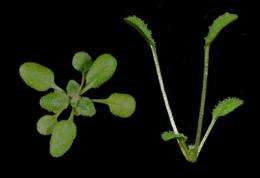
Arabidopsis thaliana plants grown at 22oC (left) and 28oC (right).

Researchers at the universities of Leicester and Oxford have made a discovery about plant growth which could potentially have an enormous impact on crop production as global warming increases.

Dr Kerry Franklin, from the University of Leicester Department of Biology led the study which has identified a single gene responsible for controlling plant growth responses to elevated temperature.

Dr Franklin said: “Exposure of plants to high temperature results in the rapid elongation of stems and a dramatic upwards elevation of leaves”.

“These responses are accompanied by a significant reduction in plant biomass, thereby severely reducing harvest yield.  Our study has revealed that a single gene product regulates all these architectural adaptations in the model plant species, .”

The work has been published in and was funded by the Royal Society and the BBSRC.

Dr Franklin added: “This study provides the first major advance in understanding how plants regulate growth responses to elevated temperature at the molecular level. This discovery will prove fundamental in understanding the effects of global climate change on crop productivity”.

“Identification of the mechanisms by which plants sense changes in ambient temperature remains a Holy Grail in plant biology research. Although the identity of such ‘temperature sensors’ remains elusive, the discovery of a key downstream regulator brings us closer to addressing this important question.”

The study has shown that mutant plants, deficient in the regulatory protein PHYTOCHROME INTERACTING FACTOR 4 (PIF4) do not display the dramatic stem elongation and leaf elevation responses observed in wild type plants upon exposure to elevated temperature. The study has further shown PIF4 to regulate a pathway involving the plant hormone auxin. The PIF4 gene product was previously identified as a co-regulator of light-mediated elongation growth, suggesting plants integrate light and temperature signalling pathways through converged regulation of the same target proteins.

Provided by University of Leicester


print this article email this article download pdf blog this article bookmark this article     Stumble it Digg this share on Facebook retweet share on Reddit add to delicious
Rate this story - 4.7 /5 (41 votes)

Rank Filter

Move the slider to adjust rank threshold, so that you can hide some of the comments.


Display comments: newest first

  • Bob_Kob - Mar 30, 2009
    • Rank: 2.3 / 5 (4)
    We could always just turn up the air-con if it gets too hot..
  • Husky - Mar 30, 2009
    • Rank: 4 / 5 (1)
    How temperature -> water evaporation rate and that all the growth blocking/stimulating hormones/proteines are already in place but that some dissolve better in water and thus getting transported easier, depending on osmosispressure as consequence of the evaporationrate, iow there would not need be a mechanism to suddenly produce a stressresponsive protein, rather temperature tips the balance of competing proteing...just a thought
  • Husky - Mar 30, 2009
    • Rank: 1 / 5 (1)
    i wonder if DMSO (a substance wich is used for instance in testerone patches to make it permeate throught the human skin) could be a usefull topical appliance/spray on leaves/fruits for plant in hotter climates to bypass the temperature regulated stem transport system and thus be able to administre growthhormones with it directly on places where higly valuable fruit or biomass favourable for biofuel is groen...
  • ITFarmer - Mar 30, 2009
    • Rank: 5 / 5 (3)
    I am a bit suprised about this article. I have been growing tomatoes for a few years now, and it is pretty common knowledge (for gardeners) that if plants are too warm when they are seedlings, they become "spiny". This is not a good quality, and is similar to children being "spoiled". When the plants are spiny they do not grow well in adverse conditions, and tend to die off, or become poor producing plants.
  • jonnyboy - Mar 30, 2009
    • Rank: 1 / 5 (2)
    more NEWS that isn't news to anyone but the guy writing the article and physorg

    amazing, aint it?
  • latersville - Mar 30, 2009
    • Rank: not rated yet
    It's news to me. I enjoy learning the scientific information Physorg presents.
  • pseudophonist - Mar 31, 2009
    • Rank: not rated yet
    So if this gene causes the plant to be come spiney and not grow well, why did it evolve? Is it just a quirk or is there some benefit that we're missing. What happens when we switch it off?

    This research does raise some interesting questions suggesting further study, with rather far reaching implications. Sounds like News to me. Kudos to the researchers at University of Leicester and Oxford
  • DozerIAm - Apr 01, 2009
    • Rank: not rated yet
    So if this gene causes the plant to be come spiney and not grow well, why did it evolve? Is it just a quirk or is there some benefit that we're missing.

    The action of the gene probably improves the plant's viability. Yield isn't important to the plant - only to the planter.

March 30, 2009 all stories

Comments: 8

4.7 /5 (41 votes)
  • Stumble this up

  • Digg this

  • share this

  • hide
  • Related Stories

  • Plants see the light to help beat the big freeze
    created Dec 07, 2007 | popularity not rated yet | comments 0
  • Molecular basis and regulation of circadian rhythms in plants
    created Jul 01, 2008 | popularity not rated yet | comments 0
  • Researchers identify genes key to hormone production in plants
    created Apr 03, 2008 | popularity not rated yet | comments 0
  • Circadian clock controls plant growth hormone
    created Aug 13, 2007 | popularity not rated yet | comments 0
  • Biologists solve plant hormone enigma
    created Jul 06, 2006 | popularity not rated yet | comments 0


  • hide
  • Relevant PhysicsForums posts

  • Super quick question about Starling forces?
    created 6 hours ago
  • Questions about diffusion
    created 11 hours ago
  • Human Leukocyte Antigen (HLA) typing
    created 18 hours ago
  • Breeding program
    created Nov 20, 2009
  • More from Physics Forums - Biology

Other News

The Monarchs' annual migration ritual has yet to be scientifically explained

Tree-eating bugs threaten Monarch butterfly in Mexico

Biology / Ecology

created 19 hours ago | popularity 4 / 5 (1) | comments 0

The mysterious Monarch butterfly, which migrates en masse annually between Canada and Mexico, is now facing a new peril: another insect thriving in Western Mexican forests.


Bigger not necessarily better, when it comes to brains

Bigger not necessarily better, when it comes to brains

Biology / Plants & Animals

created Nov 17, 2009 | popularity 4.5 / 5 (18) | comments 11

(PhysOrg.com) -- Tiny insects could be as intelligent as much bigger animals, despite only having a brain the size of a pinhead, say scientists at Queen Mary, University of London.


Extinct goat Myotragus balearicus

Extinct goat was cold-blooded

Biology / Plants & Animals

created Nov 18, 2009 | popularity 4.9 / 5 (33) | comments 10

(PhysOrg.com) -- An extinct goat that lived on a barren Mediterranean island survived for millions of years by reducing in size and by becoming cold-blooded, which has never before been discovered in mammals.


Right-handed chimpanzees provide clues to the origin of human language

Biology / Plants & Animals

created Nov 16, 2009 | popularity 3 / 5 (1) | comments 7

Most of the linguistic functions in humans are controlled by the left cerebral hemisphere. A study of captive chimpanzees at the Yerkes National Primate Research Center (Atlanta, Georgia), reported in the January 2010 issue ...


The creature was found at a depth of 161 metres

Japanese researchers film rare baby fish 'fossil'

Biology / Plants & Animals

created Nov 17, 2009 | popularity 4.7 / 5 (7) | comments 4

Japanese marine researchers said Tuesday they had found and successfully filmed a young coelacanth -- a rare type of fish known as "a living fossil" -- in deep water off Indonesia.