Researchers examine use of native southern African plants in veterinary medicine
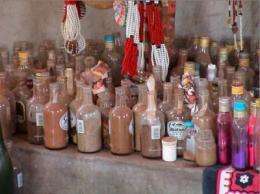
When animals in southern Africa are sick, often the first place their caretakers look for help is from native plants.
That's what makes understanding and conserving these plants so important, according to a group of Kansas State University researchers who are learning more about the uses of such plants in veterinary medicine.
"Our idea is to bridge the disciplines of anthropology, veterinary medicine and ecological conservation," said Ronette Gehring, assistant professor of clinical sciences at K-State's College of Veterinary Medicine.
She is working with fellow veterinarian Deon van der Merwe, K-State assistant professor of diagnostic medicine and pathobiology, to better understand how farmers and other people in southern Africa use native plants for animal health.
Southern Africa is rich in botanical and cultural diversity, which makes it an ideal environment to study plants as a component of ethno-veterinary medicine. Van der Merwe and Gehring are working with K-State's David Hartnett, university distinguished professor of biology, to understand the conservation needs for these important plants, and with Tiffany Kershner, assistant professor of anthropology at K-State, to understand the cultural and linguistic aspects.
Gehring will present the group's research at K-State's African Issues Symposium: Food Security, Environmental Sustainability and Human Health, which is March 30 to April 1.
Gehring said people in southern Africa rely on native plants for the health of food animals like cattle, goats, sheep and chickens, as well as for dogs, which are popular as pets.
"In the United States, medicinal plants aren't used as much for animals, except as alternative health care for pets and other companion animals," Gehring said. "In developing countries, they are very much being used as primary care. Native plants are what people have access to."
The K-State research so far has relied on the few attempts by other researchers to document the use of native plants for veterinary medicine in southern Africa, including van der Merwe's previous research, which he said established a baseline that will make it easier to do comparative research in different regions.
"With just 21 references, we have barely scratched the surface," Gehring said. "Few groups are interested in studying this. The data haven't been pulled together before, so this is an important starting point. Now we have a database to use."
The researchers found 18 areas in southern Africa where native plants are documented being used for animal health. This includes 506 herbal remedies, although these don't come from 506 unique plants. These remedies are documented being used for 81 symptoms, including intestinal parasites, wounds, diarrhea and helping cows that are calving.
"The vast majority of these 506 remedies use roots, leaves and bark, if not the whole plant," Gehring said. "This is potentially destructive to the plant, which is a concern from a conservation standpoint."
Gehring said it's also important for the researchers to understand more about the context in which these remedies are used.
"These remedies are often used by farmers rather than healers and other health care providers for whom the treatment may be more secretive," Gehring said. "Farmers may be more open about their knowledge."
Kershner, a linguistic anthropologist, said that one of the many challenges the researchers face is that for many of the smaller indigenous African languages, there is no written record.
"For some of these smaller groups, there is little documentation of linguistic and cultural practices involved in ethno-veterinary plant harvesting and treatment, yet we know they exist," she said.
As these languages become threatened by outside influences, Kershner said knowledge about native plants used in veterinary medicine might also disappear. Understanding the cultural aspects of plant use also will help anthropologists better understand how different cultures perceive and talk about their natural world, she said.
More information: More information about the symposium is available at: http://www.k-state.edu/africanstudies/2009symposium/
Source: Kansas State University


