Surveillance vehicles take flight using alternative energy
March 30, 2009
Surveillance vehicles take flight using alternative energy

Enlarge

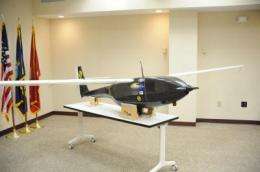
This photo shows the Ion Tiger. Credit: US Naval Research Laboratory

Nearly undetectable from the ground, unmanned aerial vehicles (UAVs) are widely used by the military to scan terrain for possible threats and intelligence. Now, fuel cell powered UAVs are taking flight as an Office of Naval Research (ONR)-sponsored program to help tactical decision-makers gather critical information more efficiently... and more quietly.

Piloted remotely or autonomously, UAVs have long provided extra "eyes in the sky" especially for missions that are too dangerous for manned aircraft. This latest technology is showcased by Ion Tiger, a UAV research program at the Naval Research Laboratory (NRL) that merges two separate efforts — UAV technology and systems.

In particular, the Ion Tiger UAV tests a hydrogen-powered fuel cell design, which can travel farther and carry heavier payloads than earlier battery-powered designs. Ion Tiger employs stealthy characteristics due to its small size, reduced noise, low heat signature and zero emissions.

"Pursuing energy efficiency and energy independence are core to ONR's Power and Energy Focus Area," said Rear Admiral Nevin Carr, Chief of Naval Research. "ONR's investments in , like fuel cell research, have application to the Navy and Marine Corps mission in future UAVs and vehicles. These investments also contribute directly to solving some of the same technology challenges faced at the national level."

Fuel cells create an electrical current when they convert hydrogen and oxygen into water and are pollution-free. A fuel cell propulsion system can also deliver potentially twice the efficiency of an internal combustion engine — while running more quietly and with greater endurance.

"In this size range, we are hopefully able to conduct very productive surveillance missions at low cost with a relatively small vehicle, and a high-quality electric payload," says NRL Principal Investigator Dr. Karen Swider-Lyons.

This spring, Ion Tiger's flight trial is expected to exceed the duration of previous flights seven-fold.

"This will really be a 'first of its kind' demonstration for a fuel cell system in a UAV application for a 24-hour endurance flight, with a 5 pound payload," says ONR Program Manager Dr. Michele Anderson. "That's something nobody can do right now."

In 2005, NRL backed initial research in fuel cell technologies for UAVs. Today, says Swider-Lyons, it's paying off with a few lessons learned from the automotive industry.

"With UAVs, we are dealing with relatively small fuel cells of 500 watts," she explains. "It is hard to get custom, high-quality fuel cell membranes built just for this program. So we are riding along with this push for technology from the automotive industry."

"What's different with fuel cell cars is that developers are focused on volume…so they want everything very compact," adds Swider-Lyons. "Our first issue is weight, our second issue is weight and our third issue is weight!"

Besides delivering energy savings and increased power potential, fuel cell technology spans the operational spectrum from ground vehicles to UAVs, to man-portable power generation for Marine expeditionary missions to meeting power needs afloat. In fact, it's technology that Marines at Camp Pendleton are using today to power their General Motors fuel cell vehicles.

Across the board, the Navy and Marine Corps are seeking more efficient sources of energy. ONR has been researching and testing power and energy technology for decades. Often the improvements to power generation and fuel efficiency for ships, aircraft, vehicles and installations yield a direct benefit to the public.

"ONR has been a visionary in terms of providing support for this program," says Swider-Lyons.

Source: Naval Research Laboratory (news : web)

4.9 /5 (7 votes)  

Filter


Move the slider to adjust rank threshold, so that you can hide some of the comments.


Display comments: newest first

Arkaleus
Mar 30, 2009

Rank: 4 / 5 (4)
Think this through with me. In a nation where the greatest spending in research and development is by the Pentagon, where are all the best and brightest Americans going?

Channeling the talent of our nation into building machines of destruction and their accompanying battle systems is a commitment to homicide and suicide.

When the day comes when all of our fantastic and efficient machines of anihilation are used, will it be a suprise? Do you expect peace to remain when all you build are the tools of war?

Instead of peace, you will enpower the violent and the terrible. Instead of happiness and health, you give the evil part of our nation the implements they need to take power by force domestically and abroad.

Under the watch of evil men we have seen the dismantling of our peacful industries and the consolidation of our military-industrial development complex. Their domination of industry and technology in this society can only serve to futher entrech the tyranny of the federal combination of powers and altogether remove the states from their independence.

What a perversion of human mind to apply our talents to the destruction of life and lands, when we claim to seek peace and plenty.

I encourage my generation to reject the temptation of our national government and refuse to apply their talents towards the creations of war. Build machines and technologies that increase our liberty and health, and develop those things which will create work and abundance at home.
NeilFarbstein
Mar 30, 2009

Rank: 2 / 5 (2)
They are spending more on combat suits with nanofeatures and unmanned drones etc to reduce the amount of lives lost in battle. The alternative would be drafting soldiers which would take away even more freedoms.
Sean_W
Mar 30, 2009

Rank: 3 / 5 (1)
Just go back to carpet bombing and indescriminent heavy artilary. It killed a lot more civilians but it did not require as much technology and Pentagon war machine funding.
COCO
Mar 31, 2009

Rank: not rated yet
I see the civilian app of finding me a new girl friend!!
MisteR33
Mar 31, 2009

Rank: 1 / 5 (1)
@coco Yes thats a good idea!

Yes my words: we makes more war, with more die civilists and with intactly nature!
Now we brought a clean depled uranium!
Or a green nano neutron bomb.

If we checking the complied way of efficience:
we must have verry much energy to make H²!

The price for using privat H² fuell cells is not to discussion.

But here in this situation is this a correctly thing.

Please looking at http://www.ethecon.org you see on the left site a button for english.
Rank 4.9 /5 (7 votes)
Related Stories
Relevant PhysicsForums posts
  • Calling function with no input argument
    created14 hours ago
  • Force free body diagram problem on gym equipment
    created15 hours ago
  • Empirical data regarding shower heads and water
    created23 hours ago
  • feed hold button on CNC lathe
    createdFeb 09, 2012
  • RFAC in Fortran
    createdFeb 09, 2012
  • dynamics 2/32
    createdFeb 08, 2012
  • More from Physics Forums - General Engineering

More news stories

Google users warned of threat to smartphone wallets

Users of Google smartphone wallets were being warned on Friday that there is a way to crack pass codes intended to thwart thieves from going on illicit shopping sprees.

Technology / Internet

created 7 hours ago | popularity 5 / 5 (2) | comments 0

Anonymous knocks CIA website offline (Update)

The website of the Central Intelligence Agency was inaccessible on Friday after the hacker group Anonymous claimed to have knocked it offline.

Technology / Internet

created 8 hours ago | popularity 5 / 5 (9) | comments 13

New error-correcting codes guarantee the fastest possible rate of data transmission

Error-correcting codes are one of the triumphs of the digital age. They’re a way of encoding information so that it can be transmitted across a communication channel — such as an optical fiber o ...

Technology / Computer Sciences

created 17 hours ago | popularity 4.9 / 5 (8) | comments 6 | with audio podcast

New power source discovered

(PhysOrg.com) -- Researchers at the Massachusetts Institute of Technology (MIT) and RMIT University have made a breakthrough in energy storage and power generation.

Technology / Energy & Green Tech

created 16 hours ago | popularity 4.8 / 5 (26) | comments 8 | with audio podcast

Small modular reactor design could be a 'SUPERSTAR'

(PhysOrg.com) -- Though most of today's nuclear reactors are cooled by water, we've long known that there are alternatives; in fact, the world's first nuclear-powered electricity in 1951 came from a reactor ...

Technology / Energy & Green Tech

created 16 hours ago | popularity 4.3 / 5 (12) | comments 22 | with audio podcast


Humans may have helped the decline of African rainforests 3000 years ago

(PhysOrg.com) -- Large areas of rainforests in Central Africa mysteriously disappeared over three thousand years ago, to be replaced by savannas. The prevailing theory has been that the cause was a change ...

Complex wiring of the nervous system may rely on a just a handful of genes and proteins

Researchers at the Salk Institute have discovered a startling feature of early brain development that helps to explain how complex neuron wiring patterns are programmed using just a handful of critical genes. ...

The power of estrogen -- male snakes attract other males

A new study has shown that boosting the estrogen levels of male garter snakes causes them to secrete the same pheromones that females use to attract suitors, and turned the males into just about the sexiest ...

Putting the squeeze on planets outside our solar system

(PhysOrg.com) -- Using high-powered lasers, scientists at Lawrence Livermore National Laboratory and collaborators discovered that molten magnesium silicate undergoes a phase change in the liquid state, abruptly ...

Could Venus be shifting gear?

(PhysOrg.com) -- ESA’s Venus Express spacecraft has discovered that our cloud-covered neighbour spins a little slower than previously measured. Peering through the dense atmosphere in the infrared, the ...

Fool's gold may prove an unlikely alternative to overexploited catalytic materials

Catalytic materials, which lower the energy barriers for chemical reactions, are used in everything from the commercial production of chemicals to catalytic converters in car engines. However, with current catalytic materials ...