DNA-Based Assembly Line for Nano-Construction of New Biosensors, Solar Cells (w/Video)
March 30, 2009 DNA-Based Assembly Line for Nano-Construction of New Biosensors, Solar Cells

Enlarge

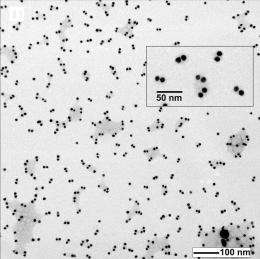
This transmission electron micrograph shows nanoparticle dimers (two-particle clusters) assembled and released through the DNA-encoded solid-support approach.

(PhysOrg.com) -- Building on the idea of using DNA to link up nanoparticles — particles measuring mere billionths of a meter — scientists at the U.S. Department of Energy’s Brookhaven National Laboratory have designed a molecular assembly line for predictable, high-precision nano-construction. Such reliable, reproducible nanofabrication is essential for exploiting the unique properties of nanoparticles in applications such as biological sensors and devices for converting sunlight to electricity. The work will be published online March 29, 2009, by Nature Materials.

The Brookhaven team has previously used , the molecule that carries life’s , to link up nanoparticles in various arrangements, including 3-D nano-crystals. The idea is that nanoparticles coated with complementary strands of DNA — segments of genetic code sequence that bind only with one another like highly specific Velcro — help the nanoparticles find and stick to one another in highly specific ways. By varying the use of complementary DNA and strands that don’t match, scientists can exert precision control over the attractive and repulsive forces between the nanoparticles to achieve the desired construction. Note that the short DNA linker strands used in these studies were constructed artificially in the laboratory and don’t “code” for any proteins, as genes do.

The latest advance has been to use the DNA linkers to attach some of the DNA-coated nanoparticles to a solid surface to further constrain and control how the nanoparticles can link up. This yields even greater precision, and therefore a more predictable, reproducible high-throughput construction technique for building clusters from nanoparticles.

FLV player

“When a particle is attached to a support surface, it cannot react with other molecules or particles in the same way as a free-floating particle,” explained Brookhaven physicist Oleg Gang, who led the research at the Lab’s Center for Functional Nanomaterials. This is because the support surface blocks about half of the particle’s reactive surface. Attaching a DNA linker or other particle that specifically interacts with the bound particle then allows for the rational assembly of desired particle clusters.

“By controlling the number of DNA linkers and their length, we can regulate interparticle distances and a cluster’s architecture,” said Gang. “Together with the high specificity of DNA interactions, this surface-anchored technique permits precise assembly of nano-objects into more complex structures.”

Instead of assembling millions and millions of nanoparticles into 3-D nanocrystals, as was done in the previous work, this technique allows the assembly of much smaller structures from individual particles. In the paper, the scientists describe the details for producing symmetrical, two-particle linkages, known as dimers, as well as small, asymmetrical clusters of particles — both with high yields and low levels of other, unwanted assemblies.
DNA-Based Assembly Line for Nano-Construction of New Biosensors, Solar Cells
Enlarge

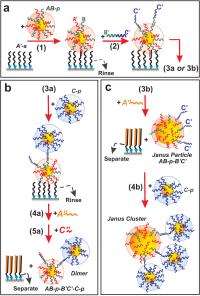
Using DNA to assemble nanoclusters: (a) (1) DNA linker strands (squiggly lines) are used to attach DNA-coated nanoparticles to a surface. (2) Linker strands are attached to the top side of the nanoparticle. (b) (3a) A nanoparticle of a second type with complementary DNA encoding recognizes the exposed linker strands and attaches to the surface-anchored nanoparticle. (4a and 5a) The assembled structure is released from the surface support, resulting in a two-particle, dimer cluster. (c) (3b) Alternatively, the immobilized particles produced in step (a) are released from the surface, leaving the opposite-side linker strands free to bind with multiple particles (4b) to form asymmetric "Janus" clusters.

“When we arrange a few nanoparticles in a particular structure, new properties can emerge,” Gang emphasized. “Nanoparticles in this case are analogous to atoms, which, when connected in a molecule, often exhibit properties not found in the individual atoms. Our approach allows for rational and efficient assembly of nano-‘molecules.’ The properties of these new materials may be advantageous for many potential applications.”

For example, in the paper, the scientists describe an optical effect that occurs when nanoparticles are linked as dimer clusters. When an electromagnetic field interacts with the metallic particles, it induces a collective oscillation of the material’s conductive electrons. This phenomenon, known as a plasmon resonance, leads to strong absorption of light at a specific wavelength.

“The size and distance between the linked particles affect the plasmonic behavior,” said Gang. By adjusting these parameters, scientists might engineer clusters for absorbing a range of wavelengths in solar-energy conversion devices. Modulations in the plasmonic response could also be useful as a new means for transferring data, or as a signal for a new class of highly specific biosensors.

Asymmetric clusters, which were also assembled by the Brookhaven team, allow an even higher level of control, and therefore open new ways to design and engineer functional nanomaterials.

Because of its reliability and precision control, Brookhaven’s nano-assembly method would be scalable for the kind of high-throughput production that would be essential for commercial applications. Brookhaven Lab has applied for a patent on the assembly method as well as several specific applications of the technology.

Provided by Brookhaven National Laboratory


print this article email this article download pdf blog this article bookmark this article     Stumble it Digg this share on Facebook retweet share on Reddit add to delicious
Rate this story - 5 /5 (9 votes)

Rank Filter

Move the slider to adjust rank threshold, so that you can hide some of the comments.


Display comments: newest first

  • MadLintElf - Mar 30, 2009
    • Rank: not rated yet
    Nano and Bio are almost at the point where they will be indistinguishable from each other. Mother nature has perfected her techniques, we can only learn from her, and apply our knowledge to solicit different outcomes.

    How long until we patent DNA strands that certain organisms have (people too) that would benefit nano-tech, and will they try to patent those processes as well?

    Thank goodness it's only Monday

    TheMadLintElf
  • QubitTamer - Mar 30, 2009
    • Rank: not rated yet
    How long before nano is weaponized to make bio-terror weapons we can't even conceive of...

    Well maybe the TV show Fringe can conceive of them, but most of us cannot.

    With great knowlege comes great power... never so true as for these lines of research...
  • MisteR33 - Mar 31, 2009
    • Rank: not rated yet
    Hello !!!
    please translate to german language!!!

March 30, 2009 all stories

Comments: 3

5 /5 (9 votes)
  • Stumble this up

  • Digg this

  • share this

  • hide
  • Related Stories

  • Using life's building blocks to control nanoparticle assembly
    created Aug 22, 2007 | popularity not rated yet | comments 0
  • New DNA-Based Technique For Assembly of Nano- and Micro-sized Particles
    created Sep 12, 2007 | popularity not rated yet | comments 0
  • Nanoparticle assembly enters the fast lane
    created Oct 11, 2006 | popularity not rated yet | comments 0
  • DNA technique yields 3-D crystalline organization of nanoparticles
    created Jan 30, 2008 | popularity not rated yet | comments 0
  • Organizing Gold Nanoparticles with DNA
    created Mar 22, 2006 | popularity not rated yet | comments 0


  • hide
  • Relevant PhysicsForums posts

Other News

Faster, cheaper DNA sequencing method developed

Faster, cheaper DNA sequencing method developed

Nanotechnology / Bio & Medicine

created Dec 20, 2009 | popularity 4.4 / 5 (24) | comments 10

(PhysOrg.com) -- Boston University biomedical engineers have devised a method for making future genome sequencing faster and cheaper by dramatically reducing the amount of DNA required, thus eliminating the ...


Hot electron solar cell

Hot Electrons Could Double Solar Cell Power Efficiency

Nanotechnology / Nanophysics

created Dec 18, 2009 | popularity 4.2 / 5 (14) | comments 2

Scientists have experimentally verified a theory suggesting that hot electrons could double the output of solar cells. The researchers, from Boston College, have built solar cells that successfully use hot ...


Molecular Transistor

Scientists create world's first molecular transistor

Nanotechnology / Nanophysics

created Dec 23, 2009 | popularity 4.9 / 5 (22) | comments 1

A group of scientists has succeeded in creating the first transistor made from a single molecule. The team, which includes researchers from Yale University and the Gwangju Institute of Science and Technology ...


An easy way to see the world's thinnest material

Nanotechnology / Nanomaterials

created Dec 23, 2009 | popularity 4.8 / 5 (9) | comments 1

It's been used to dye the Chicago River green on St. Patrick's Day. It's been used to find latent blood stains at crime scenes. And now researchers at Northwestern University have used it to examine the thinnest material ...


Light-Driven Nanorod Could Roll on Water

Light-Driven Nanorod Could Roll on Water

Nanotechnology / Nanophysics

created Dec 18, 2009 | popularity 4 / 5 (9) | comments 1

(PhysOrg.com) -- In a recent study, researchers have examined the possibility of rolling a nanorod on the surface of water. On the macroscale, perhaps the closest analogy might be the sport of logrolling, ...