Massive chemo dose targets cancerous liver
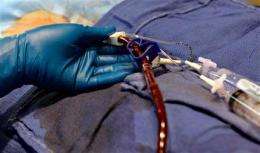
(AP) -- Bill Darker grinned as he headed into the operating room for a dramatic experiment: A super-high dose of chemotherapy dripped directly into his cancer-ridden liver, 10 times more than patients normally can tolerate.
Not to fear. Working through small puncture holes, doctors sealed off Darker's liver and washed most of the toxic medication from his blood so it didn't poison the rest of his body.
It's a rigorous effort to fight a notorious killer, cancer that has spread to the liver from elsewhere in the body and left patients with few options and little time.
"I've always wanted to treat this cancer very aggressively since I know the prognosis is very dim," said Darker, 46, who managed to save his eye from ocular melanoma only to have the cancer spread tentacles in his liver. "I just take the gloves off and go for it."
Three times, so far, he has flown from his home in Imperial Beach, Calif., to the National Institutes of Health in suburban Washington to repeat the experimental therapy. Before his last round, Darker's liver tumors had shrunk by about a third.
Now a study at NIH and 10 other hospitals nationwide aims to show whether that kind of shrinkage makes enough of a difference in the length and quality of recipients' lives, and is safe enough, for Food and Drug Administration approval to treat eye or skin melanoma that spreads to the liver.
"It seems like a good weapon," said Dr. Marybeth Hughes of the NIH's National Cancer Institute, as she prepared to treat Darker last week. "If it works effectively it would be very important, because the only other choice patients have is constant chemotherapy."
More than 200,000 U.S. patients a year learn that various types of cancer - from the eye, skin, colon, pancreas - have metastasized, or spread, to the liver. Whatever the original tumor type, few survive beyond a year or two.
Often, cancer this aggressive hits multiple organs. But up to 40,000 patients a year have a life-threatening metastasis confined just to the liver. They're the target of the new approach, called PHP, for percutaneous hepatic perfusion. While the melanoma research is furthest along, NIH is beginning smaller studies with certain other liver metastases.
How do you seal off a liver? With balloons similar to those used in heart surgery, only bigger.
Darker lay under general anesthesia as NIH's Dr. Elliott Levy carefully threaded a catheter through an artery in his left leg all the way up to where it branches off into the liver.
Then came catheter No. 2, through a vein in the right leg and up to the vena cava, the highway where blood normally flows from the liver into the heart. This tube bore an uninflated balloon at each end and holes in the middle. Guided by sophisticated X-ray images, Levy inflated the balloons at the top and bottom of the liver, blocking blood's normal exit route.
The tube's holes capture chemo-saturated blood and reroute it out of the body, to a pump where filters scrub away the drug. Filtered blood re-enters the body through a tube in the neck.
It's done with team precision. "Initiating bypass, 10:31," doctors called.
Is the seal good? They injected a dye to be sure. No leaks.
Then Hughes, the oncologist, was up. "Chemo on, 10:45," she called. For 30 minutes, she dripped a concentrated dose of the drug melphalan through catheter No. 1 into the hepatic artery, saturating the liver. The pump is to run for another half-hour after the drug's done, ultimately removing between 80 percent and 90 percent of the chemo.
"The ability to shrink cancers in the livers of patients who failed other therapies is exciting," acknowledged Dr. Neal Meropol, gastrointestinal cancer chief at Fox Chase Cancer Center, who isn't involved with the study. But he said cancer specialists are watching the work very skeptically, because it's such a complex procedure.
It's not that much more complicated than existing treatments that infuse chemo without preventing bodywide leakage, and which have widely varying results, said Dr. James Pingpank, a former NIH researcher now at the University of Pittsburgh Medical Center, one study site.
Years ago, NIH doctors created an open-surgery version of the treatment that did help but patients could endure it only once. In a partnership with New York-based Delcath Systems Inc., they've made the procedure far less invasive and potentially repeatable - assuming it works - as often needed.
But it's not risk-free. Not all the chemo is removed, so patients suffer some fatigue and a weakened immune system for a few days between treatments. The pump causes blood pressure to temporarily plummet, requiring quick doses of drugs to push it back up. Because every patient's anatomy is slightly different, doctors must carefully map blood vessels to be sure ones that lead, for example, to the stomach aren't so close that chemo could leak in.
First-stage studies reported few serious side effects, although one patient died during an apparently unrelated operation about two weeks after a PHP.
The required operating-room team means if approved, PHP could cost just under $20,000 - hefty, but fairly comparable to some other advanced cancer therapies.
Darker called the procedure easier than standard liver treatments, saying he felt good two days later: "It's running like clockwork."
---
On the Net:
Study info: http://www.livercancertrials.com
Ocular melanoma info: http://www.ocularmelanoma.org
©2009 The Associated Press. All rights reserved. This material may not be published, broadcast, rewritten or redistributed.


