Hundreds of Natural-Selection Studies Could be Wrong, Study Demonstrates
March 30, 2009
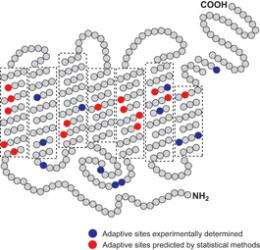
The image depicts the structure of the bovine rhodopsin protein. The blue circles represent amino acid sites that have undergone natural selection as determined through experiments, while the red circles represent amino acid sites that have undergone natural selection as determined through statistical analyses. Masafumi Nozawa, Penn State (Adapted from Yokoyama et al. 2008 PNAS)
(PhysOrg.com) -- Scientists at Penn State and the National Institute of Genetics in Japan have demonstrated that several statistical methods commonly used by biologists to detect natural selection at the molecular level tend to produce incorrect results. "Our finding means that hundreds of published studies on natural selection may have drawn incorrect conclusions," said Masatoshi Nei, Penn State Evan Pugh Professor of Biology and the team's leader. The team's results will be published in the Online Early Edition of the journal Proceedings of the National Academy of Sciences during the week ending Friday 3 April 2009 and also in the journal's print edition at a later date.
Nei said that many scientists who examine human evolution have used faulty statistical methods in their studies and, as a result, their conclusions could be wrong. For example, in one published study the scientists used a statistical method to demonstrate pervasive natural selection during human evolution. "This group documented adaptive evolution in many genes expressed in the brain, thyroid, and placenta, which are assumed to be important for human evolution," said Masafumi Nozawa, a postdoctoral fellow at Penn State and one of the paper's authors. "But if the statistical method that they used is not reliable, then their results also might not be reliable," added Nei. "Of course, we would never say that natural selection is not happening, but we are saying that these statistical methods can lead scientists to make erroneous inferences," he said.
The team examined the branch-site method and several types of site-prediction methods commonly used for statistical analyses of natural selection at the molecular level. The branch-site method enables scientists to determine whether or not natural selection has occurred within a particular gene, and the site-prediction method allows scientists to predict the exact location on a gene in which natural selection has occurred.
"Both of these methods are very popular among biologists because they appear to give valuable results about which genes have undergone natural selection," said Nei. "But neither of the methods seems to give an accurate picture of what's really going on."
Nei said that for many years he has suspected that the statistical methods were faulty. "The methods assume that when natural selection occurs the number of nucleotide substitutions that lead to changes in amino acids is significantly higher than the number of nucleotide substitutions that do not result in amino acid changes," he said. "But this assumption may be wrong. Actually, the majority of amino acid substitutions do not lead to functional changes, and the adaptive change of a protein often occurs by a rare amino acid substitution. For this reason, statistical methods may give erroneous conclusions." Nei also believes that the methods are inaccurate when the number of nucleotide substitutions observed is small.
To demonstrate the faultiness of the statistical methods, Nei's team compiled data collected by their Emory University colleague, Shozo Yokoyama, on the genes that control the abilities of fish to see light at different water depths and on the genes that control color vision in a variety of animals. The team used these data to compare statistically predicted sites of natural selection with experimentally determined sites. They found that the statistical methods rarely predicted the actual sites of natural selection, which had been identified by Yokoyama through experiments. "In some cases, statistical method completely failed to identify the true sites where natural selection occurred," said Nei. "This particular exercise demonstrated the difficulty with which statistical methods are able to detect natural selection."
To demonstrate how small sample sizes can lead to incorrect results, the team used computer simulations to examine the evolution of genes in three primates: humans, chimpanzees, and macaques. The scientists mimicked the procedures used by the authors of a 2007 paper, which applied the branch-site method to 14,000 orthologous genes -- genes that are genealogically identical among different species -- and which found that the method predicted selection in 32 of the genes. Nei and his team also studied selection using Fisher's exact test, but this test did not detect any selection. "The results indicate that the number of nucleotide substitutions that occurred were too small to detect any selection; therefore, all of the 32 cases obtained by the branch-site method must be false positives," said Nozawa.
"These statistical methods have led many scientists to believe that natural selection acted on many more genes in humans than it did in chimpanzees, and they conclude that this is the reason why humans have developed large brains and other morphological differences," said Nei. "But I believe that these scientists are wrong. The number of genes that have undergone selection should be nearly the same in humans and chimps. The differences that make us human are more likely due to mutations that were favorable to us in the particular environment into which we moved, and these mutations then accumulated through time."
Nei said that to obtain a more realistic picture of natural selection, biologists should pair experimental data with their statistical data whenever possible. Scientists usually do not use experimental data because such experiments can be difficult to conduct and because they are very time-consuming.
-
Natural selection is not the only process that drives evolution
Jan 27, 2009 |
not rated yet |
0
-
Cornell Finds Natural Selection in Humans
Oct 26, 2005 |
not rated yet |
0
-
Researchers discover evidence of very recent human adaptation
Jul 11, 2007 |
not rated yet |
0
-
Evidence of evolutionary selection found in 544 genes
Sep 16, 2008 |
not rated yet |
0
-
Researchers untangle nature of 'regressive evolution' in cavefish
Feb 15, 2007 |
not rated yet |
0
-
Engineers build first sub-10-nm carbon nanotube transistor
Feb 01, 2012 |
4.9 / 5 (29) |
30
-
Something old, something new: Evolution and the structural divergence of duplicate genes
Jan 31, 2012 |
4.6 / 5 (7) |
1
-
The hidden nanoworld of ice crystals: Revealing the dynamic behavior of quasi-liquid layers
Jan 30, 2012 |
5 / 5 (3) |
1
-
Stock market network reveals investor clustering
Jan 27, 2012 |
4 / 5 (22) |
8
-
Of microchemistry and molecules: Electronic microfluidic device synthesizes biocompatible probes
Jan 26, 2012 |
5 / 5 (1) |
0
-
a single mRNA strand is attached to sevaral ribosomes?
15 hours ago
-
Oestrogen and FSH
Feb 07, 2012
-
Linear Blood Vessel Network Examples in Animals or Plants
Feb 07, 2012
-
Neuroscientists: What is a Principal Cell Layer?
Feb 06, 2012
-
How does slime mould grow?
Feb 04, 2012
-
Why are mosquitoes and bedbugs successful?
Feb 04, 2012
- More from Physics Forums - Biology
More news stories
Study shows how DNA finds its match
It's been more than 50 years since James Watson and Francis Crick showed that DNA is a double helix of two strands that complement each other. But how does a short piece of DNA find its match, out of the millions ...
2 hours ago |
5 / 5 (5) |
0
|
Obstacles no barrier to higher speeds for worms, researchers find
Obstacles in an organism's path can help it to move faster, not slower, researchers from New York University's Applied Math Lab at the Courant Institute of Mathematical Sciences have found through a series ...
4 hours ago |
3 / 5 (1) |
3
|
Transformational fruit fly genome catalog completed
Scientists searching for the genomics version of the holy grail more insight into predicting how an animal's genes affect physical or behavioral traits now have a reference manual that should ...
2 hours ago |
5 / 5 (1) |
0
|
Tiny primate 'talks' in ultrasound
One of the world's smallest primates, the Philippine tarsier, communicates in a range of ultrasound inaudible to predator and prey alike, according to a study published on Wednesday.
11 hours ago |
4.8 / 5 (5) |
0
Scared of a younger rival? Not for some male songbirds
When mature male white-crowned sparrows duel to win a mate or a nesting territory, a young bird just doesn't get much respect.
12 hours ago |
4 / 5 (2) |
0
|
New images capture 'stealth merger' of dwarf galaxies
New images of a nearby dwarf galaxy have revealed a dense stream of stars in its outer regions, the remains of an even smaller companion galaxy in the process of merging with its host. The host galaxy, known ...
Chandra finds Milky Way's black hole grazing on asteroids
(PhysOrg.com) -- The giant black hole at the center of the Milky Way may be vaporizing and devouring asteroids, which could explain the frequent flares observed, according to astronomers using data from NASA's ...
Windows 8 preview set for February 29
Microsoft on Wednesday revealed plans to unveil a test version of its latest Windows computer operating software later this month.
In scientific coup, Russians reach Antarctic lake
After more than two decades of drilling in Antarctica, Russian scientists have reached a gigantic freshwater lake hidden under miles of ice for some 20 million years - a pristine body of water that may hold ...
European Internet campaigners battle ACTA
A controversial international accord billed as a way to beat online piracy has sparked a fightback led by Internet users in ex-communist countries who say the region's past underlines the need to defend freedom.
Phelps using hyperbaric chamber to aid recovery
(AP) -- Michael Phelps is the latest athlete to use a hyperbaric chamber to aid his recovery from training.
Mar 30, 2009
Rank: 5 / 5 (4)
FTA:
"Of course, we would never say that natural selection is not happening, but we are saying that these statistical methods can lead scientists to make erroneous inferences,"...
nuff said.
Mar 30, 2009
Rank: 5 / 5 (1)
Mar 30, 2009
Rank: 5 / 5 (1)
I imagine you mean VIGOROUSLY agree. To agree vicariously would be a very odd thing to do, indeed.
And yes, I agree too.
Nature doesn't make errors. Humans make errors, nature makes mutations.
Mar 30, 2009
Rank: not rated yet
Mar 30, 2009
Rank: 4 / 5 (1)
...small sample sizes
In addition to that lesson, the other is: "Nei said that to obtain a more realistic picture of natural selection, biologists should pair experimental data with their statistical data whenever possible. Scientists usually do not use experimental data because such experiments can be difficult to conduct and because they are very time-consuming."
I imagine the "intelligent designers" will miss the point completely and erroneously use this research for years to come or at least until .... no, they'll keep using it forever.
Mar 31, 2009
Rank: 2.6 / 5 (10)
Mar 31, 2009
Rank: not rated yet
okay
Mar 31, 2009
Rank: 3 / 5 (2)
I was wondering when you'd show up. Never late, are you.
Read it again. Then read the comments. Then go away.
Mar 31, 2009
Rank: 2.8 / 5 (4)
Natural selection is a fact, not a theory. You might as well debate about whether or not the Earth is round.
Biogenesis via natural selection is a theory and a very specious one at that. The article has no bearing whatsoever on that theory or on intelligent design in so far as it relates to the origins of life. NO ONE knows how that happened yet. What the "other side" seems to forget is that observations of a self propagating process in action is not the same as an explanation as to how said process began...far from it.
To use an analogy this article is stating that we know the Earth is round, but our methods about determining just how large the circumference is may be flawed.
Mar 31, 2009
Rank: 3 / 5 (4)
Or we could actually go on the evidence. Like the megatons of fossils showing evolution over time.
Natural selection simply cannot not happen.
Mutations occur. There is no doubt about it. The study in this article SHOWS mutations. Not all mutations are going to be detrimental. The detrimental mutations are going to be selected out. Those the are not detrimental will continue in the gene pool.
That is the heart of Natural Selection and there is no way for it to not occur. Except to stop mutation. Selection inherently follows from mutation.
Ethelred
Mar 31, 2009
Rank: 3.4 / 5 (5)
Mar 31, 2009
Rank: 2.3 / 5 (3)
Statistics, sufficiently advanced, is indistinguishable from Truth. Although it is often not true...
Apr 01, 2009
Rank: 5 / 5 (2)
Nonsense. Experimental evidence is available and the fossils are more than adequate. Heck this article has evidence of evolution.
No matter how you slice it, if there are mutations evolution is inevitable.
Of course long term evolution would take long term experiments. That is impractical. Despite that there is some actual lab evidence.
http://www.talkor...ion.html
Nothing stunning of course. No one is going to turn a squirrel into a bat in the lab. The time constraints are rather severe.
There is the obvious case of human evolution in the historical era. Europeans have evolved a strong resistance to smallpox. When the highly resistant Europeans came to Mexico the Conquistadors did not get smallpox but the Mexicans were not so fortunate. They had not spent thousands of years dying to select out the vulnerable. There were many smallpox plagues in European history. Yet by the time of the American Revolution few Europeans were contracting smallpox anymore and most were surviving(George Washington being the most obvious), unlike the historical plagues. Smallpox is suspected in several Roman plagues that killed a significant fraction of the population in parts of the Empire.
Ethelred
Apr 01, 2009
Rank: 5 / 5 (2)
Tit for tat.
If you go around giving a one to well reasoned posts just because you don't like the facts you deserve a one.
Please note the rab96 has not descended to this odious behavior and thus is not getting a one a from me.
He deserves a two since he is quite wrong about the possibility of experimental evidence but I will refrain.
Ethelred
May 02, 2009
Rank: not rated yet
Accept for the small detail that in the megaton of fossils, they still don't have the needed transitional fossils to support the hypothesis of evolution. But lets not dirty up the evolutionary argument with an actual call for factual evidence to support.
May 02, 2009
Rank: not rated yet
The voice of ignorance arises. Well at least you didn't settle for a single post on your fist day.
Here have a clue.
http://www.talkor...mediates
Sample from link:
No lets not bother having evidence for Creationism either as that seems to be against Creationist rules. Don't try running a bluff either. Especially one based on knowing nothing about biology.
Evolution cannot not happen. It is inherent in biology. ALL fossils are transitional. Or none depending on your definition of transition. If you are typical your definition will change as you learn that you have been fed a load of crap. You will either accept the reality of evolution or you will change your definition in each reply.
Do try to be atypical.
Ethelred