Laser-flash analysis echnique measures heat transport in the Earth's crust
(PhysOrg.com) -- Putting a new spin on an old technique, Anne M. Hofmeister, Ph.D., research professor of earth and planetary sciences in Arts & Sciences at Washington University in St. Louis, has revolutionized scientists' understanding of heat transport in the Earth's crust, the outermost solid shell of our planet.
Temperature is an important driver of many geological processes, including the generation of magmas (molten rocks) in the deepest parts of the Earth's crust, about 30 to 40 kilometers below the surface. Yet, until recently, temperatures deep inside the Earth's crust were uncertain, mainly because of difficulties associated with measuring thermal conductivity, or how much heat is flowing through the rocks that compose the crust.
In conventional methods of measuring thermal conductivity, measurement errors arise as the temperature of a rock nears its melting point. At such high temperatures, heat is not just transported from atom to atom by vibrations, but also by radiation (light). Since conventional methods cannot separate heat flow carried by vibrations from that associated with radiation, most measurements of how efficiently rocks transport heat at high temperatures have been overestimated. Because of this experimental uncertainty, scientists have assumed rock conductivity to be constant throughout the crust in order to make advances in models describing Earth's geological behavior.
Laser-flash analysis
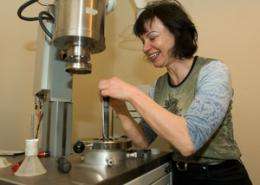
Using an industrial laser that is typically used for steel welding, Hofmeister was able to circumvent the problems that plagued the older methods. Her facility at WUSTL is the first in the world to employ such a laser for geoscience research.
Her technique, laser-flash analysis, provides much more accurate data on heat transport through rocks than conventional methods. In laser-flash analysis, a rock sample is held at a given temperature and then subjected to a laser pulse of heat, allowing Hofmeister to measure the time it takes for the heat to go from one end of the sample to the other. This measurement of thermal diffusivity, or how fast heat flows through matter, is another way to describe the thermal conductivity of a rock. Since measuring heat transport in the crust itself is impossible, Hofmeister used the laser to measure heat transport in individual rock samples at various temperatures and then averaged across samples to represent the dynamics of the crust. In collaboration with researchers from the University of Missouri — Columbia, Hofmeister applied her findings to explain geological phenomena observed in the environment.
The results, published in Nature on March 19, 2009, suggest that rock conductivity is not constant as was previously assumed, but instead varies strongly with temperature. Hofmeister explains, "Our analysis shows that rocks are more efficient at conducting heat at low temperatures than was previously thought and less efficient at high temperatures. The process of moving heat around really depends on the temperature of the rocks."
Hofmeister and her collaborators found that the conductivity of rocks in the lower crust, where the external temperature is very high, is much lower — by as much as 50 percent — than was predicted by conventional methods. These results also suggest that the lower crust may be much hotter than scientists previously recognized. Since rocks become better insulators and poorer conductors at high temperatures, the lower crust acts like a blanket over the heat-generating mantle, the layer underlying the crust.
Magma machine
The observation that the lower crust is a good thermal insulator has broad implications for scientists' understanding of fundamental geological processes such as magma production.
Hofmeister explains, "The new methods change our understanding of how heat is transported in geological environments. This pertains to where you find magmas, where you cook metamorphic rock, and where lavas form on ocean ridges."
She and her colleagues used the new temperature-dependent data to inform computer models that predict the consequences of burying and heating up rocks during mountain belt formation, as occurs in the present-day Himalayas. While prior models relied upon extraordinary processes such as high levels of radioactivity to explain melting of the crust in the Himalayas, Hofmeister and her collaborators' work suggests that the thermal properties of the rocks themselves might be sufficient to generate magmas.
In particular, they find that the strain heating, or friction, caused by mountain belt formation can trigger crustal melting. Because the lower crust is such a good thermal insulator, strain heating is much faster, more efficient, and more self-perpetuating than previously recognized.
"The melt is more insulating than the rock," explains Hofmeister, "Once you get rocks melting, the thermal diffusivity goes down, which makes it harder to cool the rocks. They stay hot longer and there's the potential for more melting."
According to Hofmeister, the Himalaya situation described in the study is probably not unique. Because heat transport is such an important driver, many models of Earth's geological behavior will need to be revisited in light of Hofmeister and her collaborators' findings.
These advances bring Hofmeister much closer to accomplishing what she describes as her life-long career objective. "The goal for most of my career has been to determine the temperature inside the earth. It's the time dependence, how long it takes heat to flow through rocks, that is going to tell us how hot the interior is," she says.
According to Hofmeister, understanding the temperature of the Earth's interior is the first step towards understanding the thermal evolution of the earth.
Provided by Washington University in St. Louis (news : web)


