A little java makes it easier to jive, researcher says
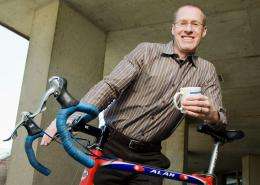
(PhysOrg.com) -- Stopping to smell the coffee - and enjoy a cup of it - before your morning workout might do more than just get your juices flowing. It might keep you going for reasons you haven’t even considered.
As a former competitive cyclist, University of Illinois kinesiology and community health professor Robert Motl routinely met his teammates at a coffee shop to fuel up on caffeine prior to hitting the pavement on long-distance training rides.
“The notion was that caffeine was helping us train harder … to push ourselves a little harder," he said.
The cyclists didn’t know why it helped, they just knew it was effective.
“I think intuitively a lot of people are taking caffeine before a workout and they don’t realize the actual benefit they’re experiencing. That is, they’re experiencing less pain during the workout,” Motl said.
He said it’s becoming increasingly common for athletes - before competing - to consume a variety of substances that include caffeine, motivated by “the notion that it will help you metabolize fat more readily.”
“That research isn’t actually very compelling,” Motl said. “What’s going on in my mind is … people are doing it for that reason, but they actually take that substance that has caffeine and they can push themselves harder. It doesn’t hurt as much.”
The U. of I. professor has been investigating the relationship between caffeine and physical activity since taking a slight detour during his doctoral-student days, when his work initially was focused on exploring possible links between caffeine intake, spinal reflexes and physical activity.
Seven years later, with several studies considering the relationship between physical activity and caffeine behind him, Motl has a much better understanding of why that cuppa Joe he used to consume before distance training and competing enhanced his cycling ability.
Early in his research, he became aware that “caffeine works on the adenosine neuromodulatory system in the brain and spinal cord, and this system is heavily involved in nociception and pain processing.” Since Motl knew caffeine blocks adenosine from working, he speculated that it could reduce pain.
A number of studies by the U. of I. professor support that conclusion, including investigations considering such variables as exercise intensity, dose of caffeine, anxiety sensitivity and gender.
Motl’s latest published study on the effects of caffeine on pain during exercise appears in the April edition of the International Journal of Sport Nutrition and Exercise Metabolism.
“This study looks at the effects of caffeine on muscle pain during high-intensity exercise as a function of habitual caffeine use,” he said. “No one has examined that before.
“What we saw is something we didn’t expect: caffeine-naďve individuals and habitual users have the same amount of reduction in pain during exercise after caffeine (consumption).”
The study’s 25 participants were fit, college-aged males divided into two distinct groups: subjects whose everyday caffeine consumption was extremely low to non-existent, and those with an average caffeine intake of about 400 milligrams a day, the equivalent of three to four cups of coffee.
After completing an initial exercise test in the lab on an ergometer, or stationary cycle, for determination of maximal oxygen consumption or aerobic power, subjects returned for two monitored high-intensity, 30-minute exercise sessions.
An hour prior to each session, cyclists - who had been instructed not to consume caffeine during the prior 24-hour period - were given a pill. On one occasion, it contained a dose of caffeine measuring 5 milligrams per kilogram of body weight (equivalent to two to three cups of coffee); the other time, they received a placebo.
During both exercise periods, subjects’ perceptions of quadriceps muscle pain was recorded at regular intervals, along with data on oxygen consumption, heart rate and work rate.
”What’s interesting,” Motl said, “is that when we found that caffeine tolerance doesn’t matter, we were perplexed at first. Then we looked at reviews of the literature relative to caffeine and tolerance effects across a variety of other stimuli. Sometimes you see them, sometimes you don’t. That is, sometimes regular caffeine use is associated with a smaller response, whereas, other times, it’s not.”
No one’s been able to figure out the reason for the inconsistency, Motl said.
“Clearly, if you regularly consume caffeine, you have to have more to have that bigger, mental-energy effect. But the tolerance effect is not ubiquitous across all stimuli. Even brain metabolism doesn’t show this tolerance-type effect. That is, with individuals who are habitual users versus non-habitual users, if you give them caffeine and do brain imaging, the activation is identical. It’s really interesting why some processes show tolerance and others don’t.”
Regarding the outcome of the current research, he said, “it may just be that pain during exercise doesn’t show tolerance effects to caffeine.”
Motl said one of the next logical steps for his research team would be to conduct studies with rodents in order to better understand the biological mechanism for caffeine in reducing pain.
“If we can get at the biological mechanism, we can begin to understand why there may or may not be this kind of tolerance.”
Motl said another research direction might be to determine caffeine’s effect on sport performance.
“We’ve shown that caffeine reduces pain reliably, consistently during cycling, across different intensities, across different people, different characteristics. But does that reduction in pain translate into an improvement in sport performance?”
Meanwhile, the current research could prove encouraging for a range of people, including the average person who wants to become more physically active to realize the health benefits.
“One of the things that may be a practical application, is if you go to the gym and you exercise and it hurts, you may be prone to stop doing that because pain is an aversive stimulus that tells you to withdraw. So if we could give people a little caffeine and reduce the amount of pain they’re experiencing, maybe that would help them stick with that exercise.
“Maybe then they’ll push a little harder as well … maybe get even better adaptations to the exercise.”
Provided by University of Illinois at Urbana-Champaign (news : web)


