Russia locks up six for Mars experiment
March 31, 2009 by Valerie Leroux Six volunteers will spend three months in a capsule in Moscow simulating for an eventual manned mission to Mars

Enlarge

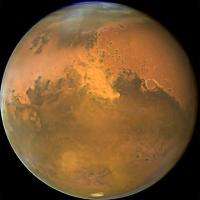
This NASA Hubble Space Telescope image shows Mars in 2005. Six volunteers from Europe and Russia were on Tuesday to climb into a capsule in Moscow and spend three months in isolation to simulate conditions for an eventual manned mission to Mars.

The hatch slammed shut Tuesday behind six volunteers from Europe and Russia who will spend three months isolated in a capsule in Moscow to simulate conditions for a manned mission to Mars.

The two Europeans and four Russians must now live in the cramped facility until the experiment ends 105 days later, allowing scientists to assess the effects of long duration space flight on their minds and bodies.

"How do I feel? I am very motivated. There is a kind of relief. We have been working for a long time and finally we are getting to the start point," Frenchman Cyrille Fournier told reporters just hours ahead of the experiment.

"The challenge is to live with the same people for a long period but it is a positive challenge. I think we are going to learn a lot about each other," added his German fellow volunteer Oliver Knickel.

"The aim is to test the physiological and psychological effects of isolation," he added.

The six climbed into the facility at Russia's Institute of Biomedical Problems (IBMP) at 2:00 pm (1000 GMT) and the hatch was firmly closed behind them.

They will not emerge again for the next three months unless they decide to pull out of the experiment for health or personal reasons.

The six -- all men -- will be allowed to take personal effects like books, laptops and DVDs into the facility in Moscow but will otherwise be sealed away from the world.

They will be travelling nowhere but the aim of the experiment is to imitate the need for full autonomy of the crew that the year-and-a-half round trip to Mars would entail.

As with a real mission, the supplies for the expedition have been painstakingly worked out in advance and no additional goods will be allowed to enter the capsule once the experiment starts.

In a bid to precisely simulate possible scenarios of a manned mission to Mars, communications with the mission control centre and loved ones outside will be subjected to a time delay of 20 minutes.

"One of the specific problems of a mission to Mars is precisely the delay in communications," said the 'commamder' of the team, Sergei Ryazansky, 34.

The 550 cubic metre (19,500 cubic feet) facility is made of three modules: one for food storage, one "medical module" that can be used to isolate a sick participant if necessary and a unit where the participants will live.

There, each participant will have tiny individual bedrooms a maximum of 3.2 square metres (34 square feet) in area which have been minimally furnished with a desk, chair and small bed. The facility also has a small gym, complete with exercise bike.

They will also have to sleep on occasions with a 128-electrode cap to record brain activity. The six will speak in their common languages of English and Russian.

Underlining the declared aim to simulate the exact conditions of a Mars mission, there is also a "landing module simulator" which the crew will occupy for the 30 day "orbit" around Mars.

The experiment is a joint project between the IBMP and the European Space Agency (ESA) and will lay the path for an even tougher Mars mission simulation later in 2009.

The two organisations are planning at the end of the year to send six more crew into the isolation facility for 520 days -- the estimated duration of a return trip to Mars.

European participants Knickel, 28, an engineer in the German army and Fournier, 40, a commercial airline pilot for Air France, were chosen from 5,600 applicants.

The Russian participants are professional cosmonauts Oleg Artemyev and Ryazansky, doctor Alexei Baranov and sports physio Alexei Shpakov.

The ESA and the US space agency NASA have separately sketched dates around three decades from now for a manned flight to Mars.

The Red Planet's distance from Earth varies between 55 million kilometres (34 million miles) and more than 400 million kilometres (250 million miles).

(c) 2009 AFP


print this article email this article download pdf blog this article bookmark this article     Stumble it Digg this share on Facebook retweet share on Reddit add to delicious
Rate this story - 3.9 /5 (7 votes)

Rank Filter

Move the slider to adjust rank threshold, so that you can hide some of the comments.


Display comments: newest first

  • MisteR33 - Mar 31, 2009
    • Rank: not rated yet
    It's a verry stupid experiment.

    A russian was mor than one year on the MIR (MnP) and have not problems!

    Now we dont know this?

    I drive alone to mars, with standard food for three years. And if the athmosphare better as NASA says - I come not back after fife years - but I send you a message in the sixth year: the tomatoes are verry fine!

    We have not so expensiv experiments with "Big Brother"!!!

    If we will have a corectly experiment, so we give 250 person civilisation (from zero to 85 years old) in a isolated room:

    recycling water, recycling food: bio-org -cyrcle, some of medicin, some of technical materials, a solare gardening set with hard-energy-uv-LEDs, 30 around area's a 1000m2 and with the same athmosphare-data as mars,...

    This community drives 9month to mars (simulated) and stay minimum 15years on this area (simulated) and we can check out the problems before we starting
    (we have the data from the projects: erth I and erth II - so we can made a security-pack for a better simulation!!)!

    If we dont do a correctly sim - we can let this.
    Its only bullshit: three month.

    more than 15years or that is not a realy sim!
  • MisteR33 - Mar 31, 2009
    • Rank: not rated yet
    mars
    mars
    mars
    EARTH not erth. ;)
  • MisteR33 - Mar 31, 2009
    • Rank: not rated yet
    We can drive now to mars, without a sim and we can drive in the univers without a sim - we have the data and we have verry much happy people to do this!

    We can kill the degenerating-problems IF we build a Spaceship with a own gravity:
    think about a zylinder with length 200m and radius of 20m!
    now you brought only a simple spin and you have in the zylinder different floors of different gravity!
    in the middle you have the G-zero/Lift-system to cockpit or nuclear-engine.

    This Space Ship One
    haves the complied demensions of length 350m, bright 120m, high 80m! its verry compact and a first cute spaceship.
    Montage in the higher orbit (600km over ground) of mother planet earth.
    We give a longtime (80years to the first change and with 22change-sets) nuclear engine for a drive of more than 1600years!!!
    The nano-instant-civilisation with nearly (working from 15 to 75years) 400peoples (zero to 85years old)!!!

    Following control!
    we can start!
    all ready?
  • holoman - Mar 31, 2009
    • Rank: not rated yet
    Near light Speed propulsion published on web could make the round trip in 174 days reducing radiation hazards to the crew.
  • fsmith - Mar 31, 2009
    • Rank: 5 / 5 (1)
    I think they should shut two people in an Apollo command module with OJ Simpson, just like Capricorn One.

March 31, 2009 all stories

Comments: 5

3.9 /5 (7 votes)
  • Stumble this up

  • Digg this

  • share this

  • hide
  • Related Stories

  • Europe, Russia in Mars mission rehearsal
    created Mar 29, 2009 | popularity not rated yet | comments 0
  • Preparing for a journey to Mars: Crew locked for 105 days in simulator
    created Mar 05, 2009 | popularity not rated yet | comments 0
  • Europe names crew for Mars 'mission'
    created Feb 26, 2009 | popularity not rated yet | comments 0
  • Russia to stage mock mission to Mars
    created Aug 05, 2006 | popularity not rated yet | comments 0
  • ESA prepares for a human mission to Mars
    created Apr 02, 2007 | popularity not rated yet | comments 0


  • hide
  • Relevant PhysicsForums posts

  • Question about 2-body gravity
    created Nov 24, 2009
  • life on Mars
    created Nov 24, 2009
  • Semi-major axis from cartesian co-ordinates
    created Nov 23, 2009
  • Primary Mirror grinding
    created Nov 23, 2009
  • More from Physics Forums - General Astronomy

Other News

Monster Waves on the Sun are Real

Monster Waves on the Sun are Real (w/ Video)

Space & Earth / Astronomy

created 8 hours ago | popularity 4.8 / 5 (10) | comments 1

Sometimes you really can believe your eyes. That's what NASA's STEREO (Solar Terrestrial Relations Observatory) spacecraft are telling researchers about a controversial phenomenon on the sun known as the "solar ...


Cosmic 'dig' reveals vestiges of the Milky Way's building blocks

Cosmic 'Dig' Reveals Vestiges of the Milky Way's Building Blocks

Space & Earth / Astronomy

created 13 hours ago | popularity 4.9 / 5 (14) | comments 1

(PhysOrg.com) -- Peering through the thick dust clouds of our galaxy's "bulge" (the myriads of stars surrounding its center), a team of astronomers has unveiled an unusual mix of stars in the stellar grouping ...


No Wheel Stall in Diagnostic Drive

Spirit Mars Rover: No Wheel Stall in Diagnostic Drive

Space & Earth / Space Exploration

created 9 hours ago | popularity 4.5 / 5 (2) | comments 0

(PhysOrg.com) -- On Sol 2095 (Tuesday, Nov. 24), Spirit performed a set of diagnostic actions related to a stall of the right-rear wheel on the previous drive, three days earlier.


Climate experts debate strategies for reducing atmospheric carbon and future warming

Climate experts debate strategies for reducing atmospheric carbon and future warming

Space & Earth / Environment

created 9 hours ago | popularity 2.8 / 5 (6) | comments 8

(PhysOrg.com) -- Reducing carbon dioxide to safe levels may require extracting carbon from the air, says Cornell climate researcher.


Oceanic crust formation is dynamic after all

Oceanic crust formation is dynamic after all

Space & Earth / Earth Sciences

created 12 hours ago | popularity 4.6 / 5 (5) | comments 0

Imagine the Earth's crust as the planet's skin: Some areas are old and wrinkled while others have a fresher, more youthful sheen, as if they had been regularly lathered with lotion.