New robot 'steered by human thought': Honda
March 31, 2009
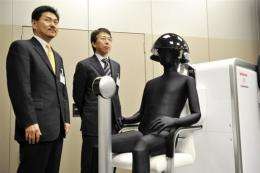
The brain-machine interface (right) equipped with headgear to measure electrical current and blood flow in the brain

Enlarge

Honda Reseach Institute president Yasuhisa Arai (L) and Mitsuo Kawato, Japan's ATR computational Neuroscience Laboratories director, stand next to a brain-machine interface, equipped with special headgear to measure slight electrical current and blood flow change occuring in the brain, at Japanese auto giant Honda's headquarters in Tokyo.

Japan's Honda said Tuesday it had developed a robot steered by human thought, thanks to a helmet-like device that measures a person's brain activity and sends signals to the machine.

The latest version of ASIMO -- the celebrity of Honda Motor Co. that can already dance, run and guide guests through an office floor -- has now been fitted with a so-called "brain machine interface" (BMI), the company said.

The state-of-the-art technology means the can perform four basic movements with its arms, legs and tongue based on the non-verbal instructions a person sends to it by concentrating on performing the action themselves.

"By only imagining moving their right hand, for example, a test person can move ASIMO's right hand," said one of the scientists involved, Tatsuya Okabe of the Honda Research Institute Japan.

"The accuracy of a movement depends on the test person and whether that person is good at concentrating."

ASIMO can perform the motions correctly in 90.6 percent of cases -- a record in the field of BMI technology -- the scientists told a Tokyo news conference, where they showed video footage of the experiment.

The research aims to create a robot which can help people with house-keeping chores such as serving dishes or watering plants.

The project is jointly run with the state-backed Advanced Research Institute International and precision-equipment manufacturer Shimadzu Corp.

"What we are doing is still basic research, but we are working on the dream of commercialising it," said Yasuhisa Arai, president of the Honda Research Institute. "But there is still a very long way to go before commercialisation."

(c) 2009 AFP

4.2 /5 (14 votes)  

Filter


Move the slider to adjust rank threshold, so that you can hide some of the comments.


Display comments: newest first

ScottyB
Mar 31, 2009

Rank: not rated yet
hmmm so you could kill some one with this robot an dthere woudl be no trace to you//.....

Sound too perfect
Bob_Kob
Mar 31, 2009

Rank: not rated yet
So you are basically remote controlling the robot to wash the dishes... you might as well do it yourself.
LariAnn
Mar 31, 2009

Rank: not rated yet
This would be great for a paraplegic, quadriplegic, or for temporarily disabled people who would not be able to "do it themselves". If you can think the movements and get the robot to do them, then you can have help around the house without needing a real person there all the time.
alexakesson
Mar 31, 2009

Rank: not rated yet
This is heading in a direction I like, with the eventuality of remote access to the internet and maneuverability in cyberspace.
Suzu
Mar 31, 2009

Rank: 1 / 5 (1)
Wont be making direct interface ala matrix be a better idea?
Rank 4.2 /5 (14 votes)
Related Stories
Relevant PhysicsForums posts
  • Does anyone make a small high temperature and high pressure pump?
    created6 hours ago
  • Strange indexing in Fortran Code
    created17 hours ago
  • Car Port post load calculation
    created19 hours ago
  • attempting to spin-cast parabola
    createdFeb 07, 2012
  • Flow around a reducing bend - effect on pumping work
    createdFeb 06, 2012
  • Formula for deflection of 6061 T6 hollow tube, please help.
    createdFeb 06, 2012
  • More from Physics Forums - General Engineering

More news stories

Google rumored to have built Heads-Up-Display glasses prototype

(PhysOrg.com) -- 9to5Google is reporting that they have received a tip from someone they believe to be a reliable source saying that Google is working on a Heads-Up-Display (HUD) pair of eye-glasses. The per ...

Electronics / Consumer & Gadgets

created 5 hours ago | popularity 4.7 / 5 (6) | comments 2 | with audio podcast weblog

Hitachi ships the industry's first 25-nanometer SLC NAND flash enterprise-class SSDs

Demonstrating its commitment to delivering leading-edge technologies and solutions for enterprise-class servers and storage systems, Hitachi Global Storage Technologies (Hitachi GST) today announced that its ...

Electronics / Hardware

created 5 hours ago | popularity not rated yet | comments 0

New Nokia phone no standout, but worth a look

The first of Nokia's new generation of smartphones isn't flashy and certainly isn't an iPhone killer. But it's a nice device, and at $40 with a two-year contract, a bargain.

Electronics / Consumer & Gadgets

created Feb 03, 2012 | popularity 1 / 5 (2) | comments 4

Intel packs performance and reliability into its latest SSD 520 series

Intel Corporation announced today its fastest, most robust client/consumer solid-state drive (SSD) to date, the Intel Solid-State Drive 520 Series (Intel SSD 520), a 6 gigabit-per-second (gbps) SATA III SSD ...

Electronics / Hardware

created Feb 07, 2012 | popularity 5 / 5 (1) | comments 3

Some HTC Android phones found vulnerable to WiFi password leak

(PhysOrg.com) -- The United States Computer Emergency Readiness Team (U-CERT) has issued a warning to users of some HTC Android phones regarding a security vulnerability that has been found. The warning pert ...

Electronics / Consumer & Gadgets

created Feb 02, 2012 | popularity 5 / 5 (1) | comments 2 | with audio podcast report


Short fasting cycles work as well as chemotherapy in mice

Man may not live by bread alone, but cancer in animals appears less resilient, judging by a study that found chemotherapy drugs work better when combined with cycles of short, severe fasting.

Physicists build highly efficient 'no-waste' laser

A team of University of California, San Diego researchers has built the smallest room-temperature nanolaser to date, as well as an even more startling device: a highly efficient, "thresholdless" laser that ...

Study shows how DNA finds its match

It's been more than 50 years since James Watson and Francis Crick showed that DNA is a double helix of two strands that complement each other. But how does a short piece of DNA find its match, out of the millions ...

Transparent iron? For the first time, an experiment shows that atomic nuclei can become transparent

At the high-brilliance synchrotron light source PETRA III, a team of DESY scientists headed by Dr. Ralf Röhlsberger has succeeded in making atomic nuclei transparent with the help of X-ray light. At the ...

Quantum physicist explains $100K offer for proof scaled-up quantum computing is impossible

(PhysOrg.com) -- MIT researcher Scott Aaronson has certainly riled the physics community with his offer this past Friday, of $100,000 to anyone who can prove that scaled-up quantum computing is impossible. ...

'Explorers,' who embrace the uncertainty of choices, use specific part of cortex

Life shrouds most choices in mystery. Some people inch toward a comfortable enough spot and stick close to that rewarding status quo. Out to dinner, they order the usual. Others consider their options systematically ...