Flexible, transparent supercapacitors -- bend and twist them like a poker card
March 31, 2009 Flexible, transparent supercapacitors are latest devices from USC nanotube lab

Enlarge

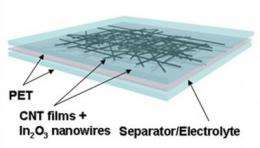
Anatomy of a supercapacitor: two films combining Indium Oxide (In2O3) separated by a layer of Nafion film. Credit: USC Viterbi School of Engineering

It is a completely transparent and flexible energy conversion and storage device that you can bend and twist like a poker card.

It continues a line of prototype devices created at the USC Viterbi School of Engineering that can perform the electronic operations now usually handled by silicon chips using carbon nanotubes and metal nanowires set in indium oxide films, and can potentially do so at prices competitive with those of existing technologies.

The device is a supercapacitor, a circuit component that can temporarily store large amounts of electrical energy for release when needed. A team headed by Chongwu Zhou describes it a newly-published paper on "Flexible and Transparent Supercapacitor based on Indium Nanowire / Heterogeneous Films" in the journal (Vol.94, Issue 4, Page 043113, 2009).

Its creators believe the device points the way to further applications, such as flexible power supply components in "e-paper" displays and conformable products.

The device stores an energy density of 1.29 Watt-hour/kilogram with a specific capacitance of 64 Farad/gram. By contrast, conventional capacitors usually have an energy density of less than 0.1 Wh/kg and a storage capacitance of several tenth millifarads.

Zhou, who holds the Jack Munushiun Early Career Chair at the USC Ming Hsieh Department of Electrical Engineering, worked with USC graduate students Po-Chiang Chen and Sawalok Sukcharoenchoke, and post-doc Guozhen Shen.

The group incorporated nanowires with carbon nanotubes (CNTs) to form heterogeneous films and further optimized the film thickness attaching on transparent plastic substrates to maintain the mechanical flexibility and optical transparency of the supercapacitors.

According to Zhou, the work, based on combing CNTs with metal nanowiers represents an advance on earlier attempts to produce supercapacitors using just CNTs or graphite.

Such efforts resulted in only modest performance compared to those using transition metal oxide materials, including such oxides of iron, manganese and rubidium. Moreover, energy storage devices made by these materials have neither mechanical flexibility nor optical transparency, which have confined their applications in the flexible and transparent electronics.

The critical improvement in performance, according to the research, can be attributed to the incorporation of metal oxide nanowires with CNT films. Indium oxide nanowire, with the properties of wide band gap, high aspect ratio, and short diffusion path length, can be one of the best candidates for transparent electrochemical capacitors. Professor Zhou's lab has pioneered this material over the past several years.

These new devices, by contrast, "demonstrated enhanced specific capacitance, power density, energy density, and long operation cycles, compared to those supercapacitors made only by CNTs," says the new release.

"We successfully produced a prototype of flexible and transparent supercapacitors built on two important nanostructured materials (including metal oxide nanowires and CNTs).

The researchers not only created metal oxide nanowire / CNT heterogeneous films as active materials and current collecting electrodes for the supercapacitors, but also examined the stability of the transparent and flexible supercapacitors through a large cycle number of charge/discharge measurements.

The paper contains description of how the new devices are made.

"CNT films were fabricated by vacuum filtration method. An adhesive and flat poly (dimethysiloxane) (PDMS) stamp was adapted to peel the CNT film off of the filtration membrane and then released it onto a polyethylene terephtalate (PET) substrate. In2O3 nanowires with a diameter of ~ 20 nm and a length of ~ 5 μm were synthesized by a pulsed laser deposition (PLD) method. The as-grown nanowires were sonicated into IPA solutions and then dispersed upon transferred CNT films to form In2O3 nanowire /CNT heterogeneous film for transparent and flexible supercapacitor study.

"In addition, with the increasing amount of In2O3 nanowires dispersed upon CNT films, the specific capacitance of the heterogeneous supercapacitor can be dramatically improved up from 25.4 Farad/gram to 64 Farad/gram. In comparisons to supercapacitors made by other transition metal oxide nanostructured materials, this observation indicates a good stability of In2O3 nanowire / CNT heterogeneous films for long-term capacitor applications."

Source: University of Southern California (news : web)


print this article email this article download pdf blog this article bookmark this article     Stumble it Digg this share on Facebook retweet share on Reddit add to delicious
Rate this story - 4.8 /5 (15 votes)

Rank Filter

Move the slider to adjust rank threshold, so that you can hide some of the comments.


Display comments: newest first

  • lengould100 - Mar 31, 2009
    • Rank: 1 / 5 (1)
    Why do they want an energy storage device to be transparent? I want supercaps as energy storage devices for my car, and I couldn't care less if they're transparent.
  • GrammarKnight - Mar 31, 2009
    • Rank: 5 / 5 (1)
    I think the operative modifier is 'super-'... but the author of the article was most impressed by the cool factor of transparency and non-traditional form factor. (as for me, I wait anxiously for the advent of the practical slap-bracelet watch/cellphone.)
  • mjporter - Mar 31, 2009
    • Rank: 5 / 5 (1)
    As far as I understand the article, they're not only flexible and transparent, but have performance superior to that of older supercaps as well.
  • poi - Apr 01, 2009
    • Rank: 3 / 5 (2)
    Why do they want an energy storage device to be transparent? I want supercaps as energy storage devices for my car, and I couldn't care less if they're transparent.

    Well because:
    Its creators believe the device points the way to further applications, such as flexible power supply components in "e-paper" displays and conformable products.

    So I guess they didn't see you and your need as a market. Sorry.
  • Iron_John - Apr 01, 2009
    • Rank: 1.7 / 5 (3)
    "Why do they want an energy storage device to be transparent?"


    So the battery may also be the windshields & body parts. Cuz at this energy density, 23 times the mass of a car battery would be required to power your car.

    Not that i care about cars; i use a bicycle exclusively, year round.


  • Husky - Apr 01, 2009
    • Rank: 5 / 5 (2)
    this would be a nice complement to those flexible nanorods mentioned in earlier articles that convert mechanical movement to electricity, imagine having both the generators and capicitors stored closely as 2 thin films in your clothing
  • QubitTamer - Apr 01, 2009
    • Rank: 3 / 5 (2)
    "Why do they want an energy storage device to be transparent?"


    So the battery may also be the windshields & body parts. Cuz at this energy density, 23 times the mass of a car battery would be required to power your car.


    Not that i care about cars; i use a bicycle exclusively, year round.


    Good for you. Some of us have families and don't live packed like sardines in urban centers where you can just run down to the market on the corner of your block to buy anything you need.

    BTW, you know that you still have a huge carbon footprint for all of the food and goods that has to be trucked into your cramped and probably crime-infested urban center that you snobbishly ride your little bicycle about, haughtilly condescending of anyone not as committed to the environment as you.
  • jonnyboy - Apr 01, 2009
    • Rank: not rated yet
    attaboy Q-bit, don't let him get away with that sh%t
  • lengould100 - Apr 01, 2009
    • Rank: not rated yet
    QubiTamer: You missed the opportunity to substitute "haughtilly condescending" with "snottishly condescending".
  • Neurohacker2 - Apr 06, 2009
    • Rank: not rated yet
    it sounds the keyboards of that old ZX81

March 31, 2009 all stories

Comments: 10

4.8 /5 (15 votes)
  • Stumble this up

  • Digg this

  • share this

  • hide
  • Related Stories


  • hide
  • Relevant PhysicsForums posts

  • Entropy vs. video game controllers
    created 3 hours ago
  • Electron oscillating in vacuum
    created 3 hours ago
  • Swings
    created 3 hours ago
  • Bicycling on the Moon
    created 5 hours ago
  • Where'd the energy come from?
    created 5 hours ago
  • Need help understanding negative pressure
    created 6 hours ago
  • More from Physics Forums - General Physics

Other News

New Digital 'Electronics' Concept May Continue Moore's Law

New Digital 'Electronics' Concept May Continue Moore's Law

Nanotechnology / Nanophysics

created Nov 05, 2009 | popularity 4.6 / 5 (50) | comments 8

(PhysOrg.com) -- Computers of the future could be operating not on electrons, but on tiny waves traveling through an electron "fluid," if a new proposal is successful. The new circuit design, recently introduced ...


Nanoparticles for gene therapy improve

Nanoparticles for gene therapy improve

Nanotechnology / Bio & Medicine

created Nov 06, 2009 | popularity 5 / 5 (4) | comments 3

(PhysOrg.com) -- About five years ago, Professor Janet Sawicki at the Lankenau Institute in Pennsylvania read an article about nanoparticles developed by MIT's Robert Langer for gene therapy, the insertion ...


Breakthrough in industrial-scale nanotube processing

Breakthrough in industrial-scale nanotube processing

Nanotechnology / Nanomaterials

created Nov 02, 2009 | popularity 4.9 / 5 (20) | comments 3

(PhysOrg.com) -- Rice University scientists today unveiled a method for the industrial-scale processing of pure carbon-nanotube fibers that could lead to revolutionary advances in materials science, power ...


Scientists witness nature's complexity unfold in self-assembling quasicrystals

Scientists witness nature's complexity unfold in self-assembling quasicrystals

Nanotechnology / Nanomaterials

created Oct 31, 2009 | popularity 4.9 / 5 (16) | comments 3

(PhysOrg.com) -- Just a few decades ago, scientists believed that all ordered matter consists of self-repeating building blocks -- atoms, ions or molecules. In this view, the ordinary solids of everyday life ...


Nanoparticles may cause DNA damage across a cellular barrier

Nanoparticles may cause DNA damage across a cellular barrier

Nanotechnology / Bio & Medicine

created Nov 05, 2009 | popularity 4.3 / 5 (9) | comments 1

(PhysOrg.com) -- Scientists have shown in the laboratory that metal nanoparticles damaged the DNA in cells on the other side of a cellular barrier. The research, by the University of Bristol, is published ...