Eye exercises help patients work out vision problems
You've probably been there. In a doctor's office, being advised to do what you dread - exercise. You get that feeling in your gut, acknowledging that, indeed, you should exercise but probably won't. Now imagine that the doctor is your optometrist.
Don't clean your glasses. You read that right. Eye exercises are used to treat a variety of vision disorders, according to Dr. Janice Wensveen, clinical associate professor at the University of Houston's College of Optometry.
Patient reactions to this quite common prescription range between surprise and relief, she said, but doing the therapy can improve their performance at school and work.
"They're curious, especially when we tell them, instead of putting a Band-Aid on it like we do with glasses or contact lenses, we're actually going to solve your problem. You're going to be cured, and that's something we don't very often do," she said.
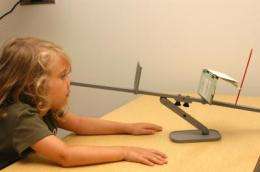
The standard at-home prescription is known as "pencil push-up therapy," said Wensveen, who practices at the University Eye Institute's Vision Therapy Clinic in the Family Practice Service.
"Patients visually follow a small letter on a pencil as they moved the pencil closer to the nose. The goal is to be able to keep the letter clear and single until it touches your nose."
Not surprisingly, she said, many patients don't follow through once they're out the door.
"You can imagine that, in the doctor's office, it sounds great, and you can do it. You think, 'Wow, this can help me?' But you get home, and you do it. You think, 'This is really dumb.' You do it once, and you never do it again," she said.
In fact, a study released in the fall by the National Eye Institute (NEI) found that office-based treatment for patients with a common eye muscle coordination disorder, along with at-home reinforcement, is more effective than home-based programs in isolation. The research, reported in the Archives of Ophthalmology, involved more than 200 young people with a condition known as convergence insufficiency, which Wensveen said likely affects between 5 percent and 20 percent of the population, depending on the definition used and the age group studied.
"As the name implies, it's somebody who can't cross their eyes, and you might think that's a weird thing to have to be able to do. But, if you just consider the geometry of looking up close, your two eyes do have to turn in so that they're both pointing at the thing that you want to see," Wensveen said.
Left unattended, Wensveen said, convergence insufficiency can affect a student's performance in school, because reading can become very frustrating.
"These are the kids who would rather do anything but sit down and do their work," she said. "And I think that's why kids especially who have convergence insufficiency are sometimes mislabeled as having attention deficit hyperactivity disorder, because they just don't want to sit down."
While most eye care professionals treat convergence insufficiency using only home-based therapy, the NEI results indicated approximately 75 percent of patients treated both in the office and at home reported fewer and less severe symptoms related to reading and other close-up work. Symptoms of convergence insufficiency include loss of place and concentration while reading, reading slowly, eyestrain, headaches, blurry vision and double vision.
"Studies would suggest there is a possible relationship between convergence insufficiency and ADHD, in that about 10 percent of patients with convergence insufficiency had a history of ADHD at initial presentation or in follow-up exams," said Dr. Nick Holdeman, executive director of the University Eye Institute. "While the research does not support a direct relationship between the two diagnoses, it is recommended that evaluation of convergence insufficiency should be undertaken in children diagnosed with ADHD."
Wensveen said the research results underscore that patients, or the parents of patients, advised to conduct eye exercises should seriously consider in-office vision therapy to get the results they desire.
"It's like using a physical trainer or a physical therapist. We will work with you to ensure that you do make progress toward being able to use your eyes comfortably and efficiently," she said.
Source: University of Houston


