Researchers use CT to examine hidden face in Nefertiti bust
March 31, 2009 CT scan reveals hidden face under Nefertiti bust (AP)

Enlarge

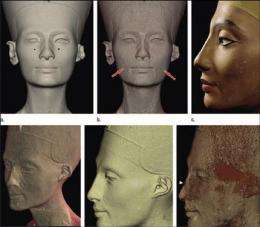
In this undated photo composite released Tuesday, March 31, 2009 by the Radiological Society of North America, the bust of Nefertiti is shown. Researchers in Germany have used a modern medical procedure to uncover a secret within one of ancient Egypt's most treasured artworks _ the bust of Nefertiti has two faces. The differences between the faces, though slight _ creases at the corners of the mouth, a bump on the nose of the stone version _ suggest to Dr. Alexander Huppertz, director of the Imaging Science Institute at Berlin's Charite hospital and medical school, that someone expressly ordered the adjustments between stone and stucco when royal sculptors immortalized the wife of Pharaoh Akhenaten 3,300 years ago. (AP Photo/Radiological Society of North America)

Using CT imaging to study a priceless bust of Nefertiti, researchers have uncovered a delicately carved face in the limestone inner core and gained new insights into methods used to create the ancient masterpiece and information pertinent to its conservation, according to a study published in the April issue of Radiology.

"We acquired a lot of information on how the bust was manufactured more than 3,300 years ago by the royal sculptor," said the study's lead author Alexander Huppertz, M.D., director of the Imaging Science Institute in Berlin, Germany. "We learned that the sculpture has two slightly different faces, and we derived from interpretation of the CT images how to prevent damage of this extremely precious art object."

Nefertiti, the wife of the Egyptian pharaoh Akhenaten, was the most renowned Great Royal Wife of all 31 Egyptian dynasties. Considered one of the greatest finds of ancient Egypt, the bust of Nefertiti was discovered in 1912, during excavation of the studio of famous royal sculptor Thutmose.

The Nefertiti bust consists of a limestone core covered in layers of stucco of varying thickness. The bust was examined using CT for the first time in 1992, but recent advances in CT technology allowed the researchers to analyze the statue in 2007 with greater precision.

"CT has changed significantly since 1992," Dr. Huppertz said. "We can now acquire three-dimensional (3-D) images at a much higher resolution."

Dr. Huppertz and colleagues used a 64-section spiral CT technique with submillimeter section thickness to examine the bust and assess its conservation status, gain information on its creation and provide a 3-D surface reformation of the inner limestone sculpture.

The results showed that a multi-step process was used to create the sculpture. The stucco layer on the face and ears is very thin, but the rear part of the reconstructed crown contains two thick stucco layers. CT images showed several fissures and non-uniform bonding between the layers.

The inner limestone face was delicately sculpted and highly symmetric. Compared to the outer stucco face, the inner face exhibited some differences: less depth in the corners of the eyelids, creases around the corner of the mouth and cheeks, less prominent cheekbones and a slight bump on the ridge of the nose. The ears on the inner sculpture were similar to those visible on the exterior.

Thin-section CT was able to provide detailed images of the inner structure in a completely nondestructive manner and showed the limestone core to be not just a mold, but a skillfully rendered work of art. Retouching the creases in the corners of the mouth and smoothing the bump on the nose on the outer face may have been the artist's choice and reflective of the aesthetic ideals of that era.

CT findings also may be important in preventing future damage to the bust. The findings of multiple, varying layers of stucco, as well as fissures in the shoulders, lower surface of the bust and rear of the crown, indicate vulnerable areas requiring very careful handling, and pressure on the layers of thick stucco is to be avoided.

"Noninvasive CT technology and very advanced 3-D post-processing tools allow us greater insight into the internal composition and conservation status of the sculpture," Dr. Huppertz said. "This knowledge will greatly contribute to the preservation of this priceless antiquity."

The Nefertiti bust is part of the collection of the Egyptian Museum of Berlin and will be moved in October 2009 to the recently restored New Museum in the historical center of Berlin.

Source: Radiological Society of North America


print this article email this article download pdf blog this article bookmark this article     Stumble it Digg this share on Facebook retweet share on Reddit add to delicious
Rate this story - 4.8 /5 (9 votes)


March 31, 2009 all stories

Comments: 0

4.8 /5 (9 votes)
  • Stumble this up

  • Digg this

  • share this

  • hide
  • Related Stories

  • Radiologists attempt to solve mystery of Tut's demise
    created Nov 27, 2006 | popularity not rated yet | comments 0
  • CT scan reveals ancient long-necked gliding reptile
    created Jun 12, 2007 | popularity not rated yet | comments 0
  • High-Tech X-Ray Equipment to Examine Dinosaur Skull
    created Jan 14, 2005 | popularity not rated yet | comments 0
  • 2,000-year-old mummy goes through 21st-century scanner
    created Aug 01, 2006 | popularity not rated yet | comments 0
  • X-rays power discoveries at Chicago's Field Museum
    created May 07, 2008 | popularity not rated yet | comments 0


  • hide
  • Relevant PhysicsForums posts

Other News

Growth in secular attitudes leaves Americans room for belief in God

Other Sciences / Social Sciences

created Oct 31, 2009 | popularity 4 / 5 (6) | comments 118

(PhysOrg.com) -- The nature of the American religious experience is changing as a rising number of people report having no formal religious affiliation, even though the number of Americans who say they pray is increasing, ...


Forest clearances sealed ancient civilisation's downfall

Forest clearances sealed ancient civilisation's downfall

Other Sciences / Archaeology & Fossils

created Nov 02, 2009 | popularity 4.9 / 5 (9) | comments 6

(PhysOrg.com) -- An ancient South American civilisation which disappeared around 1,500 years ago helped to cause its own demise by damaging the fragile ecosystem that held it in place, a study has found. ...


Oscar Pistorius

New study further disputes notion that amputee runners gain advantage from protheses

Other Sciences / Other

created Nov 04, 2009 | popularity 5 / 5 (4) | comments 5

A study by six researchers, including a University of Colorado at Boulder associate professor and his former doctoral student, shows that amputees who use running-specific prosthetic legs have no performance ...


Racial segregation key factor in subprime lending

Other Sciences / Economics

created Nov 06, 2009 | popularity 3 / 5 (2) | comments 3

(PhysOrg.com) -- New study examines impact of segregation on the prevalence of high-cost loans in U.S. metro areas. Subprime loans disproportionately located in segregated areas.


New theory on fairness in economics targets CEO pay

Other Sciences / Economics

created Nov 03, 2009 | popularity 4.3 / 5 (11) | comments 3

(PhysOrg.com) -- Chief executives in 35 of the top Fortune 500 companies were overpaid by about 129 times their "ideal salaries" in 2008, according to a new type of theoretical analysis proposed by a Purdue University researcher ...