Rocket launches may need regulation to prevent ozone depletion, says study
March 31, 2009
Rocket launches may need regulation to prevent ozone depletion, says study

Enlarge

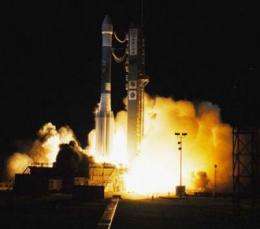
A Delta rocket launches from NASA's Kennedy Space Center carrying Mars Phoenix lander in 2007. Credit: NASA

The global market for rocket launches may require more stringent regulation in order to prevent significant damage to Earth's stratospheric ozone layer in the decades to come, according to a new study by researchers in California and Colorado.

Future ozone losses from unregulated rocket launches will eventually exceed ozone losses due to chlorofluorocarbons, or CFCs, which stimulated the 1987 Montreal Protocol banning ozone-depleting chemicals, said Martin Ross, chief study author from The Aerospace Corporation in Los Angeles. The study, which includes the University of Colorado at Boulder and Embry-Riddle Aeronautical University, provides a market analysis for estimating future ozone layer depletion based on the expected growth of the space industry and known impacts of rocket launches.

"As the rocket launch market grows, so will ozone-destroying rocket emissions," said Professor Darin Toohey of CU-Boulder's atmospheric and oceanic sciences department. "If left unregulated, rocket launches by the year 2050 could result in more ozone destruction than was ever realized by CFCs."

A paper on the subject by Ross and Manfred Peinemann of The Aerospace Corporation, CU-Boulder's Toohey and Embry-Riddle Aeronautical University's Patrick Ross appeared online in March in the journal Astropolitics.

Since some proposed space efforts would require frequent launches of large rockets over extended periods, the new study was designed to bring attention to the issue in hopes of sparking additional research, said Ross. "In the policy world uncertainty often leads to unnecessary regulation," he said. "We are suggesting this could be avoided with a more robust understanding of how rockets affect the ozone layer."

Current global rocket launches deplete the ozone layer by no more than a few hundredths of 1 percent annually, said Toohey. But as the space industry grows and other ozone-depleting chemicals decline in the Earth's stratosphere, the issue of ozone depletion from rocket launches is expected to move to the forefront.

Today, just a handful of NASA space shuttle launches release more ozone-depleting substances in the stratosphere than the entire annual use of CFC-based medical inhalers used to treat asthma and other diseases in the United States and which are now banned, said Toohey. "The Montreal Protocol has left out the space industry, which could have been included."

Highly reactive trace-gas molecules known as radicals dominate stratospheric ozone destruction, and a single radical in the stratosphere can destroy up to 10,000 ozone molecules before being deactivated and removed from the stratosphere. Microscopic particles, including soot and aluminum oxide particles emitted by rocket engines, provide chemically active surface areas that increase the rate such radicals "leak" from their reservoirs and contribute to ozone destruction, said Toohey.

In addition, every type of rocket engine causes some ozone loss, and rocket combustion products are the only human sources of ozone-destroying compounds injected directly into the middle and upper stratosphere where the ozone layer resides, he said.

Although U.S. science agencies spent millions of dollars to assess the ozone loss potential from a hypothetical fleet of 500 supersonic aircraft -- a fleet that never materialized -- much less research has been done to understand the potential range of effects the existing global fleet of rockets might have on the ozone layer, said Ross.

Since 1987 CFCs have been banned from use in aerosol cans, freezer refrigerants and air conditioners. Many scientists expect the stratospheric ozone layer -- which absorbs more than 90 percent of harmful ultraviolet radiation that can harm humans and ecosystems -- to return to levels that existed prior to the use of ozone-depleting chemicals by the year 2040.

Rockets around the world use a variety of propellants, including solids, liquids and hybrids. Ross said while little is currently known about how they compare to each other with respect to the ozone loss they cause, new studies are needed to provide the parameters required to guide possible regulation of both commercial and government rocket launches in the future.

"Twenty years may seem like a long way off, but space system development often takes a decade or longer and involves large capital investments," said Ross. "We want to reduce the risk that unpredictable and more strict ozone regulations would be a hindrance to space access by measuring and modeling exactly how different rocket types affect the ozone layer."

The research team is optimistic that a solution to the problem exists. "We have the resources, we have the expertise, and we now have the regulatory history to address this issue in a very powerful way," said Toohey. "I am optimistic that we are going to solve this problem, but we are not going to solve it by doing nothing."

Source: University of Colorado at Boulder

4.5 /5 (65 votes)  

Filter


Move the slider to adjust rank threshold, so that you can hide some of the comments.


Display comments: newest first

Modernmystic
Mar 31, 2009

Rank: 4.1 / 5 (7)
It just never ends...

Let's just grow fur again and chew nuts.
GrayMouser
Mar 31, 2009

Rank: 3.7 / 5 (6)
Some people think leaving the oceans was a bad idea...
Szkeptik
Mar 31, 2009

Rank: 4 / 5 (4)
Regulating space travel is completely out of the question. Restricting the number of launches would be devastating to the future of space travel.
Doug_Huffman
Mar 31, 2009

Rank: 5 / 5 (1)
Like putting a cow plop in a coffee can, the dung beetles have to enjoy it.
holoman
Mar 31, 2009

Rank: 2.4 / 5 (9)
How about inventing a not destructive ozone solution to launching space craft.
Modernmystic
Mar 31, 2009

Rank: 4 / 5 (4)
How about inventing a not destructive ozone solution to launching space craft.


Yeah because it's so cheap already to launch rockets....
dachpyarvile
Mar 31, 2009

Rank: 5 / 5 (2)
How about inventing a not destructive ozone solution to launching space craft.


Good luck with that one! Let's see, we have to eliminate aluminum from the construction alloys, and...

Nope. Not going to happen anytime soon. The weight increases will be out of the question due to increasing the cost of launch exponentially...
dan42day
Apr 01, 2009

Rank: 4 / 5 (4)
Doesn't burning liquid hydrogen with liquid oxygen produce pure water vapor?
dirk_bruere
Apr 01, 2009

Rank: 3.7 / 5 (3)
Try telling China!
Velanarris
Apr 01, 2009

Rank: 5 / 5 (1)
Doesn't burning liquid hydrogen with liquid oxygen produce pure water vapor?
And peroxide, and hydroxide, and methane, and carbon dioxide, and carbon monoxide, and silicates, and nitrates, and nitrites, and nitrogen dioxide, and ...

You're passing through a mixed medium with a jet of super-heated, super-reactive gas. If that medium was composed purely of O2 and H2 then yes, you'd have water, o2 and h2 as the only remains but it's not.
denijane
Apr 01, 2009

Rank: 1 / 5 (1)
Hm, the article mention the stuff emitted by the engine, not by the construction itself, so it might be possible to filter those polluter in some way.
Sooner or later that should be done. The space is our future, so now or in 15 years, we'll have to make sure a launch isn't doing more damage than good.
jonnyboy
Apr 01, 2009

Rank: not rated yet
sorry gang, I just can't resist the temptation

It just never ends...


Let's just grow fur again and chew nuts.


on the other hand the articles author could just chew on my furry nu........

Modernmystic
Apr 01, 2009

Rank: 2 / 5 (3)
Try telling China!


No kidding, they'll laugh at us as they build military space stations at the la grange points, one the moon and proceed to place nuclear weapons platforms out there....and the ozone will still be as damaged as it's going to get regardless.

But at least WE didn't damage the ozone...
robbycoats
Apr 01, 2009

Rank: 1 / 5 (2)
praise be to Al gore!
Velanarris
Apr 01, 2009

Rank: 4.5 / 5 (2)
Hm, the article mention the stuff emitted by the engine, not by the construction itself, so it might be possible to filter those polluter in some way.

Sooner or later that should be done. The space is our future, so now or in 15 years, we'll have to make sure a launch isn't doing more damage than good.

Rockets' ability to work rely completely on their exhaust. Impeding its ability to expand as exhaust cuts thrust so filtering or trapping anything at this stage of our propulsion ability is kind of out of the question.

We could look at the space elevator method, but without an overhaul of the propulsion systems I don't see it changing any time soon.
robbycoats
Apr 01, 2009

Rank: 3.7 / 5 (3)
anyone see the end to battlestar galactica the other night?? Thats exactly what these people want us to do; launch all our technology into the sun and live like monkeys.
dachpyarvile
Apr 02, 2009

Rank: 5 / 5 (2)
Hm, the article mention the stuff emitted by the engine, not by the construction itself, so it might be possible to filter those polluter in some way.


Sooner or later that should be done. The space is our future, so now or in 15 years, we'll have to make sure a launch isn't doing more damage than good.


You must have missed the following in your reading:

"Microscopic particles, including soot and aluminum oxide particles emitted by rocket engines,..."

These microscopic particles come from bits of the aluminum in the alloys of the construction reacting with the hydroxyl radicals in the transition process from H2 plus O2 into H2O, plus other reactive by-products as a result of passing superheated gases and radicals into the atmosphere on the way up. Of course, that is nothing compared to what solid-fuel rocket boosters do...
nilbud
Apr 05, 2009

Rank: 1 / 5 (3)
Could you stop trying always to turn everything into some kind of caveman military mumbo jumbo. All that military crap is obsolete, only in America do the slow witted still go on and on and on about obsolete crap like military strength. I suppose the military corporations spend a lot indoctrinating you but still, wake up. China already has it's warheads in place throughout the US. The simple fact is the US has just blown all its money on criminal wars and is now irrelevant, 8.5% unemployment and rising over 2 million in prisons and an army which can't beat a bunch of farmers with no resources.
ryuuguu
Apr 05, 2009

Rank: 1.2 / 5 (5)
This is aimed at the 90% knee jerk commentors above


"I am optimistic that we are going to solve this problem, but we are not going to solve it by doing nothing."


Thats right lets just complain about what this guy says and instead bury our heads in the sand, because doing science to see how great the problem is and finding away to solve it would not be accceptable. It is so much easier to say any scientists who point things we don't like must be part of a global anti-whatever-I-like conspirosy, than do something about a problem.
Velanarris
Apr 06, 2009

Rank: 5 / 5 (1)
This is aimed at the 90% knee jerk commentors above

"I am optimistic that we are going to solve this problem, but we are not going to solve it by doing nothing."

Thats right lets just complain about what this guy says and instead bury our heads in the sand, because doing science to see how great the problem is and finding away to solve it would not be accceptable. It is so much easier to say any scientists who point things we don't like must be part of a global anti-whatever-I-like conspirosy, than do something about a problem.

No idea where you got that from.
dachpyarvile
Apr 08, 2009

Rank: 5 / 5 (1)
This is aimed at the 90% knee jerk commentors above


"I am optimistic that we are going to solve this problem, but we are not going to solve it by doing nothing."


Thats right lets just complain about what this guy says and instead bury our heads in the sand, because doing science to see how great the problem is and finding away to solve it would not be accceptable. It is so much easier to say any scientists who point things we don't like must be part of a global anti-whatever-I-like conspirosy, than do something about a problem.


wtf??? The only way to eliminate such things is to stop launching rockets entirely. Since there are no other propulsion technologies capable of getting payloads into space at the present time, we can only scrap the space programs. I hope that never happens.
dwtoohey
Apr 08, 2009

Rank: 3 / 5 (2)
All - overall an interesting set of comments. In fact our paper points out that if policymakers ever do try to include space launch activities in any ozone-regulatory policy (and one can easily make the argument that if ozone losses from rocket activities become large enough to observe, it will happen), then it would be good to start providing

accurate information to the space industry well before any policies are formulated. This is so that they can factor the information into future designs and launch programs.


There are ways to mitigate the impacts of rocket emissions. Problem is that we don't know enough about some rocket types to say with reasonable certainty which are best, and why.


And, the issue of alumina particles is for solid rocket motors, and not as much an issue of ablation. SRMs put out as much mass in small particles as they do in chlorine, and together, this represents a big threat to ozone through catalytic chemistry (for those who followed the CFC/ozone hole issue).


What we need is a well designed (not that expensive, as it turns out) program to study the impacts of all rocket types, and one that has the support of the worldide space launch industry, scientific community, and public. Now's the time, so that the cost of such a program doesn't skyrocket (pun intended). So keep spreading the word!
QubitTamer
Aug 03, 2009

Rank: 1 / 5 (1)
how many ways can mankind destroy this planet??? I like the Earth-firsters idea... kill us all off then the planet will be saved!! Hallelujia!!!!!
dachpyarvile
Aug 07, 2009

Rank: not rated yet
how many ways can mankind destroy this planet??? I like the Earth-firsters idea... kill us all off then the planet will be saved!! Hallelujia!!!!!


I thought the earth-firster movement coined the phrase, "Earth First: We'll stripmine the other planets later!" :)
Rank 4.5 /5 (65 votes)
Related Stories
Relevant PhysicsForums posts
  • Never ending outer space.....
    created16 hours ago
  • Neutron Star fragments?
    created18 hours ago
  • stationary or not?
    created22 hours ago
  • Scale of the Universe
    createdFeb 10, 2012
  • Titan's lack of impact craters
    createdFeb 09, 2012
  • Real pictures of black hole eating a star?
    createdFeb 08, 2012
  • More from Physics Forums - General Astronomy

More news stories

Salvage workers begin pumping fuel from Italian shipwreck

Salvage workers Sunday began pumping fuel from the shipwrecked Italian cruise liner Costa Concordia, a day ahead of schedule, officials said.

Space & Earth / Environment

created 1 hour ago | popularity not rated yet | comments 0

Latin America mining boom clashes with conservation

Latin America is experiencing a mining boom as prices rise fuelled by a hike in global demand, but the region is also being hit by a wave of violent protests, strikes and rallies by environmentalists.

Space & Earth / Environment

created 9 hours ago | popularity 5 / 5 (1) | comments 1

Political leaders play key role in how worried Americans are by climate change: study

More than extreme weather events and the work of scientists, it is national political leaders who influence how much Americans worry about the threat of climate change, new research finds.

Space & Earth / Environment

created Feb 06, 2012 | popularity 5 / 5 (6) | comments 73

NASA budget will axe Mars deal with Europe: scientists

US President Barack Obama's budget proposal to be submitted next week for 2013 will cut NASA's budget by 20 percent and eliminate a major partnership with Europe on Mars exploration, scientists said Thursday.

Space & Earth / Space Exploration

created Feb 10, 2012 | popularity 5 / 5 (3) | comments 55

Humans may have helped the decline of African rainforests 3000 years ago

(PhysOrg.com) -- Large areas of rainforests in Central Africa mysteriously disappeared over three thousand years ago, to be replaced by savannas. The prevailing theory has been that the cause was a change ...

Space & Earth / Environment

created Feb 10, 2012 | popularity 4.1 / 5 (14) | comments 20 | with audio podcast report


Lab study raises questions over nano-particle impact

Tests involving chickens have raised questions about the impact on health from engineered nano-particles, the ultra-fine grains commonly used in drugs and processed foods, scientists said on Sunday.

Iran blocks email, restricts net access: reports

Iran has further restricted access to the Internet and blocked popular email services for the past few days, in a move a top lawmaker said could "cost the regime dearly," media reports said on Sunday.

Scientists discover molecular secrets of 2,000-year-old Chinese herbal remedy

For roughly two thousand years, Chinese herbalists have treated Malaria using a root extract, commonly known as Chang Shan, from a type of hydrangea that grows in Tibet and Nepal. More recent studies suggest that halofuginone, ...

New method to examine batteries -- MRI from the inside

There is an ever-increasing need for advanced batteries for portable electronics, such as phones, cameras, and music players, but also to power electric vehicles and to facilitate the distribution and storage of energy derived ...

A mitosis mystery solved: How chromosomes align perfectly in a dividing cell

Although the process of mitotic cell division has been studied intensely for more than 50 years, Whitehead Institute researchers have only now solved the mystery of how cells correctly align their chromosomes during symmetric ...

Starve a virus, feed a cure? Findings show how some cells protect themselves against HIV

A protein that protects some of our immune cells from the most common and virulent form of HIV works by starving the virus of the molecular building blocks that it needs to replicate, according to research published online ...