NASA flies to Greenland to extend polar science
Imagine a piece of ice 1,000 miles long, 400 miles wide, and 2 miles thick in the center. That's the Greenland ice sheet. But that island-sized piece of ice is melting, so NASA researchers are flying to the Arctic this week to learn more about the nature of those changes.
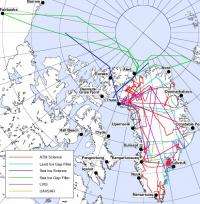
Researchers led by William Krabill of NASA's Wallops Flight Facility in Wallops Island, Va., embark this week on a month-long airborne campaign to measure ice sheet and glacier thickness. They are using NASA's P-3B aircraft -- designed for heavy lifting and low-altitude flying -- outfitted with an array of science instruments. The plane is scheduled to transit March 30 from Virginia to Thule Air Base, Greenland. Weather permitting, the P-3B will make near-daily 8-hour flights over Greenland while pointing laser and radar instruments at targets until the mission's end on May 7.
Nearly every spring since 1991 Krabill has flown NASA research planes about 2,000 feet over Greenland to collect measurements of ice thickness. Now, as Krabill and colleagues return to update their measurements, their mission has become more extensive and more urgent because of global interest in the Arctic and the aging of a key ice-observing NASA satellite.
Measurements recorded by the radars and lasers will be compared and calibrated with measurements from the Ice, Cloud and land Elevation Satellite (ICESat), which makes regular, large-scale surface elevation measurements of polar ice sheets. Launched in January 2003, ICESat is already three years beyond its primary mission lifetime, so NASA scientists and engineers are making plans to bridge the anticipated gap until the launch of ICESat-II several years from now.
"It's research like this on sea ice and the Greenland ice sheet that we use to understand how the polar regions are connected to global climate change and discover what changes are going on in atmospheric and ocean circulations," said Tom Wagner, cryosphere program manager at NASA Headquarters in Washington, D.C.
Krabill pioneered observing techniques that have created a continuous record of ice sheet changes. He first came to Wallops as a summer student in 1967, and eventually worked with a group of engineers on early radar and laser systems and on research uses for the Global Positioning System (GPS). Krabill is credited with being the first to combine the two technologies and put them on an airplane to measure changes in ice thickness.
"I realized the capability of the instruments and saw a research need we could fulfill," Krabill said.
So far, flights led by Krabill have found evidence that, in general, ice along Greenland's coast is thinning while some areas inland are thickening. Still, the net change points to an overall loss. There's enough ice and snow in Greenland to raise sea level by about 7 meters (23 feet) if it were to all melt.
To determine long-term trends in the ice, scientists need sustained, highly accurate and well-calibrated measurements of thickness. Past and present observations combined with climate models are critical to understanding the future behavior of the Greenland ice sheet.
To achieve the thickness measurements, researchers use a combination of laser and radar instruments. Laser light from the Airborne Topographic Mapper is pulsed in circular scans on the ground, which reflect back to the aircraft and are converted into elevation maps of the ice surface. Meanwhile, the Pathfinder Airborne Radar Ice Sounder instrument, to be flown by researchers from the Johns Hopkins University Applied Physics Laboratory, emits radio signals that penetrate and "see" all the way through the ice, measuring the elevation of the land surface below. By combining elevation data for the top and base of the ice, and taking into account the aircraft's position using precise Global Positioning System (GPS) data, researchers can determine ice thickness at any given location.
A similar technique will be used to measure the thickness of a different target -- sea ice floating around Greenland and across the Arctic Ocean during a flight to Fairbanks, Alaska. Combining elevation data for the top of sea ice with sea level, researchers can use the known density difference between the sea and ice to estimate sea ice thickness.
"The big fear is that a lot of the multiyear ice is gone," Wagner said. "We hear stories about sea ice growing back. Well, it has grown back every winter, but it's really thin and may not last during the summer."
Krabill and colleagues will be joined on the flights by researchers from the University of Kansas, who are flying a "snow radar" that measures how snow builds up over time on ice, how that layer becomes compacted, and how it is changing.
The P-3B will fly routes that take it directly under the path of ICESat, allowing the satellite and plane to measure the same features. Each has its benefits: the satellite provides regular, continental-scale coverage of Greenland and hard-to-reach regions like Antarctica, while the aircraft can make more detailed surveys of areas where scientists expect to see rapid change.
"We need to do both because they both work together," Wagner said. Comparing the data collected simultaneously by aircraft and satellite also will help researchers use future aircraft flights to bridge the anticipated gap in satellite coverage should the ICESat mission end before ICESat-II is launched.
Source: NASA/Goddard Space Flight Center


