Humanoid robot helps scientists to understand intelligence
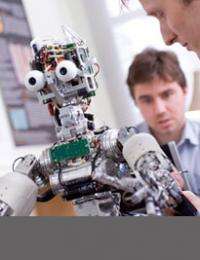
(PhysOrg.com) -- A humanoid robot newly acquired by Imperial College London will lead to a deeper understanding of human intelligence, says scientists today.
The College’s Departments of Computing and Electrical and Electronic Engineering believe that iCub, about the size of a three year old child, will further their research into cognition, the process of knowing that includes awareness, perception, reasoning and judgement.
Researchers want to learn more about how humans use cognition to interact with their world. They believe iCub’s human-like body will help them to understand how this is done.
iCub has mechanical joints that enable it to move its head, arms, fingers, eyes and legs similarly to the way that humans do. Professor Murray Shanahan, of the Department of Computing, says this is important because cognition is very much tied up with the way we interact with the world.
“Nature developed cognition for us in order to make us better at interacting with the physical and social world,” he explains. “If we want to understand the nature of cognition better then we really need to understand it in the context of something that moves or interacts with objects. That is where iCub can help us.”
The team will test their theories about cognition by creating a computer simulation of a brain, which will replicate how neurons in real brains communicate through short bursts of electrical energy. In people, this process helps us to interact with the physical world. For instance, the electrical signals sent by neurons control muscles that enable people to lift a cup to the mouth to sip on a drink.
The team will link the computer simulation of a brain to iCub so that it can process information about its environment and send bursts of electrical energy to its motors to allow it to move its arms, head, eyes and fingers to carry out very simple tasks such as lifting a ball and moving it from one place to another.
If the researchers are successful, they will have made an important step in reproducing the way that humans use cognition to interact in their world. Professor Shanahan says:
Provided by “I’m really interested in the fundamental scientific questions about ourselves and about the nature of our own brains and how they allow us to do the kinds of things that we do each day. If we can test our theories about cognition by building and experimenting with robots, then we may just be one step closer to really beginning to understand what makes us tick.”
In the long term, they believe their research could help develop a new generation of intelligent factory robots that have much more versatility and do a wider variety of jobs.
Scientists are also interested in the part of cognition that allows humans to work with one another to carry out tasks.
They will develop computer programs that will allow iCub to interact with a human so that they can carry out a task together, such as building a Lego castle from scratch.
If they succeed, they will have demonstrated the cognitive processes that enable social interaction between humans, and have created a viable way for robots to interact with humans to help them to do things. Dr Yiannis Demiris, of the Department of Electrical and Electronic Engineering, adds:
“We are really interested in making robots more empathetic to our needs. Imagine owning a robot like iCub who could be intelligent enough to understand that you are struggling to lift a heavy box and it helps you to carry it or imagine getting it to help you put up a shelf or do the housework because it recognises that you are ill. The work that we are doing could one day make this a reality.”
Imperial received iCub in December 2008 as part of an ongoing project funded by the European Commission. Researchers expect to get their first results from their experiments in the next three to five years.
Provided by Imperial College London


