Researchers develop better training for keyhole surgery
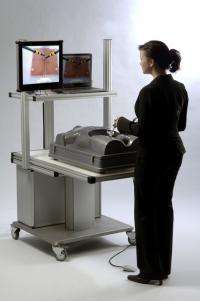
Researcher Sanne Botden has improved the training methods for surgeons who perform keyhole operations. At present, a relatively large number of errors are made during surgery of this kind. She defends her doctoral dissertation at Delft University of Technology in The Netherlands on Wednesday, 1 April.
Keyhole surgery (laparoscopy) has rapidly become a popular technique in hospitals but it requires very different skills to ‘traditional surgery’. In 2007, the Dutch Health Inspectorate reported that hospitals are too quick to use keyhole surgery. Too many surgeons underestimate the risks and complications. Most of these complications are the result of a lack of training.
In order to improve the training, a variety of simulators are available. These include ‘box trainers’ and Virtual Reality (VR) or Augmented Reality (AR) simulators. Box trainers provide realistic ‘haptic feedback’ (the sensation and resistance of actual tissue) but do not provide an objective assessment of skills. VR simulators do give an objective assessment but lack the realistic haptic feedback.
Augmented Reality is a new form of simulation, in which physical realism is combined with VR. Realistic haptic feedback is provided by the fact that the surgeon practises using real materials and instruments, and objective assessment is also possible because the position of the instruments can be determined.
Augmented reality
Researcher and doctor Sanne Botden works at the Department of Surgery of the Catharina Hospital in Eindhoven. In this training hospital various simulators are used for training in the skills lab. Botden compared the performance of the various simulators with regard to surgical stitching. The fact that AR simulators provide realistic haptic feedback was seen as an essential aspect by both experienced and inexperienced laparoscopists. The algorithm used in VR stitching modules is unrealistic, in that the virtual needle and thread behave very differently to their real-life counterparts. In the AR simulators this problem has been addressed by having the users train with real tissue, stitching materials and instruments.
‘Another important aspect is providing feedback on skills. The objective assessment given by a large number of simulators is based on time, path length and economy of movement. But these criteria do not allow you to pinpoint the aspects in need of improvement. That’s why we went in search of an assessment method which tells us exactly where the problems lie during training,’ explains Botden.
‘In order to develop this method, we made a number of adjustments to an existing stitching module on the ProMIS AR simulator. This involved providing on-screen instructions for tying a correct surgical knot and providing an assessment of the exercise afterwards. The assessment was calculated on two parameters: ‘time spent in the right area’ and ‘quality of the knot’. The right area was represented visually by a cage on the screen. This taught the trainee surgeons to stitch within a confined area.
The new method (including the assessment) was a success. After only eight practice sessions, 18 inexperienced participants were able to tie a satisfactory surgical knot while remaining within the confined area.
Further improvement needed
In her research, Sanne Botden also developed a model of the upper abdomen for eventual implementation in an AR simulator. The aim of this is to replace the animal-based models still used in many training programmes.
Botden explains ‘The training for keyhole surgery has improved greatly since the Health Inspectorate’s critical report, but I believe that further improvements are needed. At present the training is still organised at a regional level, whereas it would be far more efficient to organise it centrally.’
‘In addition, there is no final learning objective which a surgeon has to achieve before being allowed to operate on a patient. That’s something we need to introduce, especially since a range of objective assessment methods have now been developed for this area. Another point we need to focus on is which simulators are used for which purpose. For example, it’s important not to use a VR simulator for stitching training.’
Provided by Delft University of Technology


