Researchers help save rare venomous mammal from extinction
March 31, 2009 Researchers help save rare venomous mammal from extinction

Enlarge

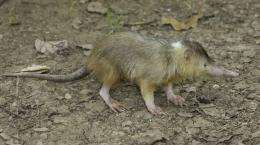
Hispaniolan solenodon (Image by Gregory Guida)

Scientists at the University of Bath are working with the Durrell Wildlife Conservation Trust to study an endangered large shrew-like mammal that kills its prey with a venomous bite.

The Biodiversity Lab research group of the University’s Department of Biology & Biochemistry will be a playing a key role in the new project that aims to help conserve two types of endemic land in the Dominican Republic.

The Hispaniolan solenodon and the Hispaniolan hutia are two of the few surviving land mammals in the Caribbean Islands, and both are endangered with extinction through habitat loss and introduced mammals.

As a member of a distinct lineage which diverged from all other mammal groups almost 80 million years ago, the Hispaniolan solenodon represents a significant amount of unique evolutionary history and is one of the very few venomous mammals. However, little is known of the basic ecology of both , or the effectiveness of existing measures in meeting their requirements.

The project led by Dr Richard Young of the Durrell Wildlife Conservation Trust, a collaborator of the Biodiversity Lab, recently received funding from Defra’s UK Darwin Initiative and will conduct research to investigate the species’ population status, habitat requirements and human-driven threats.

Dr Mark O’Connell of the University’s Department of Biology & Biochemistry will act as a consultant on the project, providing valuable technical support on Geographical Information Systems, and species distribution modelling to map threats and identify key conservation zones for the species at a national scale.

He said: “The project is of global conservation significance. It is an excellent example of how an academic and practitioner partner can work effectively together to generate much-needed knowledge to guide the conservation of threatened species.”

The project will work with the Dominican Republic government and other stakeholders to develop scientifically sound Species Action Plans, and a monitoring programme, to provide a framework for delivering conservation activities and for evaluating their outcomes.

A programme of intensive training with host country project staff in research and conservation planning will ensure skills are left behind to continue the project over the longer term.

Provided by University of Bath


print this article email this article download pdf blog this article bookmark this article     Stumble it Digg this share on Facebook retweet share on Reddit add to delicious
Rate this story - 4.1 /5 (7 votes)


March 31, 2009 all stories

Comments: 0

4.1 /5 (7 votes)
  • Stumble this up

  • Digg this

  • share this

  • hide
  • Related Stories

  • Global map shows new patterns of extinction risk
    created Nov 01, 2006 | popularity not rated yet | comments 0
  • Size matters: preventing large mammal extinction
    created Jul 21, 2005 | popularity not rated yet | comments 0
  • Newly discovered monkey is threatened with extinction
    created Jul 28, 2008 | popularity not rated yet | comments 0
  • Study: Wildlife trade figures unreliable
    created Nov 04, 2005 | popularity not rated yet | comments 0
  • New golden frog discovered in remote region of Colombia
    created Aug 28, 2007 | popularity not rated yet | comments 0


  • hide
  • Relevant PhysicsForums posts

Other News

Studies show marine reserves can be an effective tool for managing fisheries

Biology / Ecology

created 22 minutes ago | popularity not rated yet | comments 0

Studies conducted in California and elsewhere provide support for the use of marine reserves as a tool for managing fisheries and protecting marine habitats, according to biologists at the University of California, Santa ...


Book by UC Riverside biologist explains Darwin's 'Origin of Species'

Book by UC Riverside biologist explains Darwin's 'Origin of Species'

Biology / Evolution

created 26 minutes ago | popularity not rated yet | comments 0

Many people have tried to read Charles Darwin's "Origin of Species," whose publication celebrates its 150th anniversary this month, but gave up.


Study shows that some malignant tumors can be shut down after all

Biology / Cell & Microbiology

created 1hour ago | popularity 5 / 5 (1) | comments 0

Oncologists have had their hands tied because more than half of all human cancers have mutations that disable a protein called p53. As a critical anti-cancer watchdog, p53 masterminds several cancer-fighting operations within ...


What is the meaning of 'one'? Evolutionary biologists argue for new meaning of 'organismality'

Biology / Evolution

created 2 hours ago | popularity 5 / 5 (1) | comments 1

Rice University evolutionary biologists David Queller and Joan Strassmann argue in a new paper that high cooperation and low conflict between components, from the genetic level on up, give a living thing its "organismality," ...


Researchers show how to divide and conquer 'social network' of cells

Researchers show how to divide and conquer 'social network' of cells

Biology / Biotechnology

created 3 hours ago | popularity not rated yet | comments 0

On Noah's Ark animals came in twos: male and female. In human bodies trillions of cells are coupled, too, and so are the molecules from which they are composed. Yet these don't come in twos, they are regrouped ...