Long-necked dinos didn't reach for the skies
March 31, 2009
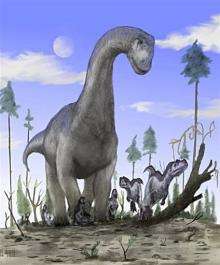
A handout image obtained from the University of Portsmouth in 2008 shows an artist's impression of a sauropod. A fondly-held belief about long-necked sauropods, the giant four-footed dinosaurs beloved of monster movies and children, is most probably untrue, a dino expert said on Wednesday.
A fondly-held belief about long-necked sauropods, the giant four-footed dinosaurs beloved of monster movies and children, is most probably untrue, a dino expert said on Wednesday.
At the zenith of the dinosaurs' reign, some sauropods evolved necks of extraordinary length -- more than nine metres (29.25 feet) in the case of the Mamenchisaurus, a titan of the Late Jurassic period around 150 million years ago.
Prevailing wisdom has it that these leviathans used their necks like giraffes today. They reached up high into the trees, munching leisurely on forest canopy that was out of reach for rival herbivores.
Not so, says a paper appearing in Biology Letters, a journal published by Britain's prestigious Royal Society.
It argues that giant sauropods most probably preferred to feed horizontally, rather than vertically, on the grounds of energy cost.
Australian evolutionary biologist Roger Seymour did a simulation of how much blood pressure a gigantic sauropod would need in order to place its head vertically.
He then calculated how much energy the creature would require in order to pump around blood at this high pressure.
"It would have required the animal to expend approximately half of its energy intake just to circulate the blood," says Seymour.
"A vertical neck would have required a high systemic arterial blood pressure. It is therefore energetically more feasible to have used a more or less horizontal neck to enable wide browsing while keeping blood pressure low."
Other dino specialists have likewise argued that long-necked sauropods were unlikely to have had a heart that was big enough to enable it to feed vertically for much of the time.
The Barosaurus -- whose neck put it in the same category of length as the Mamenchisaurus -- would have needed a heart weighing five percent of its bodyweight to pump blood to neck muscles and brain for craning upwards, according to a 2000 study.
(c) 2009 AFP
-
How a pain in the neck could be bad for your blood pressure
Aug 02, 2007 |
not rated yet |
0
-
Skull study sheds light on dinosaur diversity
Sep 15, 2005 |
not rated yet |
0
-
Only second Jurassic dinosaur ever found in Antarctica
Dec 10, 2007 |
not rated yet |
0
-
Winning by a neck -- Giraffes avoid competing with shorter browsers
Dec 22, 2006 |
not rated yet |
0
-
Aussie museum displays huge dinosaur bones
Jul 20, 2005 |
not rated yet |
0
-
Engineers build first sub-10-nm carbon nanotube transistor
Feb 01, 2012 |
4.9 / 5 (33) |
30
-
Something old, something new: Evolution and the structural divergence of duplicate genes
Jan 31, 2012 |
4.6 / 5 (7) |
1
-
The hidden nanoworld of ice crystals: Revealing the dynamic behavior of quasi-liquid layers
Jan 30, 2012 |
5 / 5 (4) |
1
-
Stock market network reveals investor clustering
Jan 27, 2012 |
3.9 / 5 (23) |
8
-
Of microchemistry and molecules: Electronic microfluidic device synthesizes biocompatible probes
Jan 26, 2012 |
5 / 5 (2) |
0
-
Factors affecting beet root cell membrane
9 hours ago
-
Stem cell question.
Feb 10, 2012
-
Protease cleavage
Feb 10, 2012
-
Pertubance in a model
Feb 10, 2012
-
Cancer drugs and Alzheimer's, Oh my!
Feb 09, 2012
-
Squishing cells
Feb 09, 2012
- More from Physics Forums - Biology
More news stories
A mitosis mystery solved: How chromosomes align perfectly in a dividing cell
Although the process of mitotic cell division has been studied intensely for more than 50 years, Whitehead Institute researchers have only now solved the mystery of how cells correctly align their chromosomes during symmetric ...
5 hours ago |
5 / 5 (6) |
0
|
Researchers find extensive RNA editing in human transcriptome
In a new study published online in Nature Biotechnology, researchers from BGI, the world's largest genomics organization, reported the evidence of extensive RNA editing in a human cell line by analysis of RNA-seq data, demons ...
5 hours ago |
5 / 5 (4) |
0
|
The proteins ensuring genome protection
Researchers from the University of Geneva (UNIGE), Switzerland, have discovered the crucial role of two proteins in developing a cell 'anti-enzyme shield'. This protection system, which operates at the level of molecular ...
5 hours ago |
5 / 5 (3) |
0
|
Entire genome of extinct human decoded from fossil
(PhysOrg.com) -- In 2010, Svante Pääbo and his colleagues presented a draft version of the genome from a small fragment of a human finger bone discovered in Denisova Cave in southern Siberia. The ...
Feb 07, 2012 |
4.7 / 5 (59) |
48
|
Why are there so few fish in the Earth's oceans?
(PhysOrg.com) -- A Stony Brook University researcher has found that, contrary to popular belief, there are not plenty of fish in the sea.
Feb 08, 2012 |
4.2 / 5 (18) |
27
|
Scientists discover molecular secrets of 2,000-year-old Chinese herbal remedy
For roughly two thousand years, Chinese herbalists have treated Malaria using a root extract, commonly known as Chang Shan, from a type of hydrangea that grows in Tibet and Nepal. More recent studies suggest that halofuginone, ...
Overeating may double risk of memory loss
New research suggests that consuming between 2,100 and 6,000 calories per day may double the risk of memory loss, or mild cognitive impairment (MCI), among people age 70 and older. The study was released today and will be ...
New method to examine batteries -- MRI from the inside
There is an ever-increasing need for advanced batteries for portable electronics, such as phones, cameras, and music players, but also to power electric vehicles and to facilitate the distribution and storage of energy derived ...
Lab study raises questions over nano-particle impact
Tests involving chickens have raised questions about the impact on health from engineered nano-particles, the ultra-fine grains commonly used in drugs and processed foods, scientists said on Sunday.
Starve a virus, feed a cure? Findings show how some cells protect themselves against HIV
A protein that protects some of our immune cells from the most common and virulent form of HIV works by starving the virus of the molecular building blocks that it needs to replicate, according to research published online ...
Google might launch Drive for cloud storage soon
(PhysOrg.com) -- Google's next big move, according to the Wall Street Journal, is a cloud storage service called Drive. Hardly first to the plate, Google is simply catching up to introducing its cloud reposi ...
Mar 31, 2009
Rank: 5 / 5 (5)
I remember somewhat non-fondly being in basic training, and as part of being 'cranked' (forced exercise), to carry my demilitarized 11 pound rifle above my head for extended periods, while running in place. As awful as this was (although granting that I got in to the best shape I've ever been in my life in a miraculously short period of time), it was a vast improvement on the even worse punishment: holding my rifle in front of me, with arms at full extension, while running in place.
I'm curious to know, based on the skeletal structures of the long-necked dinos, and how their muscles attached to the skeleton, which position would require more energy for the dinos.
-Mike
Mar 31, 2009
Rank: 3.7 / 5 (3)
Best evidence is that tendons would have carried the weight like cables holding the weight of neck counter-balanced against the weight of the tail.
DVB
Apr 01, 2009
Rank: 5 / 5 (4)
It would be easier to support a floating neck but still be able to reach the bottom of the lake.
Apr 01, 2009
Rank: 4.2 / 5 (6)
Apr 01, 2009
Rank: 4 / 5 (8)
Apr 01, 2009
Rank: 1 / 5 (1)
Apr 01, 2009
Rank: 4.5 / 5 (2)
Apr 01, 2009
Rank: 2.3 / 5 (3)
Maybe the idea was to frustrate those predators' targetting of the neck area - by evolving the height of the neck above the level which most predators can reach. Having done that however, there remains a problem with feeding. In order to reach the ground for ground-based vegetation and for drinking you're going to need a long neck (or develop a substitute neck like the elephant's trunk). The neck need never be lifted much above shoulder height.
Apr 01, 2009
Rank: 5 / 5 (2)
Apr 01, 2009
Rank: 5 / 5 (4)
Apr 01, 2009
Rank: 2.3 / 5 (7)
Yarking Dawg is correct about the amount of energy for a horizontal neck, and DozerIAm is not.
Arikin- the idea that the sauropods were swamp beasts arises from an early and incorrect belief that they were too heavy to support their weight on dry land.
Docknowlege's "reach and snatch" maneuver would cause a case of orthostatic hypotension that would leave the animal's brain without oxygen at the most crucial moment - in mid snatch. While whipping it's head up into a tree to eat some leaves it's liable to miss the food and poke its eye out on a tree branch.
The long neck is all about obtaining large amounts of food without needing to move the body much. The linear feet swept out by the head and neck is proportional to the length of the neck - assuming the neck only bends where it meets the body. If we model a neck as being able to curve, the reachable area will be some power of the neck length l, i.e. l^x, with x being somewhere between 1 and 2. A neck twice as long means two to four times as much food within easy reach.
Apr 01, 2009
Rank: 3.3 / 5 (3)
Apr 01, 2009
Rank: 4.3 / 5 (4)
Empirical evidence abounds however for the concept that creatures use their anatomic structure efficiently for the most part. There is no reason to believe in a black and white scenario of horizontal or vertical feeding...
Apr 01, 2009
Rank: 3.7 / 5 (3)
Apr 02, 2009
Rank: 5 / 5 (3)
Apr 02, 2009
Rank: 4 / 5 (2)
Yes, unless you weigh multiple tons. Then it seems like a good way to conserve energy.
Apr 03, 2009
Rank: 4.5 / 5 (2)
So I'm guessing that the long neck was already in place by the time the sauropod became big. Energy conservation might then come into play and be reponsible for the final extension to the very long neck you see in the giant sauropods.
Apr 03, 2009
Rank: 4.7 / 5 (3)
Well, either the neck came first or the size came first. Very often a feature (not a bug!) evolves to solve one problem, and then gets repurposed for another problem down the road.
http://en.wikiped...aptation
Apr 04, 2009
Rank: 3.7 / 5 (3)
Apr 05, 2009
Rank: 1 / 5 (1)
And craning the neck horizontally, looking for the Smarties that were dropped on the floor!
Apr 06, 2009
Rank: not rated yet
Apr 06, 2009
Rank: not rated yet