Researchers discover new fat-fighting pathway
April 1, 2009 Researchers discover new fat-fighting pathway

Enlarge

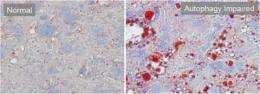
The inability to activate autophagy (right) results in massive accumulation of fat (shown here in red) in the liver. Nuclei of hepatocytes are stained in blue. Credit: Albert Einstein College of Medicine

Researchers at Albert Einstein College of Medicine of Yeshiva University have discovered a process that controls the amount of fat that cells store for use as a back-up energy source. Disruption of this process allows cellular fat to accumulate — a key factor in age-related metabolic diseases such as obesity and type 2 diabetes. The study is published today in the online version of Nature.

Discovery of this previously unknown fat-fighting pathway could lead to novel drugs for the treatment of metabolic syndrome (characterized by obesity, disorders, and ) and for a common known as "fatty liver" or steatohepatitis. Nonalcoholic steatohepatitis (NASH) is a common, often "silent" liver disease. Although NASH resembles alcoholic liver disease, it occurs in people who drink little or no alcohol. NASH affects 2 to 5 percent of Americans, according to the National Institute of Diabetes and Digestive and Kidney Diseases.

All cells store lipids, a type of fat, in the form of small droplets that can be broken down for energy when needed. In situations of excessive food intake or in certain diseases such as diabetes or obesity, these lipid droplets become so large that they interfere with normal cell function.

"In this study, we found that the amount of fat stored in these intracellular lipid droplets is controlled through autophagy, a process until now thought to help primarily in digesting and recycling damaged cellular structures," says Mark Czaja, M.D., professor of medicine at Einstein whose team worked collaboratively on the research with the laboratory of Ana Maria Cuervo, M.D., Ph.D., associate professor of developmental & molecular biology, medicine, and anatomy & structural biology at Einstein.

Autophagy, or "self-eating," is carried out by lysosomes, which function as the cell's recycling center. In studies of liver cells in culture and in live animals, Dr. Czaja and his colleagues discovered that lysosomes do something never before observed: continuously remove portions of lipid droplets and process them for energy production.

"When food is scarce, autophagy becomes a main source of energy for the cells and this process of digesting lipid droplets is accelerated," says Dr. Cuervo. "If autophagy slows down, as occurs in aging, the lipid droplets stored in cells keep growing and eventually become so big that they can no longer be degraded."

This slowdown in fat control appears to trigger a vicious cycle in which the enlarging fat droplets impair autophagy, allowing even more fat to accumulate, and so on, which could eventually contribute to diseases such as diabetes. The researchers noted that therapies aimed at helping autophagy operate more efficiently might prevent disease by keeping fat droplets under control.

Drs. Cuervo and Czaja's paper, "Autophagy regulates lipid metabolism" is published in the April 1 online version of Nature. Their co-authors at Einstein include Rajat Singh and Susmita Kaushik (primary co-authors), Yongjun Wang, Youqing Xiang, and Inna Novak; as well as Masaaki Komatsu and Keiji Tanaka of the Tokyo Metropolitan Institute of Medical Science, Bunkyo-ku, Tokyo, Japan.

Source: Albert Einstein College of Medicine


print this article email this article download pdf blog this article bookmark this article     Stumble it Digg this share on Facebook retweet share on Reddit add to delicious
Rate this story - not rated yet


April 1, 2009 all stories

Comments: 0

not rated yet
  • Stumble this up

  • Digg this

  • share this

  • hide
  • Related Stories

  • Fundamental discovery reveals how fat is stored in cells
    created Dec 17, 2007 | popularity not rated yet | comments 0
  • Einstein researchers discover important clue to the cause of Parkinson's disease
    created Jan 02, 2008 | popularity not rated yet | comments 0
  • COPI complex is a regulator of lipid homeostasis
    created Nov 25, 2008 | popularity not rated yet | comments 0
  • Gladstone scientists reveal the genetics of fat storage in cells
    created May 21, 2008 | popularity not rated yet | comments 0
  • New study shows belly fat may affect liver function
    created Jun 10, 2008 | popularity not rated yet | comments 0


  • hide
  • Relevant PhysicsForums posts

  • nesfatin
    created Nov 22, 2009
  • Obsessive Compulsive Disorder
    created Nov 20, 2009
  • West's zone 2 starling resistor respiratory physiology
    created Nov 18, 2009
  • 50-0-50 rule
    created Nov 18, 2009
  • More from Physics Forums - Medical Sciences

Other News

Measured -- The time it takes us to find the words we need

Medicine & Health / Psychology & Psychiatry

created 5 hours ago | popularity 3.3 / 5 (3) | comments 0

(PhysOrg.com) -- The time it takes for our brains to search for and retrieve the word we want to say has been measured for the first time. The discovery is reported in a paper published in the Proceedings of the National Ac ...


Multitasking may be Achilles heel for hepatitis C

Medicine & Health / Research

created 2 hours ago | popularity 5 / 5 (1) | comments 0

(PhysOrg.com) -- Hepatitis C, a formidable virus that affects 130 million people worldwide, is nursing some pretty impressive bruises. By knocking out sections and subsections of one of its proteins, scientists reveal weak ...


Multiple health concerns surface as winter, vitamin D deficiences arrive

Medicine & Health / Health

created 7 hours ago | popularity 5 / 5 (2) | comments 2

A string of recent discoveries about the multiple health benefits of vitamin D has renewed interest in this multi-purpose nutrient, increased awareness of the huge numbers of people who are deficient in it, spurred research ...


Gene therapy improves vision

Gene therapy improves vision

Medicine & Health / Research

created 3 hours ago | popularity 5 / 5 (1) | comments 0

German scientist Paul Ehrlich found what he coined the "magic bullet" in the early 20th century upon developing the world’s first effective treatment of syphilis.


Tissue tension regulates tumor progression

Medicine & Health / Cancer

created 3 hours ago | popularity not rated yet | comments 0

(PhysOrg.com) -- UCSF scientists have shown for the first time that the rigidity of a tissue can induce cancer. The research team identified an enzyme that is crucial for regulating tissue stiffness and demonstrated that ...