Hubble Finds Hidden Exoplanet in Archival Data
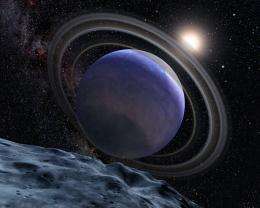
(PhysOrg.com) -- A powerful, newly refined image-processing technique may allow astronomers to discover extrasolar planets that are possibly lurking in over a decade's worth of Hubble Space Telescope archival data.
David Lafreniere of the University of Toronto, Ontario, Canada, has successfully demonstrated this new strategy for planet hunting by identifying an exoplanet that went undetected in Hubble images taken in 1998 with its Near Infrared Camera and Multi-Object Spectrometer (NICMOS). In addition to illustrating the power of new data-processing techniques, this finding underscores the value of the Hubble data archive, on which those new techniques can be used.
The planet, estimated to be at least seven times Jupiter's mass, was originally discovered in images taken with the Keck and Gemini North telescopes in 2007 and 2008. It is the outermost of three massive planets known to orbit the dusty young star HR 8799, which is 130 light-years away. NICMOS could not see the other two planets because its coronagraphic spot — a device which blots out the glare of the star — also interferes with observing the two inner planets.
"We've shown that NICMOS is more powerful than previously thought for imaging planets," says Lafreniere. "Our new image-processing technique efficiently subtracts the glare from a star that spills over the coronagraph's edge, allowing us to see planets that are one-tenth the brightness of what could be detected before with Hubble." Lafreniere adapted an image reconstruction technique that was first developed for ground-based observatories.
Using the new technique, he recovered the planet in NICMOS observations taken 10 years before the Keck/Gemini discovery. The Hubble picture not only provides important confirmation of the planet's existence, it provides a longer baseline for demonstrating that the object is in an orbit about the star. "To get a good determination of the orbit we have to wait a very long time because the planet is moving so slowly (it has a 400-year period)," says Lafreniere. "The 10-year-old Hubble data take us that much closer to having a precise measure of the orbit."
NICMOS's view provided new insights into the physical characteristics of the planet, too. This was possible because NICMOS works at near-infrared wavelengths that are severely blocked by Earth's atmosphere due to absorption by water vapor.
"The planet seems to be only partially cloud covered and we could be detecting the absorption of water vapor in the atmosphere," says Travis Barman of Lowell Observatory, Flagstaff, Ariz. "The infrared light measured from the Hubble data is consistent with a spectrum showing a broad water absorption feature (at 1.4-1.49 microns), but the level of absorption seen is lower than it would be if the photosphere were completely devoid of dust. Dust clouds can smooth out many of the spectral features that would otherwise be there—including water absorption bands," Barman says. "Measuring the water absorption properties will tell us a great deal about the temperatures and pressures in the atmospheres, in addition to the cloud coverage. If we can accurately measure the water absorption features for the outermost planet around HR 8799, we will learn a great deal about their atmospheric properties. Hubble, situated well above the Earth's atmosphere, is excellently located for such a study."
"During the past 10 years Hubble has been used to look at over 200 stars with coronagraphy, looking for planets and disks. We plan to go back and look at all of those archived images and see if anything can be detected that has gone undetected until now," says Christian Marois of the Herzberg Institute of Astrophysics, Victoria, Canada. "We'll need a baseline of a few years for most objects to detect Keplerian motion and hence confirm their status as planets. The hardest part is to find them in the first place."
If his team sees a companion object to a star in more than one NICMOS picture, and it appears to have moved along an orbit, follow-up observations will be made with ground-based telescopes. If they see something once but its brightness and separation from the star would be reasonable for a planet, they will also do follow-up observations with ground-based telescopes.
Taking the image of an exoplanet is not an easy task. Planets can be billions of times fainter than the star around which they orbit and are typically located at separations smaller than 1/2000th the angular size of the full moon from their star. The planet recovered in the NICMOS data is about 100,000 times fainter than the star when viewed in the near-infrared.
"Even when using the best telescopes available, with the best resolution, the light from the bright star spills out in the area where the much fainter planets are located, making them impossible to see. It is essential to subtract out this bright glare of stellar light from the image to see faint dots, i.e., planets, that could be hidden underneath," says Rene Doyon of the University of Montreal.
The stability of how light is scattered in the NICMOS camera, called the point spread function (PSF), is key for using Hubble images to recover planets. This technique works by taking images of different stars and combining them to create a PSF of a star that closely resembles the star that is being studied for planets. This requires a reasonably steady PSF because images of different stars are taken on different days. Atmospheric conditions would vary from day-to-day for ground-based telescopes, but not for a space telescope that enjoys unprecedented image stability over repeated visits to a target.
Provided by Space Telescope Science Institute


