World's largest laser completed
April 1, 2009 World's largest laser completed

Enlarge

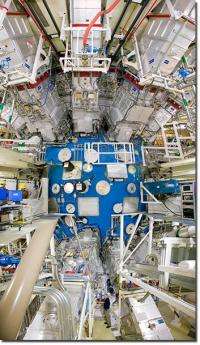
Composite photo shows all three floors containing the 264,000-pound, 10-meter diameter target chamber. Diagnostic instruments will be attached to the round hatches. Photo montage by Jacqueline McBride

(PhysOrg.com) -- The Department of Energy today announced that the National Nuclear Security Administration (NNSA) has certified the completion of the historic effort to build the world's largest laser.

Housed at the Department of Energy's Lawrence Livermore National Laboratory, the National Ignition Facility (NIF) is expected to allow scientists to achieve fusion ignition in the laboratory, obtaining more from the target than is provided by the .

The completion of NIF opens the door to scientific advancement and discovery that promises to enhance our national security, could help break America's dependence on foreign oil, and will lead to new breakthroughs in the worlds of astrophysics, materials science and many other scientific disciplines.

"Completion of the National Ignition Facility is a true milestone that will make America safer and more energy independent by opening new avenues of scientific advancement and discovery," said NNSA Administrator Thomas D'Agostino.

"NIF will be a cornerstone of a critical national security mission, ensuring the continuing reliability of the U.S. nuclear stockpile without underground nuclear testing, while also providing a path to explore the frontiers of basic science, and potential technologies for energy independence," he said.
World's largest laser completed
Enlarge

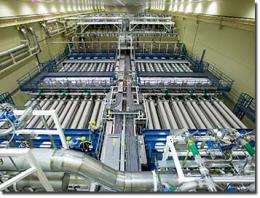
Laser Bay 2, one of NIF's two laser bays, was commissioned on July 31, 2007. Each laser bay is approximately 400 feet long.

NIF is a critical part of NNSA's mission of maintaining the safety and reliability of our nuclear deterrent without conducting nuclear testing. The United States has not deployed a new nuclear weapon in over 20 years, nor conducted an underground nuclear test since 1992.

Instead, scientists at the NNSA maintain the warheads in the stockpile well beyond their original life by using sophisticated supercomputers and facilities that test the safety, security and reliability of U.S. weapons in NNSA laboratories.

With NIF, scientists will be able to evaluate key scientific assumptions in current computer models, obtain previously unavailable data on how materials behave at temperatures and pressures like those in the center of a star, and help validate NNSA's supercomputer simulations by comparing code predictions against observations from laboratory experiments.

Because of its groundbreaking advance in technology, NIF also has the potential to produce breakthroughs in fields beyond national security. It may help advance fusion energy technology, which could be an element of making the United States energy independent. It could also help scientists better understand the makeup of stars It could also help scientists better understand the makeup of stars and giant planets both within and outside our solar system.

The stadium-sized NIF is capable of focusing all of its 192 individual beams, each about 40 centimeters square, into a spot about one-half millimeter in diameter at the center of its 10 meter diameter target chamber. NIF has the ability to deliver large amounts of energy with extreme precision in billionths of a second.

NIF has already produced historic scientific advances. Earlier this month, NIF became the first fusion laser in the world to break the megajoule barrier (a megajoule is the energy consumed by 10,000 100-watt light bulbs in one second) by delivering 1.1 million joules of ultraviolet energy to the center of its target chamber - more than 25 times more energy than the previous record-holder.

Provided by Lawrence Livermore National Laboratory


print this article email this article download pdf blog this article bookmark this article     Stumble it Digg this share on Facebook retweet share on Reddit add to delicious
Rate this story - 3.9 /5 (10 votes)

Rank Filter

Move the slider to adjust rank threshold, so that you can hide some of the comments.


Display comments: newest first

  • Mercury_01 - Apr 01, 2009
    • Rank: 3.8 / 5 (4)
    Awesome, Cause Ive got a cataract that's really buggin' the hell out of me. When can I make an appointment?
  • el_gramador - Apr 02, 2009
    • Rank: 3.3 / 5 (3)
    Hmm. Let me see. Let me see.... Does Tuesday work for you? Though I must warn you that there are dangers involved in this method. Dangers include: Death, hole in your skull, boiled eyeballs, etc.
  • Bonkers - Apr 02, 2009
    • Rank: 3.5 / 5 (2)
    Is it just me, or do you dread the folksy explanations (10,000 100Watt bulbs for 1 second)

    - megajoules, pah, this beast has hardly enough energy to boil 2 kettles... Granted its a bit faster though.
  • QubitTamer - Apr 02, 2009
    • Rank: 2.3 / 5 (3)
    To think the recent breakthroughs in cold fusion will render this all useless...

    snicker...
  • moj85 - Apr 02, 2009
    • Rank: 3.5 / 5 (2)
    but imagine being able to boil 2 kettles in 1/800th of a second! Now thats TEA.
  • lengould100 - Apr 03, 2009
    • Rank: 3 / 5 (2)
    I'm a bit skeptical. "breakeven", "obtaining more energy from the target than is provided by the laser", is not a sufficient condition for a useful fusion power generator. What that ignores is the energy quality of the supplied energy vs. the output energy. "1.1 million joules of ultraviolet energy" probably required at least 4.4 million joules of thermal energy at some power plant, perhaps up to 11.0 million joules when laser efficiency is considered. What's really needed is no "break-even" but 10x break-even, and how far from that is this thing? 'course no-one cares, it's strictly a military weapons machine and would be built regardless of its power generation potential. Just wish they'd quit PR'ing the (highly unlikely) civilian power generation side of it. Time to call it what it is, a completely unnecesary military weapon.
  • Soylent - Apr 04, 2009
    • Rank: 5 / 5 (1)
    I'm a bit skeptical. "breakeven", "obtaining more energy from the target than is provided by the laser", is not a sufficient condition for a useful fusion power generator.


    No of course it isn't. If you achieve ignition you still have some huge obstacles remaining.

    The biggest obstacle is getting the rate of fire up from a few shots per day to a few shots per second. Lasers made of big crystals with poor thermal conductivity and an efficiency of 1% will never be able to cycle fast; you have to repeat the same trick with something like ~30% efficient laser diodes(pulse shape and degree of collimation must be at least as good). This might take up way too much space and be way too expensive, we'll see.

    The ideal driver would be something like heavy ions; easy to cool and compact. But then the NIF data won't be so useful.
    There are other obstacles, such as getting the cost of targets down from $10 000 each to a handful of cents. This is probably doable with mass production.

    The very fast fusion neutrons need to be absorbed by FLiBe to produce tritium, which needs to be collected. Tritium collection is very much a solved problem. Designing a vessel that will withstand being bombarded with 14 MeV neutrons without having to be replaced every few years is probably going to turn out to be rather difficult.

    "1.1 million joules of ultraviolet energy" probably required at least 4.4 million joules of thermal energy at some power plant, perhaps up to 11.0 million joules when laser efficiency is considered.


    These flash lamps to pump the laser; you're looking at about 1% electrical efficiency, so it's quite a bit worse than that.
  • Mercury_01 - Apr 05, 2009
    • Rank: 1 / 5 (1)
    You guys are dorks.
  • zbarlici - Apr 05, 2009
    • Rank: 1 / 5 (1)
    i second that :P

  • superhuman - Apr 05, 2009
    • Rank: 5 / 5 (1)
    NIF has already produced historic scientific advances. Earlier this month, NIF became the first fusion laser in the world to break the megajoule barrier.


    This is supposed to be a "historic scientific advance"? PR idiots who wrote all this crap should be used as test targets.
  • Soylent - Apr 05, 2009
    • Rank: not rated yet
    This is supposed to be a "historic scientific advance"? PR idiots who wrote all this crap should be used as test targets.


    Oh, but who would clean up all the gunge in the test chamber?
  • Leathersoup - Apr 06, 2009
    • Rank: 5 / 5 (1)
    The minute I see CHA on the moon I'm coming down there to turn that puppy off.
  • Mercury_01 - Apr 07, 2009
    • Rank: not rated yet
    Spooooon!!!1

April 1, 2009 all stories

Comments: 13

3.9 /5 (10 votes)
  • Stumble this up

  • Digg this

  • share this

  • hide
  • Related Stories

  • World’s largest laser picks up the pace
    created Nov 29, 2007 | popularity not rated yet | comments 0
  • World's largest laser gears up for ignition experiments
    created Mar 09, 2009 | popularity not rated yet | comments 0
  • First experiments on national ignition facility validate computer simulations on road to ignition
    created Dec 02, 2005 | popularity not rated yet | comments 0
  • NNSA/LLNL supercomputer breaks computing record: exceeds 100 teraflops
    created Mar 24, 2005 | popularity not rated yet | comments 0
  • Supercomputer Sets New Performance Record
    created Jun 23, 2006 | popularity not rated yet | comments 0


  • hide
  • Relevant PhysicsForums posts

  • Galileo's Pendulum
    created 5 hours ago
  • Going to CERN in December! can anybody help?
    created 7 hours ago
  • Concept of 3 balls falling from building at different angles
    created 7 hours ago
  • "Pendulum"
    created 7 hours ago
  • Passage principle
    created 8 hours ago
  • is weight universal?
    created 9 hours ago
  • More from Physics Forums - General Physics

Other News

First Neutrino Events Observed at T2K Near Detector

First Neutrino Events Observed at T2K Near Detector

Physics / General Physics

created 6 hours ago | popularity 5 / 5 (9) | comments 0

(PhysOrg.com) -- Physicists from the Japanese-led multi-national T2K neutrino collaboration announced today that over the weekend they detected the first events generated by their newly built neutrino beam ...


Researchers develop virtual streams to help restore real ones

Physics / General Physics

created 2 hours ago | popularity not rated yet | comments 0

Researchers at the University of Minnesota have developed a unique new computer model called the Virtual StreamLab, designed to help restore real streams to a healthier state. The Virtual StreamLab, which demonstrates the ...


New tool for helping pediatric heart surgery

Physics / General Physics

created 16 hours ago | popularity not rated yet | comments 0

A team of researchers at the University of California, San Diego and Stanford University has developed a way to simulate blood flow on the computer to optimize surgical designs. It is the basis of a new tool that may help ...


In the Brain, Seven Is A Magic Number

In the Brain, Seven Is A Magic Number

Physics / General Physics

created Nov 23, 2009 | popularity 4.4 / 5 (28) | comments 10

Having a tough time recalling a phone number someone spoke a few minutes ago or forgetting items from a mental grocery list is not a sign of mental decline; in fact, it's natural.


Scientists react as they stand in front of a screen at CERN

First atoms reported smashed in Large Hadron Collider (Update)

Physics / General Physics

created Nov 23, 2009 | popularity 4.7 / 5 (26) | comments 19

Two circulating beams on Monday produced the first particle collisions in the world's biggest atom smasher, the Large Hadron Collider (LHC), three days after its restart, scientists announced.