Keep on spinning: A persistent spin state that could revolutionize spintronics
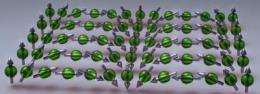
(PhysOrg.com) -- By controlling the collective spin state of highly mobile electrons in semiconductors, researchers in the Materials Sciences Division (MSD) at the U.S. Department of Energy's Lawrence Berkeley National Laboratory have taken a major step forward in the technology of spintronics. At the same time they have discovered a new conservation law, an important advance in fundamental physics.
"With our spin-orbit tuning, electrons that start at point A with the same spin may take many different paths, but when they reach point B they'll end up with the same spin again," says MSD's Jake Koralek, first author of the Nature paper that outlines the research.
The ability to control spin states of highly mobile electrons at different locations in a semiconductor, and the ability to turn this collective state on and off at will, could lead to much more efficient spin transistors and other devices.
Koralek is a member of Joseph Orenstein's laboratory at Berkeley Lab. In 2006, after discussing how the spin orientation of electrons might be manipulated in spintronic devices with theorist Allan MacDonald of the University of Texas, Orenstein, who is also a professor in the Department of Physics at the University of California at Berkeley, initiated a research program into persistent spin helices, working with graduate student Chris Weber, now at Santa Clara University.
Spinning at random
Traditional electronic devices are based on electron charge; spintronic devices make use of the intrinsic spin orientation of electrons as well. Controlling and measuring the magnetic fields of electrons whose spins are aligned in a computer hard drive, for example, results in faster data recovery and lower power consumption.
In semiconductors, however, a "gas" of free electrons moving through the crystal lattice reacts to the electric fields of the atoms it encounters; through an interaction called spin-orbit coupling, individual electron spins fluctuate wildly in response to different fields and soon become randomly oriented.
"Two different mathematical and physical terms, the Rashba term and the Dresselhaus term, dominate the spin-orbit coupling in our samples," says Koralek. "Both these terms can be manipulated independently."
Orenstein, working with Shoucheng Zhang and Andrei Bernevig from Stanford University, had predicted that when the two terms are exactly equal in a two-dimensional gas of electrons, a new symmetry emerges, resulting in a persistent spin helix - a collective spin state with a theoretically infinite lifetime.
The experimenters' first step was to create a two-dimensional electron gas by confining the electrons in a "quantum well," a layer of material - in this case, gallium arsenide - only a few nanometers (billionths of a meter) thick. The quantum well forces the charged particles to travel in a plane; as electrons move through it, their interaction with passing atoms causes them to precess, eventually exchanging initial spin-up states for spin-down states. Normally the Rashba and Dresselhaus spin-orbit coupling terms are uneven, and precession is random.
The Rashba term depends on the electric field applied across the quantum well. Electric fields in semiconductors are usually controlled by introducing dopant atoms, impurity atoms that induce positive or negative fields.
"Dopant atoms slow down free electrons, so we wanted to keep the dopants out of the quantum well," says Koralek. "Instead we doped only the adjacent substrate. We then tuned the electric field by changing the doping asymmetry - that is, we put different concentrations of dopants on either side of the well."
The Dresselhaus term, by contrast, depends on the confinement of the electron gas - in other words, the thickness of the quantum well (and also the velocity of the electrons). By creating samples with quantum wells of different thickness, the experimenters tuned the Dresselhaus term until it closely matched the Rashba term.
Spinning together
The final step was to induce a "helical" spin state in the electron gas and measure how this collective spin state evolved thereafter. To do this, the researchers simultaneously hit the sample with two femtosecond (quadrillionth of a second) titanium-sapphire laser pulses at an angle to each other, generating an interference pattern in the sample.
The laser pulses were polarized at right angles to each other, so they created an interference grating in which the light intensity was constant but its helicity varied. The electron spins in the quantum well become oriented either up or down, depending on whether they absorbed left or right circularly polarized light.
"With spin-orbit tuning you can control both the rate at which the electrons precess and the direction in which they precess," says Koralek. "What we've done is tune the spin-orbit coupling to insure that no matter which direction they're going, they always precess in the same plane, with their spins varying periodically between spin-up and spin-down at a rate proportional to their velocity."
Koralek compares this helical spin precession to a round clock, rolling along in a straight line. If the clock starts with its hands in the 12 o'clock position, it can roll back and forth along the line many times, but every time it passes over its starting position, the hands will be back in the 12 o'clock position. "In fact, you will know the orientation of the clock at all positions along the line," he says.
One of the most exciting feature of the spin helix measured by Orenstein's group is its persistence - not yet infinite, to be sure, but still a hundred times longer than any observed before. Further adjustments to the experimental parameters - for example tuning not only the electric field and the width of the quantum well but electron density as well - should improve the lifetime of the helix still further.
More information: "Emergence of the persistent spin helix in semiconductor quantum wells," by J. D. Koralek, C. P. Weber, J. Orenstein, B. A. Bernevig, Shoucheng Zhang, S. Mack, and D. D. Aschwalom, appears in the April 2, 2009 issue of Nature and is available online to subscribers at www.nature.com/nature/index.html .
Source: Lawrence Berkeley National Laboratory (news : web)


