Researchers peer into nanowires to measure dopant properties
April 2, 2009 Researchers peer into nanowires to measure dopant properties

Enlarge

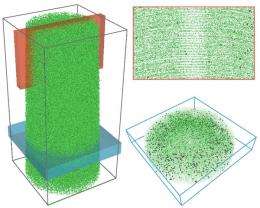
Atom-by-atom mapping of a germanium nanowire by atom probe tomography. Left: 3D reconstruction of an individual Ge nanowire with each green sphere representing an individual Ge atom. The dimensions are 50x50x100 nm3. The region enclosed by the red box is displayed at upper right, with single atomic planes visible in the center of the image. The grey spheres are phosphorous dopant atoms used to control the conductivity. (The dimensions are 5x25x15 nm3). The region enclosed by the blue box is displayed in the lower right, revealing an inhomogeneous distribution of phosphorous atoms. (The dimensions are 50x50x10 nm3). The 'shell' of enhanced doping results from surface reactions during growth of the nanowire.

(PhysOrg.com) -- Semiconductor nanowires -- tiny wires with a diameter as small as a few billionths of a meter — hold promise for devices of the future, both in technology like light-emitting diodes and in new versions of transistors and circuits for next generation of electronics. But in order to utilize the novel properties of nanowires, their composition must be precisely controlled, and researchers must better understand just exactly how the composition is determined by the synthesis conditions.

Nanowires are synthesized from elements that form bulk semiconductors, whose are in turn controlled by adding minute amounts of impurities called dopants. The amount of dopant determines the of the nanowire.

But because are so small — with diameters ranging from 3 to 100 nanometers — researchers have never been able to see just exactly how much of the dopant gets into the nanowire during synthesis. Now, using a technique called atom probe tomography, Lincoln Lauhon, assistant professor of materials science and engineering at Northwestern University's McCormick School of Engineering and Applied Science, has provided an view of the composition of a nanowire. By precisely measuring the amount of dopant in a nanowire, researchers can finally understand the synthesis process on a quantitative level and better predict the of nanowire devices.

The results were published online March 29 in the journal Nature Nanotechnology.

"We simply mapped where all the atoms were in a single nanowire, and from the map we determined where the dopant atoms were," he says. "The more dopant atoms you have, the higher the conductivity."

Previously, researchers could not measure the amount of dopant and had to judge the success of the synthesis based on indirect measurements of the conductivity of nanowire devices. That meant that variations in device performance were not readily explained.

"If we can understand the origin of the electrical properties of nanowires, and if we can rationally control the conductivity, then we can specify how a nanowire will perform in any type of device," he says. "This fundamental scientific understanding establishes a basis for engineering."

Lauhon and his group performed the research at Northwestern's Center for Atom Probe Tomography, which uses a Local Electrode Atom ProbeTM microscope to dissect single nanowires and identify their constituents. This instrumentation software allows 3-D images of the nanowire to be generated, so Lauhon could see from all angles just how the dopant atoms were distributed within the nanowire.

In addition to measuring the dopant in the nanowire, Lauhon's colleague, Peter Voorhees, Frank C. Engelhart Professor of Materials Science and Engineering at Northwestern, created a model that relates the nanowire doping level to the conditions during the nanowire synthesis. The researchers performed the experiment using germanium wires and phosphorous dopants — and they will soon publish results using silicon — but the model provides guidance for nanowires made from other elements, as well.

"This model uses insight from Lincoln's experiment to show what might happen in other systems," Voorhees says. "If nanowires are going to be used in device applications, this model will provide guidance as to the conditions that will enable us to add these elements and control the doping concentrations."

Both professors will continue working on this research to broaden the model.

"We would like to establish the general principles for doping semiconductor nanowires," Lauhon says.

More information: The paper is titled "Direct measurement of dopant distribution in an individual vapour-liquid-solid nanowire."

Source: Northwestern University (news : web)


print this article email this article download pdf blog this article bookmark this article     Stumble it Digg this share on Facebook retweet share on Reddit add to delicious
Rate this story - 5 /5 (1 vote)


April 2, 2009 all stories

Comments: 0

5 /5 (1 vote)
  • Stumble this up

  • Digg this

  • share this

  • hide
  • Related Stories

  • Nanosys Announces Issued Patent Covering Fundamental Nanowire Heterostructures
    created May 06, 2005 | popularity not rated yet | comments 0
  • Researchers shine light on atomic transistor
    created Nov 22, 2006 | popularity not rated yet | comments 0
  • Nano World: Superior nanowire transistors
    created May 30, 2006 | popularity not rated yet | comments 0
  • Research advances nanowire technology for large-scale applications
    created Feb 26, 2009 | popularity not rated yet | comments 0
  • Breakthrough toward industrial-scale production of nanodevices
    created Nov 12, 2007 | popularity not rated yet | comments 0


  • hide
  • Relevant PhysicsForums posts

  • Photoelectric effect
    created 3 hours ago
  • Ranges of coherence lengths for......
    created 6 hours ago
  • Has einsteins experient with time been proven, why hasn't it been applied or used
    created 7 hours ago
  • Drop of Water
    created 8 hours ago
  • Generalized Coordinate Systems
    created 8 hours ago
  • Electromagnet design
    created 10 hours ago
  • More from Physics Forums - General Physics

Other News

Findings show nanomedicine promising for treating spinal cord injuries

Findings show nanomedicine promising for treating spinal cord injuries

Nanotechnology / Bio & Medicine

created 16 hours ago | popularity 4.5 / 5 (4) | comments 0

(PhysOrg.com) -- Researchers at Purdue University have discovered a new approach for repairing damaged nerve fibers in spinal cord injuries using nano-spheres that could be injected into the blood shortly ...


New Digital 'Electronics' Concept May Continue Moore's Law

New Digital 'Electronics' Concept May Continue Moore's Law

Nanotechnology / Nanophysics

created Nov 05, 2009 | popularity 4.6 / 5 (55) | comments 9

(PhysOrg.com) -- Computers of the future could be operating not on electrons, but on tiny waves traveling through an electron "fluid," if a new proposal is successful. The new circuit design, recently introduced ...


Nanoparticles for gene therapy improve

Nanoparticles for gene therapy improve

Nanotechnology / Bio & Medicine

created Nov 06, 2009 | popularity 5 / 5 (4) | comments 3

(PhysOrg.com) -- About five years ago, Professor Janet Sawicki at the Lankenau Institute in Pennsylvania read an article about nanoparticles developed by MIT's Robert Langer for gene therapy, the insertion ...


Breakthrough in industrial-scale nanotube processing

Breakthrough in industrial-scale nanotube processing

Nanotechnology / Nanomaterials

created Nov 02, 2009 | popularity 4.9 / 5 (20) | comments 3

(PhysOrg.com) -- Rice University scientists today unveiled a method for the industrial-scale processing of pure carbon-nanotube fibers that could lead to revolutionary advances in materials science, power ...


Scientists witness nature's complexity unfold in self-assembling quasicrystals

Scientists witness nature's complexity unfold in self-assembling quasicrystals

Nanotechnology / Nanomaterials

created Oct 31, 2009 | popularity 4.9 / 5 (17) | comments 3

(PhysOrg.com) -- Just a few decades ago, scientists believed that all ordered matter consists of self-repeating building blocks -- atoms, ions or molecules. In this view, the ordinary solids of everyday life ...