Ice-free Arctic Ocean possible in 30 years, not 90 as previously estimated
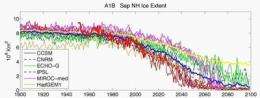
(PhysOrg.com) -- A nearly ice-free Arctic Ocean in the summer may happen three times sooner than scientists have estimated. New research says the Arctic might lose most of its ice cover in summer in as few as 30 years instead of the end of the century.
The amount of the Arctic Ocean covered by ice at the end of summer by then could be only about 1 million square kilometers, or about 620,000 square miles. That's compared to today's ice extent of 4.6 million square kilometers, or 2.8 million square miles. So much more open water could be a boon for shipping and for extracting minerals and oil from the seabed, but it raises the question of ecosystem upheaval.
While the Intergovernmental Panel on Climate Change in 2007 assessed what might happen in the Arctic in the future based on results from more than a dozen global climate models, two researchers reasoned that dramatic declines in the extent of ice at the end of summer in 2007 and 2008 called for a different approach.
Out of the 23 models now available, the new projections are based on the six most suited for assessing sea ice, according to Muyin Wang, a University of Washington climate scientist with the Joint Institute for the Study of the Atmosphere and Ocean based at the UW, and James Overland, an oceanographer with the National Oceanic and Atmospheric Administration's Pacific Marine Environmental Laboratory in Seattle. Wang is lead author and Overland is co-author of a paper being published April 3 by the American Geophysical Union's Geophysical Research Letters.
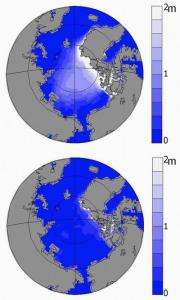
Wang and Overland sought models that best matched what has actually happened in recent years, because, "if a model can't do today's conditions well, how can you trust its future predictions?" Wang says. Among the models eliminated were those showing too little ice or too much compared to conditions that have occurred.
Models also were chosen that are able to reflect the difference between summer and winter ice packs, which demonstrates a model's ability to take into account changing amounts of solar radiation from summer to winter, Wang says.
Among the six fitting the researchers' criteria, three have sophisticated sea-ice physics and dynamics capabilities.
Once the extent of ice at the end of summer drops to 4.6 million square kilometers -- it was actually 4.3 million square kilometers in 2007 and 4.7 million in 2008 -- all six models show rapid sea-ice declines. Averaged together the models point to a nearly ice-free Arctic in 32 years, with some of the models putting the event as early as 11 years from now.
"In recent years the combination of unusual warm temperatures from natural causes and the global warming signal have worked together to provide an earlier summer sea-ice loss than was predicted when scientists considered the effects from human-caused carbon dioxide alone," says Overland, who is also an affiliate UW professor of atmospheric sciences.
"The uncertainty in future timing for a September sea-ice free Arctic is strongly influenced by the chaotic nature of natural variability," the authors write in the paper. Still, "the one climate realization that we are living through appears to be a fast track for September sea ice loss," they write.
Scientists don't expect the Arctic to be totally ice free, figuring that ice still will be found along northern Canada and Greenland where powerful winds sweeping across the Arctic Ocean force ice layers to slide on top of each other, making for a very thick ice cover.
The National Oceanic and Atmospheric Administration funded the work.
Provided by University of Washington


