Hydrogen cars closer to reality with new storage system design
April 2, 2009 Hydrogen cars closer to reality with new storage system design

Enlarge

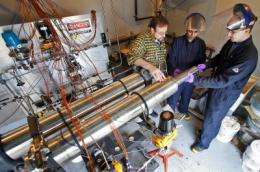
Issam Mudawar, from left, a Purdue professor of mechanical engineering, discusses a hydrogen-storage system for cars with graduate student Milan Visaria and Timothée Pourpoint, an assistant professor of aeronautics and astronautics and manager of the Hydrogen Systems Laboratory. Researchers have created the system's heat exchanger, which is critical because it allows the system to be filled quickly. The research is funded by General Motors Corp. Credit: Purdue News Service photo/Andrew Hancock

Researchers have developed a critical part of a hydrogen storage system for cars that makes it possible to fill up a vehicle's fuel tank within five minutes with enough hydrogen to drive 300 miles.

The system uses a fine powder called metal hydride to absorb gas. The researchers have created the system's heat exchanger, which circulates coolant through tubes and uses fins to remove heat generated as the hydrogen is absorbed by the powder.

The heat exchanger is critical because the system stops absorbing hydrogen effectively if it overheats, said Issam Mudawar, a professor of mechanical engineering who is leading the research.

"The hydride produces an enormous amount of heat," Mudawar said. "It would take a minimum of 40 minutes to fill the tank without cooling, and that would be entirely impractical."

Researchers envision a system that would enable motorists to fill their car with hydrogen within a few minutes. The hydrogen would then be used to power a to generate electricity to drive an electric motor.

The research, funded by General Motors Corp. and directed by GM researchers Darsh Kumar, Michael Herrmann and Abbas Nazri, is based at the Hydrogen Systems Laboratory at Purdue's Maurice J. Zucrow Laboratories. In February, the team applied for three provisional patents related to this technology.

"The idea is to have a system that fills the tank and at the same time uses accessory connectors that supply coolant to extract the heat," said Mudawar, who is working with mechanical engineering graduate student Milan Visaria and Timothée Pourpoint, a research assistant professor of aeronautics and astronautics and manager of the Hydrogen Systems Laboratory. "This presented an engineering challenge because we had to figure out how to fill the fuel vessel with hydrogen quickly while also removing the heat efficiently. The problem is, nobody had ever designed this type of heat exchanger before. It's a whole new animal that we designed from scratch."

The metal hydride is contained in compartments inside the storage "pressure vessel." Hydrogen gas is pumped into the vessel at high pressure and absorbed by the powder.

"This process is reversible, meaning the hydrogen gas may be released from the metal hydride by decreasing the pressure in the storage vessel," Mudawar said. "The heat exchanger is fitted inside the pressure vessel. Due to space constraints, it is essential that the heat exchanger occupy the least volume to maximize room for hydrogen storage."

Conventional automotive coolant flows through a U-shaped tube traversing the length of the pressure vessel and heat exchanger. The heat exchanger, which is made mostly of aluminum, contains a network of thin fins that provide an efficient cooling path between the metal hydride and the coolant.

"This milestone paves the way for practical on-board hydrogen storage systems that can be charged multiple times in much the same way a gasoline tank is charged today," said Kumar, a researcher at GM's Chemical & Environmental Sciences Laboratory and the GM R&D Center in Warren, Mich. "As newer and better metal hydrides are developed by research teams worldwide, the heat exchanger design will provide a ready solution for the automobile industry."

The researchers have developed the system over the past two years. Because metal hydride reacts readily with both air and moisture, the system must be assembled in an airtight chamber, Pourpoint said.

Research activities at the hydrogen laboratory involve faculty members from the schools of aeronautics and astronautics, mechanical engineering, and electrical and computer engineering.

Source: Purdue University (news : web)


print this article email this article download pdf blog this article bookmark this article     Stumble it Digg this share on Facebook retweet share on Reddit add to delicious
Rate this story - 3.9 /5 (16 votes)

Rank Filter

Move the slider to adjust rank threshold, so that you can hide some of the comments.


Display comments: newest first

  • Disrupted - Apr 02, 2009
    • Rank: 3 / 5 (2)
    Awesome... I'm happy for these researchers and I hope this is "THE" step in propelling a huge (planet-friendly) shift from oil/gas based automobiles.

    BUT... I have a feeling this technology has been possible for years (and suppressed) and only now being "allowed" to start being revealed to the public.
  • TJ_alberta - Apr 03, 2009
    • Rank: 4 / 5 (2)
    so what's going to happen when the car has been sitting outside at night and the fuel tank and fuel cell cool down to -40, is the endothermic release of the hydrogen going to be a problem? At what ambient temperature does the hydrogen stay bound to the hydride?
  • Duude - Apr 03, 2009
    • Rank: 4 / 5 (2)
    I've read about developments like this one for years and get excited only to later wonder why nothing makes it to the big show. Some might think technology is suppressed for the benefit of rich corporations. Too conspiratorial for my taste. The facts are scientists involved in this type of research need to eat like everyone else. Their development is totally dependent upon sponsorship, whether private or public. Private is much more picky about the details where the devil apparently dwells. Every scientist uses exaggeration from time to time to inflate the value of their development. Its a problem but it doesn't mean technology doesn't move forward anyway. So, take all these stories with a big grain of salt. If more studies along the same line crop up more and more you know they're likely onto something.
  • BrettC - Apr 13, 2009
    • Rank: 4 / 5 (1)
    If that much heat is released, isn't a large quantity of energy lost?
  • DozerIAm - Apr 15, 2009
    • Rank: not rated yet
    If that much heat is released, isn't a large quantity of energy lost?


    Well, its "a" quantity of energy lost. I doubt its enough energy to make it worth the weight and space to recover it.

April 2, 2009 all stories

Comments: 5

3.9 /5 (16 votes)
  • Stumble this up

  • Digg this

  • share this

  • hide
  • Related Stories

  • Hydrogen storage can be improved
    created Jan 27, 2005 | popularity not rated yet | comments 0
  • Hydrogen storage in nanoparticles works
    created Mar 31, 2008 | popularity not rated yet | comments 0
  • GM, Sandia to advance hydrogen storage
    created Jan 08, 2005 | popularity not rated yet | comments 0
  • Prototype hydrogen storage tank maintains extended thermal endurance
    created Jun 04, 2008 | popularity not rated yet | comments 0
  • Hydrogen Storage for Cars?
    created Dec 21, 2007 | popularity not rated yet | comments 0


  • hide
  • Relevant PhysicsForums posts

Other News

Framed for child porn -- by a PC virus

Framed for child porn -- by a PC virus

Technology / Internet

created 16 hours ago | popularity 5 / 5 (5) | comments 2

(AP) -- Of all the sinister things that Internet viruses do, this might be the worst: They can make you an unsuspecting collector of child pornography.


Campaigners are stepping up efforts to curb online tracking

Advertisers face resistance to on-line tracking

Technology / Internet

created Nov 08, 2009 | popularity 5 / 5 (4) | comments 0

Campaigners are stepping up efforts to curb online tracking of Internet use by firms that deliver adverts tailored to the specific interests of consumers, as polls reveal widespread unease with the practice.


A system of space solar power system (SSPS)

Japan eyes solar station in space as new energy source

Technology / Energy

created Nov 08, 2009 | popularity 4.7 / 5 (14) | comments 20

It may sound like a sci-fi vision, but Japan's space agency is dead serious: by 2030 it wants to collect solar power in space and zap it down to Earth, using laser beams or microwaves.


Dartmouth professor finds that iconic Oswald photo was not faked

Professor finds that iconic Oswald photo was not faked (w/ Video)

Technology / Computer Sciences

created Nov 05, 2009 | popularity 3.8 / 5 (9) | comments 38

(PhysOrg.com) -- Dartmouth Computer Scientist Hany Farid has new evidence regarding a photograph of accused John F. Kennedy assassin Lee Harvey Oswald. Farid, a pioneer in the field of digital forensics, digitally ...


airpod

Car That Runs on Compressed Air Questioned by Critics (w/ Video)

Technology / Energy

created Nov 03, 2009 | popularity 3.8 / 5 (21) | comments 34

(PhysOrg.com) -- As electric cars begin breaking into the short-distance vehicle market, one French company thinks that it has an alternative to the electric vehicle: a car that runs on compressed air. Motor ...