Sleep: Spring cleaning for the brain?
April 2, 2009 Sleep: Spring cleaning for the brain?

Enlarge

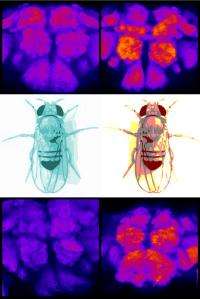
On the left, the brain of the well-rested blue fly has low levels of a synaptic protein called BRP in this 3D view from a confocal mircoscope. On the right, the brain of the sleep-deprived fly glows orange in areas of BRP concentration. (Bruchpilot or BRP is a protein involved in communication between neurons.)In the tired fly, the protein is present at high concentartions in three major areas of the fly's brain that are associated with learning. Sleep reduces the levels of this protein, an indication that synapses get smaller and/or weaker. This process of "downscaling" may be important so the brain is reset to normal levels of synaptic activity and can begin learning again the next day. Image by: courtesy UW Health Public Affairs

(PhysOrg.com) -- If you've ever been sleep-deprived, you know the feeling that your brain is full of wool.

Now, a study published in the April 3 edition of the journal Science has molecular and structural evidence of that woolly feeling — proteins that build up in the brains of sleep-deprived and drop to lower levels in the brains of the well-rested. The proteins are located in the , those specialized parts of neurons that allow cells to communicate with other neurons.

researchers at the University of Wisconsin-Madison School of Medicine and Public Health believe it is more evidence for their theory of "synaptic homeostasis." This is the idea that synapses grow stronger when we're awake as we learn and adapt to an ever-changing the environment, that sleep refreshes the brain by bringing synapses back to a lower level of strength. This is important because larger synapses consume a lot of energy, occupy more space and require more supplies, including the proteins examined in this study.

Sleep — by allowing synaptic downscaling — saves energy, space and material, and clears away unnecessary "noise" from the previous day, the researchers believe. The fresh brain is then ready to learn again in the morning.

The researchers — Giorgio Gilestro, Giulio Tononi and Chiara Cirelli, of the Center for Sleep and Consciousness — found that levels of proteins that carry messages in the synapses (or junctions) between neurons drop by 30 to 40 percent during sleep.

In the Science paper, three-dimensional photos using confocal microscopy show the brains of sleep-deprived flies filled with a synaptic protein called Bruchpilot (BRP), a component of the machinery that allows communication among neurons. In well-rested flies, levels of BRP and four other synaptic proteins drop back to low levels, providing evidence that sleep resets the brain to allow more growth and learning the next day.

"We know that sleep is necessary for our brain to function properly, to learn new things every day, and also, in some cases, to consolidate the memory of what we learned during the day," says Cirelli, associate professor of psychiatry. "During sleep, we think that most, if not all, synapses are downscaled: at the end of sleep, the strongest synapses shrink, while the weakest synapses may even disappear."

The confocal microscope views show this happening in all three major areas of the fruit-fly brain, which are known to be very plastic (involved in learning).

In a paper published last year, Tononi, Cirelli and their co-investigators found similar chemical changes in the synapses of rats' brains. They also showed that rats' brains have a stronger "evoked response" to electrical stimulation after being awake, and a weaker one after sleep. That finding provided more evidence, using electrophysiological rather than molecular techniques, consistent with the idea that synapses grow stronger during the day, then weaker during sleep.

Because sleep performs the same function in the brains of species as diverse as fruit flies and rats, Cirelli says it was likely conserved by evolution because it is so important to an animal's health and survival.

The Wisconsin laboratory has pioneered ways of studying sleep in different species, including fruit flies.

To keep the flies awake, they're put into a "fly agitator" that holds 10 plates, each containing 32 drowsy flies. A robot arm shakes the plates occasionally to keep the flies from dozing.

Flies were deprived of sleep for as long as 24 hours. Researchers then dissected their brains and measured the levels of four pre-synaptic proteins and one post-synaptic protein. All levels rose progressively during periods of wakefulness and fell after sleep. Other experiments confirmed that the changes in protein levels were not caused by exposure to light and darkness or by the stimulation itself, but by sleep and waking. They also used confocal microscopy and an antibody that specifically recognizes BRP to measure the expression of this protein in many fly-brain areas.

Higher levels of these synaptic proteins during waking may be evidence of random experiences that fill the brain every day and need to be dissipated to make room for the learning and memories that are truly significant.

"Much of what we learn in a day, we don't really need to remember," Cirelli says. "If you've used up all the space, you can't learn more before you clean out the junk that is filling up your brain."

Source: University of Wisconsin-Madison (news : web)


print this article email this article download pdf blog this article bookmark this article     Stumble it Digg this share on Facebook retweet share on Reddit add to delicious
Rate this story - 4.1 /5 (8 votes)

Rank Filter

Move the slider to adjust rank threshold, so that you can hide some of the comments.


Display comments: newest first

  • Mauricio - Apr 02, 2009
    • Rank: 2 / 5 (4)
    It explain some physiological function of sleep (in flies), it does not explain why dreams are organized with a rather bizarre logic. Dreams are not rain of disconnected data or noise. They are more like a travel to an alternate reality.
  • Disrupted - Apr 02, 2009
    • Rank: 5 / 5 (3)
    Well... the article wasn't really about dreams.

    The article is very interesting, and I can't help thinking about the future applications this advancing research may bring about. Imagine a pill being developed that can reduce or eliminate these pre-synaptic and pro-synaptic proteins, making sleep barely necessary.

    Personally, I like my sleep. :) But it is interesting.
  • Alizee - Apr 03, 2009
    • Rank: 1 / 5 (1)
    Well - as usually, this finding was predicted by AWT already in context of consciousness theory (.. a bored yawn follows..):

    http://tinyurl.com/d4rzxj
    http://tinyurl.com/ckuytl

    You can consider this connection as another evidence of AWT and its explanation of consciousness..
  • thales - Apr 03, 2009
    • Rank: 5 / 5 (1)
    Imagine a pill being developed that can reduce or eliminate these pre-synaptic and pro-synaptic proteins, making sleep barely necessary.


    I thought of that too, but (if I recall correctly) EVERY vertebrate requires sleep. Considering the significant disadvantages to sleeping --vulnerability to predators, time lost that would otherwise be productive, etc. -- it seems that sleep must be just about the only way to do whatever it is it does. So I think it is going to prove exceedingly difficult to get rid of our dependence on sleep. My guess is it will require smart nanotech.

  • Disrupted - Apr 04, 2009
    • Rank: not rated yet
    So I think it is going to prove exceedingly difficult to get rid of our dependence on sleep. My guess is it will require smart nanotech.


    Oh, I agree completely. Even if we *were* able to (almost) eliminate the need for sleep, I think most people (for example, ME) would go crazy from boredom or constant input or thought. Sometimes sleep simply helps us escape all the sounds and pressure of everyday life.

    Again... I like my sleep. lol. :)

April 2, 2009 all stories

Comments: 5

4.1 /5 (8 votes)
  • Stumble this up

  • Digg this

  • share this

  • hide
  • Related Stories

  • Study: Brain connections strengthen during waking hours, weaken during sleep
    created Jan 20, 2008 | popularity not rated yet | comments 0
  • Exploring the function of sleep
    created Aug 26, 2008 | popularity not rated yet | comments 0
  • A good night's sleep with the flip of a switch?
    created Apr 30, 2007 | popularity not rated yet | comments 0
  • Brain tweak lets sleep-deprived flies stay sharp
    created Jul 31, 2008 | popularity not rated yet | comments 0
  • Searching for shut eye: Study identifies possible sleep gene
    created Jul 29, 2008 | popularity not rated yet | comments 0


  • hide
  • Relevant PhysicsForums posts

  • Improving the brain through chemistry
    created Nov 07, 2009
  • Sleep / REM Sleep and homeostasis
    created Nov 07, 2009
  • The Biceps Reflex
    created Nov 05, 2009
  • Consequenses of striking a Vein and an artery?
    created Nov 05, 2009
  • computing with real neurons
    created Nov 05, 2009
  • Priapism & Viagra
    created Oct 31, 2009
  • More from Physics Forums - Medical Sciences

Other News

New York residents walk on the sidewalk  in Manahattan in New York

Path to good health, less pollution is the sidewalk: report

Medicine & Health / Health

created 10 minutes ago | popularity not rated yet | comments 0

US pressure groups joined forces Monday to urge authorities to spend more to improve Americans' health and cut greenhouse gas emissions.


AIDS is leading cause of death, disease for women

Medicine & Health / HIV & AIDS

created 20 minutes ago | popularity not rated yet | comments 0

(AP) -- In its first study of women's health around the globe, the World Health Organization said Monday that the AIDS virus is the leading cause of death and disease among women between the ages of 15 and 44.


St. Jude and UF Proton Therapy Institute to begin proton therapy clinical trial

Medicine & Health / Cancer

created 28 minutes ago | popularity not rated yet | comments 0

St. Jude Children's Research Hospital and the University of Florida Proton Therapy Institute have formed a collaboration to provide proton therapy for St. Jude patients. The announcement follows the approval of the first ...


The world's most common operation

Medicine & Health / Diseases

created 10 minutes ago | popularity not rated yet | comments 0

As many as 10 million people around the world suffer from cataracts. Thomas Kohnen of the Goethe University in Frankfurt and his coauthors discuss cataract surgery with the implantation of an artificial lens in the current ...


Physician bias might keep life-saving transplants from black and Hispanic patients

Medicine & Health / Other

created 1 seconds ago | popularity not rated yet | comments 0

Physician bias might be the reason why African Americans are not receiving kidney/pancreas transplants at the same rate as similar patients in other racial groups. Dr. Keith Melancon, director of kidney and pancreas transplantation ...