On new cell phones, QWERTY eases out 1-2-3
April 2, 2009 By PETER SVENSSON , AP Technology Writer
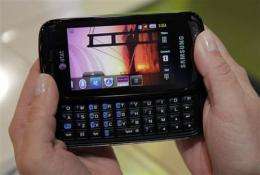
The Samsung Impression, the first phone on the U.S. market with a screen that uses organic light-emitting diodes rather than liquid crystals, is shown at the International CTIA Wireless show in Las Vegas, Wednesday, April 1, 2009. The shift from numerical keypads to alphabetic keyboards, which has overturned cell phone design in the space of a two years, is a recognition of the popularity of text messaging, and to a lesser extent, wireless Internet use. (AP Photo/Jae C. Hong)
(AP) -- Goodbye, numeric cell phone keypads. You're going the way of the rotary dial. Touch screens and QWERTY keyboards will take over from here, thank you.
At North America's largest cell phone trade show, running this week in Las Vegas, there were few new phones for the U.S. market that had a numerical keypad instead of an alphabetic keyboard. Touch screens also were out in force.
These changes are a recognition of the popularity of text messaging and wireless Internet use. Industry organization CTIA Wireless, which hosts the show, said U.S. subscribers sent 1 trillion text messages last year, three times the 2007 volume. Meanwhile, the same people used 2.2 trillion minutes of voice calls, an increase of less than 5 percent.
This shift in how people use their mobile devices has overturned cell phone design. According to NPD Group, 31 percent of phones sold in U.S. stores in the fourth quarter of 2008 had full-alphabet keyboards, up from 5 percent two years earlier.
AT&T Inc., the second-largest wireless carrier after Verizon Wireless, introduced six phones this week, all of which had either a touch screen, a typewriter-style keyboard, or both. At the booth of Samsung Electronics Co., the largest seller of phones in the U.S., there were no new keypad phones.
Motorola Inc., the largest domestic maker of phones, was showing off one low-end handset with a keypad. It went on sale through AT&T two weeks ago. But Motorola's big news was a model called the Evoke, which has a touch screen. It's designed for the U.S. market, though it doesn't have a carrier distribution agreement yet.
LG Electronics Inc. displayed a new handset, the GD900, that seemed to both emphasize a numeric keypad and make it vanish. A pad slides out from the GD900's body, but it's made of transparent plastic, so you can see right through it. You don't need to use keypad at all, since the screen is touch-sensitive. Other new LG phones were also dominated by touch screens.
Even at the low end of the market, keyboards for text messaging are becoming common and affordable. AT&T expects to sell two of the keyboard-equipped phones it introduced, the Samsung Magnet and LG Neon, for about $20 to $30.
Old-fashioned numeric keypads still will have a prominent place - but largely overseas. In a twist of market dynamics, the demand for QWERTY phones is mainly a North American phenomenon, said Ross Rubin, an analyst at NPD.
Although touch screens are gaining in popularity all over the world, people in other countries got into text messaging much earlier and "became acclimated to texting with a keypad," Rubin said. Meanwhile, the U.S. market has been influenced by high-end smart phones like the Treo and the BlackBerry that pioneered small versions of typewriter-style keyboards.
As a result, numeric keypads were still dominant at the CTIA booth of Nokia Corp., the world's largest maker of cell phones, which has a relatively minor presence in the U.S. The same was the case at the booth of Japanese-Swedish manufacturer Sony Ericsson.
Other notable wireless devices at the show (prices are with two-year contracts):
- The Samsung Impression is the first phone on the U.S. market with a screen that uses organic light-emitting diodes rather than liquid crystals. Since OLEDs emit their own light, rather than filtering a fluorescent backlight like LCDs, they can save on battery life and provide better image quality. The Impression has a 3.2-inch touch screen capable of showing very saturated colors and dark blacks, and a slide-out QWERTY keyboard. AT&T will sell the phone for $200 starting Tuesday. OLEDs have shown up before in camera displays, and Sony sells a small, expensive OLED TV.
- AT&T will sell the Nokia E71x, which is billed as the thinnest smart phone in the country, less than half an inch thick. The layout is similar to that of a BlackBerry or BlackJack, and includes a keyboard. Nokia has had a hard time penetrating the U.S. smart phone market, and previous, similar Nokia models sold by AT&T haven't made much of dent on the dominant market share of Research In Motion Ltd.'s BlackBerry. Despite being so thin, the E71x has a 3.2 megapixel camera with autofocus. The phone will cost $100. AT&T has no firm launch date.
- Sprint Nextel Corp. trotted out the Samsung Instinct s30, a follow-up to the first Instinct, which it introduced last year as a touch-screen competitor to the iPhone. The s30 has a thinner, more rounded body and includes a more fully featured Web browser. The s30 will be available April 19 for $130.
- Samsung is making a Web tablet for Clearwire Corp.'s wireless broadband network, which uses a technology known as WiMax. There are laptops and modems for the network, which is live in Portland, Ore., and Baltimore, but there hasn't been a standalone portable device for Clearwire since Nokia discontinued its WiMax tablet in January. Samsung's Mondi will go on sale in the next three months. No price was announced. It doesn't work as a phone, but it could run teleconferencing applications like Skype. The underlying software is Windows Mobile. Naturally, the Mondi has a keyboard and a touch screen, with a 4.3-inch diagonal.
©2009 The Associated Press. All rights reserved. This material may not be published, broadcast, rewritten or redistributed.
-
LG Electronics supplies keyboard-equipped mobile phones to Cingular Wireless
Feb 25, 2005 |
not rated yet |
0
-
Touch-screen tech coming to cellphones
Jul 11, 2006 |
not rated yet |
0
-
The Memoir: Samsung, T-Mobile USA Introduce New 8-Megapixel Camera Phone
Feb 06, 2009 |
not rated yet |
0
-
LG Launches Versatile LG-KF700
Apr 22, 2008 |
not rated yet |
0
-
Startup VeryKool Targets U.S. Cell-Phone Market
Mar 29, 2007 |
not rated yet |
0
-
Engineers build first sub-10-nm carbon nanotube transistor
Feb 01, 2012 |
4.9 / 5 (33) |
30
-
Something old, something new: Evolution and the structural divergence of duplicate genes
Jan 31, 2012 |
4.6 / 5 (7) |
1
-
The hidden nanoworld of ice crystals: Revealing the dynamic behavior of quasi-liquid layers
Jan 30, 2012 |
5 / 5 (4) |
1
-
Stock market network reveals investor clustering
Jan 27, 2012 |
3.9 / 5 (23) |
8
-
Of microchemistry and molecules: Electronic microfluidic device synthesizes biocompatible probes
Jan 26, 2012 |
5 / 5 (2) |
0
-
How to tilt a object
3 hours ago
-
How to calculate total compressibility in liquid porous solid system
9 hours ago
-
Need help reading 3-D
Feb 11, 2012
-
A way to send and receive wireless data
Feb 11, 2012
-
Calling function with no input argument
Feb 10, 2012
-
Force free body diagram problem on gym equipment
Feb 10, 2012
- More from Physics Forums - General Engineering
More news stories
Japan scientist makes 'Avatar' robot
A Japanese-developed robot that mimics the movements of its human controller is bringing the Hollywood blockbuster "Avatar" one step closer to reality.
Feb 10, 2012 |
5 / 5 (9) |
12
Intel packs performance and reliability into its latest SSD 520 series
Intel Corporation announced today its fastest, most robust client/consumer solid-state drive (SSD) to date, the Intel Solid-State Drive 520 Series (Intel SSD 520), a 6 gigabit-per-second (gbps) SATA III SSD ...
Feb 07, 2012 |
5 / 5 (1) |
4
Google rumored to have built Heads-Up-Display glasses prototype
(PhysOrg.com) -- 9to5Google is reporting that they have received a tip from someone they believe to be a reliable source saying that Google is working on a Heads-Up-Display (HUD) pair of eye-glasses. The per ...
New Kindle Touch is an impressive e-reader
When it comes to reading digital books, tablets are all the rage. But there's a lot to like about simple e-readers, which over the past year have become both a lot cheaper and a lot less clunky.
Electronics / Consumer & Gadgets
Feb 09, 2012 |
5 / 5 (4) |
1
Apple to debut 'iPad 3' in March: report
Apple will unveil a new version of its market-ruling iPad table computer in March, according to a report in Dow Jones-owned technology blog All Things D.
Electronics / Consumer & Gadgets
Feb 09, 2012 |
1.9 / 5 (21) |
0
Scientists discover molecular secrets of 2,000-year-old Chinese herbal remedy
For roughly two thousand years, Chinese herbalists have treated Malaria using a root extract, commonly known as Chang Shan, from a type of hydrangea that grows in Tibet and Nepal. More recent studies suggest that halofuginone, ...
New method to examine batteries -- MRI from the inside
There is an ever-increasing need for advanced batteries for portable electronics, such as phones, cameras, and music players, but also to power electric vehicles and to facilitate the distribution and storage of energy derived ...
Google might launch Drive for cloud storage soon
(PhysOrg.com) -- Google's next big move, according to the Wall Street Journal, is a cloud storage service called Drive. Hardly first to the plate, Google is simply catching up to introducing its cloud reposi ...
A mitosis mystery solved: How chromosomes align perfectly in a dividing cell
Although the process of mitotic cell division has been studied intensely for more than 50 years, Whitehead Institute researchers have only now solved the mystery of how cells correctly align their chromosomes during symmetric ...
Lab study raises questions over nano-particle impact
Tests involving chickens have raised questions about the impact on health from engineered nano-particles, the ultra-fine grains commonly used in drugs and processed foods, scientists said on Sunday.
Starve a virus, feed a cure? Findings show how some cells protect themselves against HIV
A protein that protects some of our immune cells from the most common and virulent form of HIV works by starving the virus of the molecular building blocks that it needs to replicate, according to research published online ...
Apr 02, 2009
Rank: not rated yet
Simple reason: I use DVORAK keyboard layout. I've pretty much forgotten where the keys are in QWERTY. Plus touch screen is sleeker and involves fewer moving parts which obviously means a greater mechanical life.
Apr 02, 2009
Rank: not rated yet
Apr 09, 2009
Rank: not rated yet
After about a year, most keypads do start wearing out in my experience if used heavily.