Self-Healing: Sunlight Helps Scratches on Cars, Electronics and Furniture Disappear
April 2, 2009 by Miranda Marquit iPod Touch

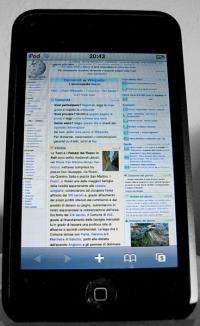
Will the iPod be able to heal itself of scratches? Image source: Goldmund100 via Wikimedia Commons

(PhysOrg.com) -- There are few things in life that are more annoying than having your iPod's beautiful face marred by scratches. But what if those scratches could "heal" themselves? New technology developed at the University of Southern Mississippi could lead to just that situation. And it would work on more than just your handheld music device: Scratches on furniture and cars could disappear as well.

It isn't magic, though. In order to protect your merchandise from scratches, it would be necessary to coat them with a special polyurethane treatment. The is clear, and its special properties are derived from chitosan. Chitosan is the material that makes the exoskeletons of such creatures as crustaceans and insects hard. The chitosan is combined with oxetane. Oxetane is ring-shaped -- and unstable. This becomes important for the healing of scratches.

When something scratches the coating, the oxetane ring is broken. The reactive ends of the broken rings are eager to re-bond to something. The ultraviolet rays of the sun act as an activation mechanism for the chitosan. The chitosan binds the molecule fragments together, closing the ring again and helping the scratch to "heal". The scratch appears to have disappeared, leaving the surface smooth once more. The process takes about half an hour in natural .

This new advance is significant because creating non-living coatings that can repair themselves is tricky work. From expandable gel to nanoparticles, the quest for a coating that heals its own scratches has come up short. The latest attempt, though, seems a little more promising. It combines natural sunlight with a substance that occurs naturally in nature. Bio-mimicry continues to provide interesting answers to perplexing problems of science and technology, and the use of chitosan as part of a self-healing polymer is another example.

The coating isn't quite ready for commercial use, however. There is no answer to what happens when a second scratch is made over the position of the first scratch. And what happens if you have intersecting scratches? Nevertheless, there is tremendous potential for this coating.

© 2009 PhysOrg.com


print this article email this article download pdf blog this article bookmark this article     Stumble it Digg this share on Facebook retweet share on Reddit add to delicious
Rate this story - 4.6 /5 (10 votes)

Rank Filter

Move the slider to adjust rank threshold, so that you can hide some of the comments.


Display comments: newest first

  • SincerelyTwo - Apr 02, 2009
    • Rank: not rated yet
    Or just get a coating over your device that *will not* scratch? There's a specific product on the market right now which people are using for the iPhone/iTouch, you can't scratch the stuff, it's insane.

    Of course I guess this wouldn't apply to getting in a car wreck and all the plastic reforming to its previous state. Is this article implying we could go that far? I'm thinking not - but that sure as hell would be cool.
  • dse471 - Apr 02, 2009
    • Rank: not rated yet
    TDK developed a coating a long time ago (before DVD-Rs had a foothold). Anyway, it was too expensive to be deemed worthwhile for these low-data density media. Now, though, the coating is used on Blu-ray discs and called Durabis. If you could put the coating on a $30 disc, why hasn't anyone marketed it on a $300 phone? People *would* pay for it..
  • DonR - Apr 03, 2009
    • Rank: not rated yet
    The applications are awesome, especially for items that regularly see sunlight anyway; car paint, sunglasses, building windows, car windscreens...

    And if we could get "repair kits" consisting of a UV lamp, the item would never need to see the sun anyway.

    There are other solutions, obviously, but I love this idea. I'd be entranced watching my sunglasses unscratch themselves while I wore them.
  • TJ_alberta - Apr 03, 2009
    • Rank: not rated yet
    need this for my glasses

April 2, 2009 all stories

Comments: 4

4.6 /5 (10 votes)
  • Stumble this up

  • Digg this

  • share this

  • hide
  • Related Stories


  • hide
  • Relevant PhysicsForums posts

  • Zinc Oxide reduction
    created 8 hours ago
  • depolymerization of HDPE
    created Nov 08, 2009
  • Question, whats the best chemistry software for a college student?
    created Nov 08, 2009
  • Why only opposite spin electrons in an orbital ?
    created Nov 08, 2009
  • More from Physics Forums - Chemistry

Other News

Toward home-brewed electricity with 'personalized solar energy'

Toward home-brewed electricity with 'personalized solar energy'

Chemistry / Materials Science

created Nov 04, 2009 | popularity 3.4 / 5 (9) | comments 4

New scientific discoveries are moving society toward the era of "personalized solar energy," in which the focus of electricity production shifts from huge central generating stations to individuals in their ...


Scientists Reproduce a Building Block of Life in Laboratory

Scientists Reproduce a Building Block of Life in Laboratory

Chemistry / Biochemistry

created Nov 06, 2009 | popularity 4.8 / 5 (23) | comments 0

(PhysOrg.com) -- NASA scientists studying the origin of life have reproduced uracil, a key component of our hereditary material, in the laboratory.


Newly Discovered Fat Molecule: An Undersea Killer with an Upside

Newly Discovered Fat Molecule: An Undersea Killer with an Upside

Chemistry / Biochemistry

created Nov 05, 2009 | popularity 4.8 / 5 (10) | comments 0

(PhysOrg.com) -- A chemical culprit responsible for the rapid, mysterious death of phytoplankton in the North Atlantic Ocean has been found by collaborating scientists at Rutgers University and the Woods Hole ...


CU-Boulder map of human bacterial diversity shows wide interpersonal differences

Map of Human Bacterial Diversity Shows Wide Interpersonal Differences

Chemistry / Biochemistry

created Nov 05, 2009 | popularity 4.7 / 5 (11) | comments 0

(PhysOrg.com) -- A University of Colorado at Boulder team has developed the first atlas of bacterial diversity across the human body, charting wide variations in microbe populations that live in different ...


Mimicking nature, scientists can now extend redox potentials

Mimicking nature, scientists can now extend redox potentials

Chemistry / Biochemistry

created Nov 04, 2009 | popularity 4.8 / 5 (5) | comments 0

(PhysOrg.com) -- New insight into how nature handles some fundamental processes is guiding researchers in the design of tailor-made proteins for applications such as artificial photosynthetic centers, long-range ...