Dissecting a stellar explosion
April 3, 2009 Dissecting a stellar explosion

Enlarge

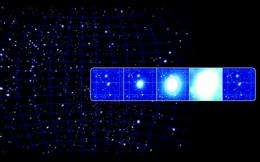
This artist's impression illustrates how a gamma-ray burst can flare dramatically over a short time period (gamma ray bursts usually last between a hundredth of a second to a hundred seconds). The bursts can occur as often as several times a day. There is no way to predict when or where they will next occur. ESA missions such as XMM-Newton, Integral and Ulysses study these mysterious, powerful bursts. Credits: ESA (Illustration by AOES Medialab)

(PhysOrg.com) -- Integral has captured one of the brightest gamma-ray bursts ever seen. A meticulous analysis of the data has allowed astronomers to investigate the initial phases of this giant stellar explosion, which led to the ejection of matter at velocities close to the speed of light. In particular, the astronomers believe that the explosion lifted a piece of the central engine's magnetic field into space.

On 19 December 2004, the blast from an exploding star arrived at Earth. ESA's Integral satellite, an orbiting gamma-ray observatory, recorded the entire event, providing information for what may prove to be one of the most important gamma-ray bursts (GRBs) seen in recent years. As the data was collected, astronomers saw the 500-second-long burst rise to extraordinary brilliance.

"It is in the top 1% of the brightest GRBs we have seen," says Diego Götz, CEA Saclay, France, who headed the investigation.

The brightness of the event, known as GRB 041219A, has allowed the team to perform a painstaking investigation to extract a property known as the polarisation of the . The team have shown that the gamma rays were highly polarised and varied tremendously in level and orientation.
Dissecting a stellar explosion
Enlarge

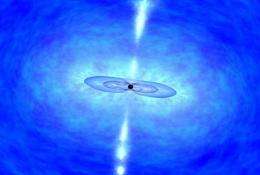
This artist's impression shows the centre of a dying star collapsing minutes before the star implodes. The blast from a Gamma Ray Burst is thought to be produced by a jet of fast-moving gas that bursts from near the central engine; probably a black hole created by such a collapse of the massive star. Credits: NASA/Dana Berr

Polarisation refers to the preferred direction in which the radiation wave oscillates. Polaroid sunglasses work with visible light by letting through only a single direction of polarisation, blocking most of the light from entering our eyes.

The blast from a GRB is thought to be produced by a jet of fast-moving gas bursting from near the central engine; probably a black hole created by the collapse of the massive star. The polarisation is directly related to the structure of the in the jet. So it is one of the best ways for astronomers to investigate how the central engine produces the jet. There are a number of ways this might happen.

In the first scenario, the jet carries a portion of the central engine's magnetic field into space. A second involves the jet generating the magnetic field far from the central engine. A third concerns the extreme case in which the jet contains no gas just magnetic energy, and a fourth scenario entails the jet moving through an existing field of radiation.

In each of the first three scenarios, the polarisation is generated by what is called synchrotron radiation. The magnetic field traps particles, known as electrons, and forces them to spiral, releasing polarised radiation. In the fourth scenario, the polarisation is imparted through interactions between the electrons in the jet and photons in the existing radiation field.

Götz believes that the Integral results favour a synchrotron model and, of those three, the most likely scenario is the first, in which the jet lifts the central engine's magnetic field into space. "It is the only simple way to do it," he says.

What Götz would most like to do is measure the polarisation for every GRB, to see whether the same mechanism applies to all. Unfortunately, many GRBs are too faint for the current instrumentation to succeed. Even the state-of-the-art IBIS instrument on Integral can only record the polarisation state of gamma rays if a celestial source is as bright as GRB 041219A.

"So, for now we just have to wait for the next big one," he says.

Source: European Space Agency (news : web)


print this article email this article download pdf blog this article bookmark this article     Stumble it Digg this share on Facebook retweet share on Reddit add to delicious
Rate this story - 4.5 /5 (6 votes)


April 3, 2009 all stories

Comments: 0

4.5 /5 (6 votes)
  • Stumble this up

  • Digg this

  • share this

  • hide
  • Related Stories

  • Robotic Telescope unravels mystery of cosmic blasts
    created Mar 15, 2007 | popularity not rated yet | comments 0
  • Swift Observes An Unusual Bang In The Far Universe
    created Apr 06, 2006 | popularity not rated yet | comments 0
  • Science with Integral -- 5 years on
    created Oct 17, 2007 | popularity not rated yet | comments 0
  • Gamma-ray bursts active longer than thought
    created May 23, 2007 | popularity not rated yet | comments 0
  • Gamma-Ray Burst Challenges Theory
    created Mar 08, 2007 | popularity not rated yet | comments 0


  • hide
  • Relevant PhysicsForums posts

  • Question about 2-body gravity
    created 14 hours ago
  • life on Mars
    created 16 hours ago
  • Semi-major axis from cartesian co-ordinates
    created Nov 23, 2009
  • Primary Mirror grinding
    created Nov 23, 2009
  • dark energy can escape black holes.
    created Nov 23, 2009
  • Are there green, purple and pink stars?
    created Nov 22, 2009
  • More from Physics Forums - General Astronomy

Other News

Cassini Captures Ghostly Dance of Saturn's Northern Lights

Cassini Captures Ghostly Dance of Saturn's Northern Lights (w/ Video)

Space & Earth / Space Exploration

created 6 hours ago | popularity 5 / 5 (3) | comments 0

(PhysOrg.com) -- In the first video showing the auroras above the northern latitudes of Saturn, Cassini has spotted the tallest known "northern lights" in the solar system, flickering in shape and brightness ...


First black holes may have incubated in giant, starlike cocoons, says CU-Boulder study

First black holes may have incubated in giant, starlike cocoons

Space & Earth / Astronomy

created 9 hours ago | popularity 4.7 / 5 (9) | comments 7

(PhysOrg.com) -- The first large black holes in the universe likely formed and grew deep inside gigantic, starlike cocoons that smothered their powerful x-ray radiation and prevented surrounding gases from ...


ET: Check your voicemail

ET: Check your voicemail

Space & Earth / Space Exploration

created 6 hours ago | popularity 3.4 / 5 (5) | comments 4

(PhysOrg.com) -- Alien beings on faraway planets may not have noticed, but it’s been 35 years since human beings made the first deliberate effort to send them a message.


The drying shores of the Dead Sea

Dead Sea needs world help to stay alive

Space & Earth / Environment

created 8 hours ago | popularity 3.7 / 5 (3) | comments 0

The Dead Sea may soon shrink to a lifeless pond as Middle East political strife blocks vital measures needed to halt the decay of the world's lowest and saltiest body of water, experts say.


From Greenhouse to Icehouse

From Greenhouse to Icehouse

Space & Earth / Earth Sciences

created 15 hours ago | popularity 4.8 / 5 (8) | comments 7

A new study that reconstructed ocean temperatures from millions of years ago could provide new insight into how the Earth responds to climate change.