Collapse of the ice bridge supporting Wilkins Ice Shelf appears imminent
April 3, 2009 Collapse of the ice bridge supporting Wilkins Ice Shelf appears imminent

Enlarge

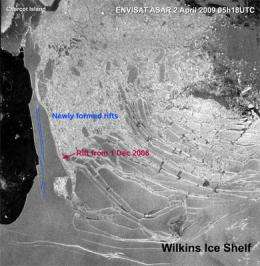
Envisat’s Advanced Synthetic Aperture Radar (ASAR) captured the early stage of the disruption of the ice bridge that connects the Wilkins Ice Shelf to Charcot and Latady Islands on 2 April 2009 at 05:18 UTC. The new rifts that developed along the length axis of the ice bridge are visible. The first detachment along these new rifts occurred about seven hours later. Credits: ESA (Annotations by A. Humbert, Münster University)

(PhysOrg.com) -- The Wilkins Ice Shelf is at risk of partly breaking away from the Antarctic Peninsula as the ice bridge that connects it to Charcot and Latady Islands looks set to collapse. The beginning of what appears to be the demise of the ice bridge began this week when new rifts forming along its centre axis resulted in a large block of ice breaking away.

The Advanced Synthetic Aperture Radar (ASAR) images acquired on 2 April by ESA’s Envisat satellite confirm that the rifts are quickly expanding along the bridge.

Dr Angelika Humbert from the Institute of Geophysics, Münster University, and Dr Matthias Braun from the Center for Remote Sensing, University of Bonn, witnessed the recent development during their daily monitoring activities of the ice sheet using data from Envisat and the German Aerospace Center’s TerraSAR-X satellite.

By having a time series of radar satellite images throughout this event, Humbert and Braun are able to determine how the rifts develop and how the narrowest part of the bridge responds to these changes. Knowing these details allows them to learn more about the behaviour of ice under stress.

Satellite acquisitions of the ice shelf are available to the public via ESA’s ‘Webcam from Space’. The web page will be updated with Envisat images as they are received to allow the public to witness the event.

By acquiring daily images of Antarctica that are easily accessible to scientists, ASAR has provided an unprecedented time series of the recent break-up events and allowed scientists to continuously monitor these developments to better understand the break-up process of ice shelves.
Collapse of the ice bridge supporting Wilkins Ice Shelf appears imminent
Enlarge

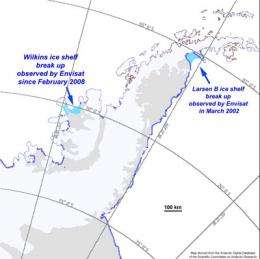
Map showing break-up events of Larsen-B and Wilkins ice shelves, as observed by Envisat, in Antarctica. Credits: ESA

Many changes occurred to the ice shelf in 2008, as witnessed by Envisat. In late February, 425 sq km of ice calved away, narrowing the ice bridge down to a 6-km strip. At the end of May a 160-sq-km chunk of ice broke away and reduced the ice bridge to just 2.7 km, leaving it only 900 m wide at its narrowest location.

"In the past months, we have observed the ice bridge deforming and its narrowest location acting as a kind of hinge," Humbert said.

"During the last year the ice shelf has lost about 1800 sq km or about 14% of its size. The break-up events in February and May 2008 happened in just hours, leaving the remaining part of the ice bridge in a fragile situation," Humbert explained. "Rift developments during October and November resulted presumably from the loss of 1220 sq km along the northern ice front during June and July 2008."

Antarctic’s ice sheet was formed by thousands of years of accumulated and compacted snow. Along the coast the ice gradually floats on the sea, forming massive ledges known as ice shelves. Several of these ice shelves, including seven in the past 20 years, have retreated and disintegrated.

The Wilkins Ice Shelf had been stable for most of the last century before it began retreating in the 1990s. Scientists are currently investigating the reasons and processes of the recent ice shelf break-ups and whether the current situation is linked to the extraordinary warming during the past 50 years, in which the has warmed by 2.5°C - far more than the global average.

Polar areas are very remote and the conditions often found there, such as restricted daylight and thick cloud cover, make it very difficult to carry out in situ research. The advent of satellites has allowed scientists to continuously monitor these regions.

ASAR is particularly suited for polar monitoring because it can operate at night and penetrate through clouds. Long-term satellite monitoring over Antarctica is important because it provides authoritative evidence of trends and allows scientists to make predictions.

Following the conclusion of the International Polar Year in March, ESA is compiling complete datasets over polar areas and making them available to polar scientists at no cost.

Provided by European Space Agency (news : web)


print this article email this article download pdf blog this article bookmark this article     Stumble it Digg this share on Facebook retweet share on Reddit add to delicious
Rate this story - 4.5 /5 (74 votes)

Rank Filter

Move the slider to adjust rank threshold, so that you can hide some of the comments.


Display comments: newest first

  • Mayday - Apr 03, 2009
    • Rank: 1 / 5 (1)
    Ah, could someone please catch this on video? From nearby.
  • SincerelyTwo - Apr 03, 2009
    • Rank: 3.3 / 5 (4)
    i'm confused about the details of the argument going on over the last few years on global warming. when people say it's a lie/scam/etc, is it the fear mongering over the claim that people are responsible? or are people denying that the earth can/does warm up and cool down periodically?

    there is research which suggests earth is not the only planet heating up at the moment.

    just wondering.
  • nkalanaga - Apr 03, 2009
    • Rank: 3 / 5 (6)
    A little of both. Some people refuse to accept the idea that humans CAN affect the Earth, and thus believe that any changes have to be natural. Others, fortunately very few, believe that the Earth doesn't change, and therefore any reported changes have to be false.

    And, there have been a few who have argued that ALL warming is caused by humans, which doesn't help matters. Yes, Mars and Jupiter also seem to be warming, although we really don't have data for a long enough period to know if this is a long-term trend. Most researchers agree that Earth is warming, and that humans are PARTLY responsible for that warming. Incidentally, we were also partly responsible for a cooling trend in the 50s and 60s, due to sulfur in the upper atmosphere. It reflected sunlight, countering warming from increasing CO2, but also caused acid rain. We have reduced sulfur emissions, and now the extra heat is getting through. As several people have said, "One can't do anything without side effects".
  • zbarlici - Apr 03, 2009
    • Rank: 3.2 / 5 (5)
    There was a article in the local Free Press about arctic ice, and how at the rate the thaw is happening, there will be no snow/ice in 30 years. Aparently the white color of the ice shelf reflects the sun`s light away from the earth. With the huge arctic ice shelf gone, i wonder what the changes would be with all that extra heat being dumped on the earth instead of being reflected away?
  • zbarlici - Apr 03, 2009
    • Rank: 2 / 5 (1)
    ah here is the article i was referring to

    http://tiny.cc/TOV1e
  • mikiwud - Apr 04, 2009
    • Rank: 2.9 / 5 (7)
    I see we have some "newbies" to this debate.
    There are two main sides,
    The "Warmists" who believe that Man, through Carbon Dioxide released by burning fossil fuels, is responsible for all the warming since the start of the industrial age.
    The second, "Sceptics", who think that the changes in climate are mostly natual.
    Whatever drove the changes in the past (thousands or millions of years),the warmists say it is something different this time (i.e. CO2) and by cutting back we can change it.(Tax us into oblivion)
    The sceptics say there is no proof that CO2 is the main driver and that any other causes (and there are many), however small or large, prove the warmists wrong.
    I am a sceptic as regular posters will be quick to tell you. Keep an open mind and do your own research.
    Try www.icecap.us or www.wattsupwiththat.com for starters. www.junkscience.com is another good site, and gives a few more links at the bottom.
    BTW, The Earth has not warmed in the past decade, even cooled a bit.
    Cheers,
    Mick.
    PS. Ignore articles in the Main Stream Media,especially the BBC, most are biased (as it will soon become obvious).
  • Bewter - Apr 04, 2009
    • Rank: 3 / 5 (1)
    Anyone know how much of the suns energy is stored in ocean salt water. I'm curious if diluted with fresh water from an ice shelf what impact it could have upon weather patterns.
  • nkalanaga - Apr 06, 2009
    • Rank: 1.5 / 5 (2)
    Fresh and salt water store about the same amount of heat, and any salt water in contact with the melting shelf is already close to freezing, so the melting in itself won't have much effect. It could change ocean density, and affect circulation patterns, and water is darker than ice, so the newly ice-free water will absorb more heat.

    As for the "sceptics", I note that they, by mikiwud's definition, deny that humans have any effect, simply because there may be other factors. I'm in the middle, as it's unlikely that our doubling of the CO2 level in the last century has NO effect. As for CO2's effect on greenhouse warming, if the atmosphere had no CO2, the average temperature of the Earth would be below freezing. But there can be too much of a good thing.

    And, anyone who disagrees with a "sceptic" is automatically biased, and therefore, wrong?
  • mikiwud - Apr 07, 2009
    • Rank: 3 / 5 (2)
    nkalanaga,
    Don't missquote me. I said MOSTLY natural and that there is no proof that CO2 is the MAIN driver of climate change (and this is true, unless any one can point to a scientific paper, not a computer model)
    Sceptics point out that a LOT of other drivers have been shown, not by computer models, to effect the climate. Therefore, CO2 CANNOT be the only driver and pobably not even the main one.
    The only ones who disagree with sceptics can only be ones who say CO2 is the ONLY driver. Anyone else must then be a sceptic, even if they don't realise or admit it.
  • Velanarris - Apr 07, 2009
    • Rank: 4.5 / 5 (2)
    I'm also a skeptic, one of the more outspoken ones at that. Rather than "tell" you how to think as some members of the AGW and the anti-AGW camps do with arguments from authority, I encourage you to do some research before comming to a decision either way.

    Personally, due to the masked effects of CO2 and it's low concentration I don't think anthropogenically released CO2 is a main driver in any way shape or form. This is partially ue to quantity. Humans have generated, over the entire industrial age 0.028% of the atmosphere's CO2 content. Atmospheric CO2 totals are below 0.03% of the total atmospheric makeup.

    I do believe man can affect climate, but more so through land use changes, building skyscrapers, leveling hills and mountains, etc.

    If you'd like to discuss your view, or mine at length, I always make myself available through the PM system.
  • nkalanaga - Apr 07, 2009
    • Rank: 4 / 5 (1)
    Mikiwud: in your words "any other causes (and there are many), however small or large, prove the warmists wrong."

    Yes, by your definition, since you claim that "warmists" believe that humans are the sole cause.

    "The "Warmists" who believe that Man, through Carbon Dioxide released by burning fossil fuels, is responsible for all the warming since the start of the industrial age."

    You leave no room for those, and there are many, who believe that there are multiple causes, AND that humans are the primary cause. Both you, and the "warmists", are absolutists, while the truth is somewhere in the middle.
  • mikiwud - Apr 08, 2009
    • Rank: not rated yet
    nkalanaga,
    Sorry, I probably used the wrong word in "warmist" when I should have said "Gorist".Al Gore, Jim Hanson and many governments (through the IPCC) blame Man and CO2 for all the Global Warming as you and your definition of warmists sensibly do not.
    The difference between "sceptics" and your definition of "warmist" is only the level of each cause and is thus open to friendly debate.
    Gorists, who I used to call warmists, believe blindly in 100% man and CO2 being the cause as almost a religion. Being as they cannot prove this
    they resort to personal attacks and fudging data to discredit the opposition. Hanson, Mann and others have been shown to do this. It was wrong of me to group all in this camp.
    All climate models presume water vapour causes a positive feedback to the agreed slight increase in temp caused by CO2 (2 to 4 times). This has been shown to be wrong and the feedback is negative.
    Another main point to be discused is whether increased warming is a bad thing, it never was in the past. That is why Mann et al tried to deny the Medieval Warm Period in his Hockey Stick graph. I think we ALL would agree that cooling definitly is bad.
    It seems we have three not two groups, two open to discusion and one,not. Sceptic do not believe in any one thing, just that something is wrong. We don't want to change the world, just stop others doing so in the name of a false "god".
    Thoughts?

    BTW, I have been personaly attacked in another thread by someone I had not commented on (or even seen the name before), in a thread I had not up that point posted in. It makes life a bit more interesting. I will try not to catagorise people in future unless really necessary. (catAlGorise? sorry could not resist it)
    Mick.
  • lengould100 - Apr 08, 2009
    • Rank: 1 / 5 (1)
    I tend to believe the expert scientists who've been studying this issue for many years.
  • Velanarris - Apr 08, 2009
    • Rank: 5 / 5 (1)
    I tend to believe the expert scientists who've been studying this issue for many years.

    So the geologists and AGW skeptics who've been studying on the ground in the Artic and Antartic for years who are diametrically opposed to your view are correct? Or are you selectively deciding who to believe based off of 30 years worth of satellite data from some rocketeers? Keep in mind the most famous rocketeers Hansen and Mann, are physicists, not climatologists, meterologists, or geologists.

April 3, 2009 all stories

Comments: 14

4.5 /5 (74 votes)
  • Stumble this up

  • Digg this

  • share this

  • hide
  • Related Stories

  • Wilkins Ice Shelf under threat
    created Nov 28, 2008 | popularity not rated yet | comments 0
  • 'Webcam' from Space: Envisat observing Wilkins Ice Shelf
    created Dec 12, 2008 | popularity not rated yet | comments 0
  • Even the Antarctic winter cannot protect Wilkins Ice Shelf
    created Jun 13, 2008 | popularity not rated yet | comments 0
  • Wilkins Ice Shelf hanging by its last thread
    created Jul 10, 2008 | popularity not rated yet | comments 0
  • Antarctic ice shelf 'hangs by a thread'
    created Mar 25, 2008 | popularity not rated yet | comments 0


  • hide
  • Relevant PhysicsForums posts

Other News

Astronauts finish another spacewalk, still no baby (AP)

Astronauts finish another spacewalk, still no baby

Space & Earth / Space Exploration

created 9 hours ago | popularity 3 / 5 (2) | comments 0

(AP) -- A spacewalking astronaut put aside the impending birth of his daughter and blazed through his first-ever venture outside the International Space Station on Saturday.


Unseasonably hot and dry weather combined with strong winds to fan scores of blazes in the country's southeastern states

Australia issues 'catastrophic' alerts as fires rage

Space & Earth / Environment

created 15 hours ago | popularity 4 / 5 (3) | comments 0

Australia has issued "catastrophic" alerts after record-breaking temperatures and wild lightning storms sparked more than 100 fires across the country, officials said Saturday.


Commuters wait on the platform shrouded by fog in London

Climate change not man-made, say majority of Britons: poll

Space & Earth / Environment

created Nov 15, 2009 | popularity 3.3 / 5 (15) | comments 46

Less than half of Britons believes that human activity is to blame for global warming, according to a poll carried out for The Times newspaper and published on Saturday.


Mysteriously warm times in Antarctica

Mysteriously warm times in Antarctica

Space & Earth / Earth Sciences

created Nov 18, 2009 | popularity 4.2 / 5 (21) | comments 28

(PhysOrg.com) -- A new study of Antarctica's past climate reveals that temperatures during the warm periods between ice ages (interglacials) may have been higher than previously thought. The latest analysis ...


UN: Fight climate change with free condoms (AP)

UN: Fight climate change with free condoms

Space & Earth / Environment

created Nov 18, 2009 | popularity 3.1 / 5 (11) | comments 24

(AP) -- The battle against global warming could be helped if the world slowed population growth by making free condoms and family planning advice more widely available, the U.N. Population Fund said Wednesday.