Norway joins EU's Galileo satnav project
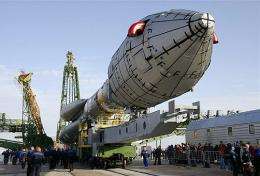
April 3, 2009 Workmen prepare the Galilieo satellite of the European Space Agency

Enlarge

Workmen prepare the Galilieo satellite of the European Space Agency (ESA) on its launch pad at Kazakhstan's Baikonur cosmodrome in 2008. Norway said it will stump up close to 70 million euros in funding for the European Union's satellite navigation project Galileo.

Norway said Friday it will stump up close to 70 million euros in funding for the European Union's satellite navigation project Galileo.

The Norwegian government will give a boost by providing 68.9 million euros (92.5 million dollars) towards the 3.4 billion euro project.

While Norway is not a member of the 27-member bloc, the country's economy and business minister Sylvia Brustad said it was important that Oslo took part in Galileo's development.

"The project will be of huge importance for the development of the European space industry and it is therefore important that Norwegian businesses are now able to compete," Brustad said in a statement.

The EU has previously struggled to secure financing for , which is expected to be launched in 2013 as a rival to the US (GPS), and had to release unused funds from the bloc's massive agricultural budget.

In September, the European Commission and the , which includes Norway as a member, shortlisted 11 European firms which are bidding for future contracts connected to Galileo.

Two test satellites, Giove-A and Giove-B, were launched in December 2005 and April 2008.

When fully operational, Galileo will use as many as 30 satellites.

(c) 2009 AFP


print this article email this article download pdf blog this article bookmark this article     Stumble it Digg this share on Facebook retweet share on Reddit add to delicious
Rate this story - 2.3 /5 (3 votes)

Rank Filter

Move the slider to adjust rank threshold, so that you can hide some of the comments.


Display comments: newest first


April 3, 2009 all stories

Comments: 1

2.3 /5 (3 votes)
  • Stumble this up

  • Digg this

  • share this

  • hide
  • Related Stories

  • Europe Wants To Speed Up Galileo GPS Program
    created Nov 18, 2005 | popularity not rated yet | comments 0
  • Two years in space for Galileo satellite
    created Dec 19, 2007 | popularity not rated yet | comments 0
  • Galileo launch delayed
    created Mar 13, 2006 | popularity not rated yet | comments 0
  • First Galileo satellite travels to launch site
    created Dec 01, 2005 | popularity not rated yet | comments 0
  • First Member Of Galileo Satellite Family To Be Launched 26 December
    created Dec 15, 2005 | popularity not rated yet | comments 0


  • hide
  • Relevant PhysicsForums posts

  • The shape of our solar system's orbits.
    created Nov 07, 2009
  • Above or Below the Line of Nodes
    created Nov 07, 2009
  • Supernova vs. Nova?
    created Nov 07, 2009
  • Supernova's Gamma Rays and Comets
    created Nov 06, 2009
  • More from Physics Forums - General Astronomy

Other News

Deep creep means milder, more frequent earthquakes along Southern California's San Jacinto fault

Deep creep means milder, more frequent earthquakes along Southern California's San Jacinto fault

Space & Earth / Earth Sciences

created 19 hours ago | popularity 4.5 / 5 (4) | comments 0

With an average of four mini-earthquakes per day, Southern California's San Jacinto fault constantly adjusts to make it a less likely candidate for a major earthquake than its quiet neighbor to the east, the ...


Success in 'space elevator' competition (AP)

Success in 'space elevator' competition (Update 3)

Space & Earth / Space Exploration

created Nov 05, 2009 | popularity 4.3 / 5 (33) | comments 50

(AP) -- A robot powered by a ground-based laser beam climbed a long cable dangling from a helicopter on Wednesday to qualify for prize money in a $2 million competition to test the potential reality of the ...


In a Galaxy Far, Far Away...

In a Galaxy Far, Far Away...

Space & Earth / Astronomy

created Nov 06, 2009 | popularity 4.8 / 5 (5) | comments 17

(PhysOrg.com) -- Astronomers have published the discovery of the farthest known object in the cosmos: a star that exploded when the universe was only 630 million years old -- only 4.6% of its current age. ...


'Dropouts' pinpoint earliest galaxies

'Dropouts' pinpoint earliest galaxies

Space & Earth / Astronomy

created Nov 06, 2009 | popularity 4.2 / 5 (10) | comments 13

Astronomers, conducting the broadest survey to date of galaxies from about 800 million years after the Big Bang, have found 22 early galaxies and confirmed the age of one by its characteristic hydrogen signature ...


Space hotel taking bookings for 2012 opening

Space hotel taking bookings for 2012 opening

Space & Earth / Space Exploration

created Nov 05, 2009 | popularity 4.4 / 5 (21) | comments 11

(PhysOrg.com) -- The first orbiting space hotel is on track to open for its first customers in 2012, but hurry, as bookings are filling fast.