Researchers Demonstrate a New Model for Drug Discovery With a Fluorescent Anesthetic
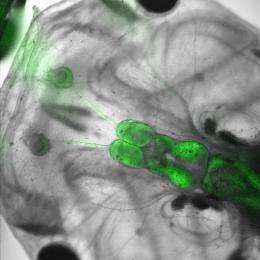
(PhysOrg.com) -- A collaboration of University of Pennsylvania and University of Wisconsin chemists and anesthesiologists have identified a fluorescent anesthetic compound that will assist researchers in obtaining more precise information about how anesthetics work in the body and will provide a means to more rapidly test new anesthetic compounds in the search for safer and more effective drugs.
The study is published online in the Proceedings of the National Academy of Science.
Using the fluorescing compound 1-aminoanthracene, or 1-AMA, the team developed a high-throughput assay to test for new anesthetic compounds. The assay will allow researchers to search for new anesthetic drugs and new molecular targets for anesthetics while at the same time creating high-resolution images of the compounds in action, a missing component that has hindered anesthetic research.
Researchers confirmed the compound as anesthetic after testing it successfully in tadpoles. By using transparent, albino tadpoles in the study, researchers were able to follow the fluorophore tag and image it in the brain of the immobilized, living animal. Because the compound is fluorescent, researchers are able to image the compound in vivo in order to study its physiological effects. Where and how an anesthetic compound travels in an organism when administered and to what cells and concentrations are unknown in anesthetic administration and a key to improving efficacy and to reducing side effects. Because anesthetics bind weakly to their chemical targets, which may play a role in some of the unintended side effects, searching for new targets in the central nervous system is difficult.
“We don't know much about how anesthetics work at a molecular level,” said Roderic G. Eckenhoff, MD, vice chair for research and the Austin Lamont Professor of Anesthesiology and Critical Care at Penn’s School of Medicine. “Thus, the development of new anesthetics has become a stagnant field. This new tool will allow for the high-throughput screening of novel drugs.”
Researchers from the School of Medicine and School of Arts and Sciences at Penn initiated the study in response to the health-care industry’s need for new and more powerful tools to discover and test new anesthetics and to learn more about how they work. The authors identified 1-AMA in a screen for compounds that bind to a cavity in horse spleen apoferritin, HSAF, that Eckenhoff and co-workers have shown to bind clinical anesthetics.
Researchers noticed a resemblance in the crystal structure of the apoferritin protein to that of the transmembrane region of the superfamily of ligand-gated channels that includes the GABA receptor. Anesthetics are known to positively modulate GABA signaling.
Because 1-AMA competes with other anesthetics to bind to apoferritin, researchers surmised that the protein likely binds to the same region of apoferritin as traditional anesthetics and thus shares their mechanism of action. Fluorescence of 1-AMA is enhanced when bound to apoferritin. Thus, displacement of 1-AMA by other anesthetics attenuates the fluorescence signal and allows determination of anesthetic affinity, that is, the drugs that bind tightly to the ferritin anesthetic site. In this way, 1-AMA fluorescence could be used to discover new anesthetics. This provides a unique fluorescence assay for compound screening and anesthetic discovery.
Using confocal microscopy to image the distribution of the protein, the team found that 1-AMA localizes largely in the brain and olfactory regions, unlike some general anesthetics which spread widely throughout the body. Ideally, clinical anesthetics would have a very focused target area in order to minimize systemic toxicity.
The Penn team will now collaborate with the National Chemical Genomics Center in Rockville, Md., to screen rapidly for novel anesthetic compounds, allowing for the screening of hundreds of thousands of new compounds per week.
“The 1-AMA compound opens up new avenues for identifying the relevant biomolecular targets of general anesthetics,” Ivan J. Dmochowski, PhD, assistant professor in the Department of Chemistry at Penn, said.
“1-AMA appears to be specific in its binding to proteins and also in its in vivo localization, which should give us the opportunity to determine its mechanism of action,” he said. “We hope to be able to extend our findings to learn how current general anesthetics, such as propofol, work in human patients. There are many different and challenging aspects of trying to learn how anesthetics work that involve medicinal chemistry, biochemistry, molecular modeling, imaging, cell electrophysiology, pharmacology, neurobiology and animal physiology.”
According to the study, 1-AMA increases the transmission potential of the body’s main neurotransmitter inhibitor, GABA. The compound also gives an appropriate dissociation constant, Kd 0.1 mM, for binding to the general anesthetic site in horse spleen apoferritin, meaning the compound is behaving as traditional general anesthetics would in humans.
In use for more than 150 years, general anesthetics are one of medicine’s greatest advances and yet there is still much to be learned about them. For many of the most commonly used anesthetic compounds, the molecular mechanisms behind their numbing effects and the way these compounds travel the pathways of the body remain poorly understood or altogether unknown.
According to the study team, anesthetics can bring on potentially harmful, even deadly, side effects for patients including rapid drops in blood pressure and heart rate, nausea and potentially irreversible cognitive problems, especially in older patients.
Provided by Pennsylvania State University (news : web)


