Nicotine may have more profound impact than previously thought
April 3, 2009
Nicotine may have more profound impact than previously thought

Enlarge

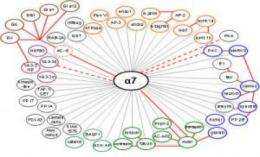
Researchers have found that the alpha-7 receptor, a site known to bind with nicotine, interacts with 55 different proteins. Nicotine may affect bodily processes -- and perhaps the actions of other commonly used drugs -- more broadly than was previously thought. Credit: Credit: Hawrot Lab/Brown University

Nicotine isn't just addictive. It may also interfere with dozens of cellular interactions in the body, new Brown University research suggests.

Conversely, the data could also help scientists develop better treatments for various diseases. Pharmaceutical companies rely on basic research to identify new cellular interactions that can, in turn, serve as targets for potential new drugs.

"It opens several new lines of investigation," said lead author Edward Hawrot, professor of molecular science, molecular pharmacology, physiology and biotechnology at Brown University.

Hawrot's research is highlighted in a paper published April 3 in the . He and a team that included graduate students William Brucker and Joao Paulo set out to provide a more basic understanding of how affects the process of cell communication through the mammalian .

The Brown University researchers looked specifically at the alpha-7 nicotinic acetylcholine receptor in mouse . A very similar receptor exists in humans. The alpha-7 receptor is the most enigmatic of the so-called "nicotinic" receptors, so named because nicotine binds to them when it is introduced into the body. Most receptors are on the surface of cells and are sensitive to small signaling molecules such as the neurotransmitter acetylcholine, which is the naturally occurring signal the body uses to activate alpha-7 receptors.

Their discovery: 55 proteins were found to interact with the alpha-7 nicotinic receptor. Scientists had not previously known of those connections.

"This is called a "nicotinic" receptor and we think of it as interacting with nicotine, but it likely has multiple functions in the brain," Hawrot said. "And in various, specific regions of the brain this same alpha-7 receptor may interact with different proteins inside neurons to do different things."

One in particular — the G alpha — was among the most unexpected proteins to be identified in the study, as it is usually associated with a completely different class of receptors (the eponymous G-protein coupled receptors (GPCRs).

This finding is significant because G alpha proteins are involved in many different biochemical and signaling processes throughout the brain and the rest of the body. body.

An example of the importance of G alpha proteins: 40 percent of all currently used therapeutic drugs target a member of the large GPCR family of receptors.

The new finding suggests that the alpha-7 receptors have a much broader role in the body than previously suspected and that the newly identified associated proteins could also be affected when nicotine binds to the alpha-7 receptor.

Nicotine may affect bodily processes — and perhaps the actions of other commonly used drugs — more broadly than was previously thought.

This advance could lead to the development of new treatments to combat smoking addiction. At the same time, the finding could also have future implications for diseases such as schizophrenia, Hawrot said.

Recent genetic studies have suggested that some cases of schizophrenia are associated with deletions where a block of genes, including the gene for the alpha-7 receptor, is missing. Hawrot said the connection, while not conclusive, offers hope for new strategies in the development of treatments for those suffering from the disorder.

To conduct their study, Hawrot's lab looked at mice genetically engineered by other researchers to lack the alpha-7 nicotinic acetylcholine receptor. Those mice were compared with normal mice, so the difference in receptor-associated proteins could be highlighted.

Source: Brown University (news : web)

4.6 /5 (7 votes)  

Filter


Move the slider to adjust rank threshold, so that you can hide some of the comments.


Display comments: newest first

cmn
Apr 04, 2009

Rank: not rated yet
This isn't surprising, as anyone that has smoked for awhile than quit will notice a change in bodily function after a couple weeks.
E_L_Earnhardt
Apr 04, 2009

Rank: not rated yet
And nicotine sprays on all our vegitables just before harvest?? Pipe smokers out-live cigarette smokers!? (They even outlive non-smokers!) Electron
speed & spin,("HEAT") increases mitosis rate! COOL the cells and the cancer stops!
el_gramador
Apr 04, 2009

Rank: not rated yet
Okay, just provide a vector that doesn't kill surrounding cells and you are golden.
Rank 4.6 /5 (7 votes)
Relevant PhysicsForums posts
  • We the immaterial soul
    created6 hours ago
  • Is Everyday Technology Killing Us?
    createdFeb 08, 2012
  • Exercise and weight loss
    createdFeb 08, 2012
  • Why do we have head aches? Our brains can't feel anything.
    createdFeb 07, 2012
  • "The end of diseases" by David Agus, interview from Daily Show with Jon Stewart
    createdFeb 04, 2012
  • Oncolytic adenovirus
    createdFeb 04, 2012
  • More from Physics Forums - Medical Sciences

More news stories

FDA-approved drug rapidly clears amyloid from the brain, reverses Alzheimer's symptoms in mice

Neuroscientists at Case Western Reserve University School of Medicine have made a dramatic breakthrough in their efforts to find a cure for Alzheimer's disease. The researchers' findings, published in the journal Science, show t ...

Medicine & Health / Neuroscience

created Feb 09, 2012 | popularity 4.9 / 5 (53) | comments 21 | with audio podcast

Green tea found to reduce disability in the elderly

(Medical Xpress) -- A lot of research has been done over the past several years looking into the health benefits of green tea. As a result, scientists have found that regular consumption of the beverage leads ...

Medicine & Health / Health

created Feb 07, 2012 | popularity 4.4 / 5 (14) | comments 11 | with audio podcast report

Teen school drop-outs three times as likely to be on benefits in later life

Teen school drop-outs are almost three times as likely to be on benefits in later life as their peers who complete their schooling, indicates research published online in the Journal of Epidemiology and Community Health.

Medicine & Health / Health

created Feb 06, 2012 | popularity not rated yet | comments 12

To perform with less effort, practice beyond perfection

Whether you are an athlete, a musician or a stroke patient learning to walk again, practice can make perfect, but more practice may make you more efficient, according to a surprising new University of Colorado Boulder study.

Medicine & Health / Neuroscience

created Feb 09, 2012 | popularity 4.4 / 5 (15) | comments 6 | with audio podcast

Anyone can learn to be more inventive, cognitive researcher says

There will always be a wild and unpredictable quality to creativity and invention, says Anthony McCaffrey, a cognitive psychology researcher at the University of Massachusetts Amherst, because an "Aha moment" is rare and ...

Medicine & Health / Psychology & Psychiatry

created Feb 09, 2012 | popularity 4.6 / 5 (11) | comments 5 | with audio podcast


Google might launch Drive for cloud storage soon

(PhysOrg.com) -- Google's next big move, according to the Wall Street Journal, is a cloud storage service called Drive. Hardly first to the plate, Google is simply catching up to introducing its cloud reposi ...

Walney offshore wind farm is world's biggest (for now)

(PhysOrg.com) -- The Walney wind farm on the Irish Sea--characterized by high tides, waves and windy weather--officially opened this week. The farm is treated in the press as a very big deal as the Walney ...

Latin America mining boom clashes with conservation

Latin America is experiencing a mining boom as prices rise fuelled by a hike in global demand, but the region is also being hit by a wave of violent protests, strikes and rallies by environmentalists.

Love a click away in Indonesia's Twitter Republic

He was a geeky kid from Yogyakarta, she a glamorous city girl in Jakarta. In a country with one of the world's most vibrant social networking scenes they fell in love on Twitter.

Europeans protest controversial Internet pact

Tens of thousands of people marched in protests in more than a dozen European cities Saturday against a controversial anti-online piracy pact that critics say could curtail Internet freedom.

Navy to begin tests on electromagnetic railgun prototype launcher

The Office of Naval Research (ONR)'s Electromagnetic (EM) Railgun program will take an important step forward in the coming weeks when the first industry railgun prototype launcher is tested at a facility ...