A young pulsar shows its hand
April 3, 2009
A young pulsar shows its hand

Enlarge

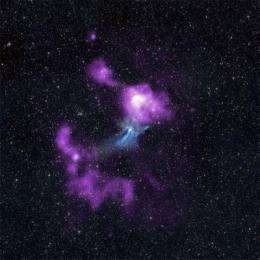
This image contains infrared, X-ray, and radio data. It shows the environment into which the pulsar's nebula is expanding. Credit: X-ray: NASA/CXC/SAO/P. Slane et al; Infrared: 2MASS/UMass/IPAC-Caltech; Radio: Molonglo Obs. Synthesis Tel.

A small, dense object only twelve miles in diameter is responsible for this beautiful X-ray nebula that spans 150 light years. At the center of this image made by NASA's Chandra X-ray Observatory is a very young and powerful pulsar, known as PSR B1509-58, or B1509 for short. The pulsar is a rapidly spinning neutron star which is spewing energy out into the space around it to create complex and intriguing structures, including one that resembles a large cosmic hand.

In this image, the lowest energy X-rays that Chandra detects are red, the medium range is green, and the most energetic ones are colored blue. Astronomers think that B1509 is about 1,700 years old and is located about 17,000 light years away.

Neutron stars are created when run out of fuel and collapse. B1509 is spinning completely around almost 7 times every second and is releasing energy into its environment at a prodigious rate -- presumably because it has an intense magnetic field at its surface, estimated to be 15 trillion times stronger than the Earth's magnetic field.

A young pulsar shows its hand
Enlarge

At the center of this Chandra image, a pulsar -- only twelve miles in diameter -- is responsible for this X-ray nebula that spans 150 light years. This pulsar is spinning around almost 7 times a second and has a magnetic field at its surface estimated to be 15 trillion times stronger than the Earth's magnetic field. This combination of rapid rotation and ultra-strong magnetic field drives an energetic wind of electrons and ions, ultimately creating the elaborate nebula seen by Chandra. Credit: NASA/CXC/SAO/P. Slane et al.

The combination of rapid rotation and ultra-strong magnetic field makes B1509 one of the most powerful electromagnetic generators in the Galaxy. This generator drives an energetic wind of electrons and ions away from the neutron star. As the electrons move through the magnetized nebula, they radiate away their energy and create the elaborate nebula seen by Chandra.

In the innermost regions, a faint circle surrounds the pulsar, and marks the spot where the wind is rapidly decelerated by the slowly expanding nebula. In this way, B1509 shares some striking similarities to the famous Crab Nebula. However B1509's nebula is 15 times wider than the Crab's diameter of 10 light years.

Finger-like structures extend to the north, apparently energizing knots of material in a neighboring known as RCW 89. The transfer of energy from the wind to these knots makes them glow brightly in X-rays (orange and red features to the upper right). The temperature in this region appears to vary in a circular pattern around this ring of emission, suggesting that the pulsar may be precessing like a spinning top and sweeping an energizing beam around the gas in RCW 89.

Source: Chandra X-ray Center

4.7 /5 (22 votes)  

Filter


Move the slider to adjust rank threshold, so that you can hide some of the comments.


Display comments: newest first

SincerelyTwo
Apr 03, 2009

Rank: 4.2 / 5 (5)
"A small, dense object only twelve miles in diameter is responsible for this beautiful X-ray nebula that spans 150 light years."

... hhooollyyyyyy sshhh****tttttt!

5/5 for mind boggling proportions of information.

Modernmystic
Apr 03, 2009

Rank: 2.8 / 5 (5)
Yeah I gotta say I was EXTREMELY impressed with the whole 12 miles in diameter to 150 light years across ratio too...

Put these kind of objects into a better perspective for me.
yyz
Apr 03, 2009

Rank: 4 / 5 (1)
I find it interesting that this XR image shows the possible interaction of the pulsar and nearby nebula RCW 89, and with a possible precessing pulsar jet to boot! And the dimensions compared to the Crab Nebula (M 1) is astounding! Imagine the strength of the magnetic field.
barkster
Apr 03, 2009

Rank: 4 / 5 (2)
It was the "15 trillion times stronger than the Earth's magnetic field" that boggled me. Imagine what the iron in your blood would do in the presence of THAT magnetic field.
jyro
Apr 05, 2009

Rank: 2.5 / 5 (2)
The problem I'm having is that it's 1700 years old and 17,000 light years away, how can we see it? Do x-rays travel faster than light?
Fakeer
Apr 05, 2009

Rank: 4.5 / 5 (2)
all electromagnetic radiation travels at c. I think here however they are saying that the pulsar is 1700yrs old. which means it may have been a stellar object for millions of years prior to that till the advent of its collapse. but I don't recall when during the process of this implosion do x-ray emissions begin.
yyz
Apr 06, 2009

Rank: not rated yet
I'm curious as to how the diameter of the pulsar itself was determined? Although predominately mentioned in the article, no explanation of how they obtained this figure is mentioned.
Rank 4.7 /5 (22 votes)
Related Stories
Relevant PhysicsForums posts
  • Never ending outer space.....
    created12 hours ago
  • Neutron Star fragments?
    created14 hours ago
  • stationary or not?
    created18 hours ago
  • Scale of the Universe
    createdFeb 10, 2012
  • Titan's lack of impact craters
    createdFeb 09, 2012
  • Real pictures of black hole eating a star?
    createdFeb 08, 2012
  • More from Physics Forums - General Astronomy

More news stories

Latin America mining boom clashes with conservation

Latin America is experiencing a mining boom as prices rise fuelled by a hike in global demand, but the region is also being hit by a wave of violent protests, strikes and rallies by environmentalists.

Space & Earth / Environment

created 5 hours ago | popularity not rated yet | comments 0

Political leaders play key role in how worried Americans are by climate change: study

More than extreme weather events and the work of scientists, it is national political leaders who influence how much Americans worry about the threat of climate change, new research finds.

Space & Earth / Environment

created Feb 06, 2012 | popularity 5 / 5 (6) | comments 72

NASA budget will axe Mars deal with Europe: scientists

US President Barack Obama's budget proposal to be submitted next week for 2013 will cut NASA's budget by 20 percent and eliminate a major partnership with Europe on Mars exploration, scientists said Thursday.

Space & Earth / Space Exploration

created Feb 10, 2012 | popularity 5 / 5 (3) | comments 55

Humans may have helped the decline of African rainforests 3000 years ago

(PhysOrg.com) -- Large areas of rainforests in Central Africa mysteriously disappeared over three thousand years ago, to be replaced by savannas. The prevailing theory has been that the cause was a change ...

Space & Earth / Environment

created Feb 10, 2012 | popularity 4.1 / 5 (14) | comments 20 | with audio podcast report

High planetary tilt lowers odds for life?

Highly-tilted worlds would have extreme seasons, subjecting life to alternating periods of scorching and subzero temperatures. This could make the development of all but hardiest, simplest creatures a long ...

Space & Earth / Space Exploration

created Feb 06, 2012 | popularity 4.8 / 5 (12) | comments 14 | with audio podcast


Google might launch Drive for cloud storage soon

(PhysOrg.com) -- Google's next big move, according to the Wall Street Journal, is a cloud storage service called Drive. Hardly first to the plate, Google is simply catching up to introducing its cloud reposi ...

Love a click away in Indonesia's Twitter Republic

He was a geeky kid from Yogyakarta, she a glamorous city girl in Jakarta. In a country with one of the world's most vibrant social networking scenes they fell in love on Twitter.

Europeans protest controversial Internet pact

Tens of thousands of people marched in protests in more than a dozen European cities Saturday against a controversial anti-online piracy pact that critics say could curtail Internet freedom.

Walney offshore wind farm is world's biggest (for now)

(PhysOrg.com) -- The Walney wind farm on the Irish Sea--characterized by high tides, waves and windy weather--officially opened this week. The farm is treated in the press as a very big deal as the Walney ...

Navy to begin tests on electromagnetic railgun prototype launcher

The Office of Naval Research (ONR)'s Electromagnetic (EM) Railgun program will take an important step forward in the coming weeks when the first industry railgun prototype launcher is tested at a facility ...

Explained: Sigma

It's a question that arises with virtually every major new finding in science or medicine: What makes a result reliable enough to be taken seriously? The answer has to do with statistical significance -- but ...