As West warms, some fear for tiny mountain dweller
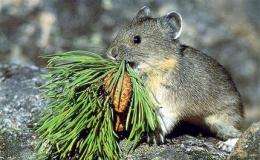
(AP) -- The American pika - a short-legged, hamster-sized fur ball that huddles in high mountain slopes - isn't built for long-distance travel.
So as the West's climate warms, the tiny pika has little choice but to scurry a little farther upslope to beat the heat.
Problem is, in some places, they've run out of room to run, according to scientists. Without cool rocky refuges, the finicky pika can't survive.
Soon, if conservationists have their way, the pika could be the first species in the lower 48 states to get federal endangered species protections primarily because of the effects of climate change.
"It's feeling an exaggerated brunt of global warming," said Greg Loarie, an Earthjustice attorney involved with lawsuits to get the pika protections. "Unlike others, it can't move north. It's stuck."
The U.S. Fish and Wildlife Service is scheduled to decide by May 1 whether to take an in-depth look at the pika - a diminutive relative of the rabbit that inhabits 10 Western states - and whether it may need to be on the endangered species list.
The polar bear is already listed because of threats of global warming. The pika could be next. And more petitions naming climate change as a cause of species decline are likely in the coming years, said Dan Ashe, science adviser to the head of the Fish and Wildlife Service.
"It's like the 'check engine' light that comes on in your car. It tells you something's going on here," Ashe said.
For pikas in the Great Basin, which includes parts of Nevada and Utah, the news is already grim.
Donald Grayson, a University of Washington archaeologist, studied 57 archaeological sites dating back 40,000 years. Where pikas once typically lived at about 5,700 feet above sea level, they are now averaging higher than 8,000 feet, according to Grayson's research published in 2005.
"In the Great Basin, pikas now are at such high elevations, there's not any place for them to go any higher," he said. "I actually think that pikas in the Great Basin are probably doomed."
The pika also lives in parts of California, Colorado, Idaho, Montana, New Mexico, Oregon, Washington and Wyoming.
A study in 2003 found six of 25 previously known pika populations in the Great Basin had disappeared. Researchers have returned to the 25 sites since then but their results have not yet been published.
"Climate seems to be the single strongest driver but it's interacting" with other factors such as grazing, habitat loss, roads and human disturbance, said Erik Beever, a U.S. Geological Survey ecologist in Anchorage, Alaska, who studied pikas for about 15 years, including the 2003 study in the Great Basin when he was a graduate student.
Part of the problem is that the pika's peculiar traits are suited for alpine conditions: dense fur, slow reproductivity and a thermal regulation system that doesn't do well when temperatures get above about 78 degrees.
"There's not a lot of wiggle room with these guys," Beever said, referring to the small difference between pikas' mean body temperature and the temperature at which they die.
That could spell trouble for the pika, especially in parts of the West where climate change is expected to produce some of the most significant temperature changes in the country.
But pikas aren't running into trouble everywhere.
Connie Millar, an alpine ecologist with the U.S. Forest Service, spends much of her research time in the Sierra Nevada mountains. On her travels, she notes signs of pikas: sightings, distinctive squeaks, telltale heaps of grasses the animals gather and save for winter munching.
Over the last two years, she found only 2 percent of 279 pika sites were abandoned, and in some places pikas were showing up at lower-than-expected elevations. In parts of the western Great Basin she checked, about 17 percent of expected pikas sites showed no signs of the animals.
Climate change, interacting with complex ecosystems, isn't likely to have uniform effects, especially on a widespread species such as the pika.
"What it's doing in one place, it might not be doing elsewhere," Millar said.
Teams fanned out across Utah last summer looking for pikas at 113 spots where they might be living. Of those, about 75 percent had signs, state officials said.
Although pikas are well-known to hikers along high, rocky slopes in several flagship national parks, including Yellowstone, Glacier and Yosemite, population studies have been sporadic across their range.
The Center for Biological Diversity, an environmental group, sued the federal government to protect the pika under the Endangered Species Act. A similar suit was also filed against the state of California.
The federal lawsuit resulted in a settlement in February requiring a decision from the Fish and Wildlife Service by May 1. A hearing on the lawsuit in California - where state wildlife officials have disputed the assertion that pikas are threatened - is scheduled for later this month.
"What the loss of the pika shows us is that global warming is impacting wildlife here in our own backyard," said Shaye Wolf, a San Francisco-based biologist for the environmental group. "It provides an early indicator of what's to come if we don't reduce our greenhouse gas pollution."
But listing the pika or any other species because of threats from global warming raises a new set of questions for wildlife managers.
The Bush administration listed the polar bear as a threatened species in 2008, the first to be protected because of the threats of global warming. Officials quickly completed regulations, though, to ensure the listing couldn't be used to block projects that contribute to global warming. That decision is now being challenged in court.
Ashe said it's unclear exactly what steps could be taken to protect the pika from climate change. Recovery plans could address other specific threats such as grazing or roads - or target certain pika subspecies - but climate change has international causes and implications.
For wildlife managers, it's a new and shifting territory. But that doesn't mean efforts shouldn't be made, said Loarie, the Earthjustice attorney.
"The pika is the tip of the iceberg," he said. "Scientists are saying if global warming continues on this track, there are more extinctions coming. I don't think that most people are willing to accept that."
©2009 The Associated Press. All rights reserved. This material may not be published, broadcast, rewritten or redistributed.


