Inbreeding taking toll on Michigan wolves
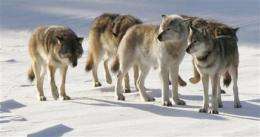
(AP) -- The two dozen or so gray wolves that wander an island chain in northwestern Lake Superior are suffering from backbone malformations caused by genetic inbreeding, posing yet another challenge to their prospects for long-term survival, according to wildlife biologists.
Although confirmed only recently, the problem apparently has been festering for decades in the small, isolated packs in Michigan's Isle Royale National Park. The abnormalities, also found in some domestic dogs, can cause pain and partial paralysis while limiting the range of motion so crucial for predators in the wild.
The discovery raises the ethically thorny question of whether scientists should try to dilute the gene pool by introducing wolves from elsewhere, said researchers with Michigan Tech University in Houghton, which hosts a 51-year-old study of the island park's wolves and moose.
It is among the world's longest continuing observations of symbiotic relationships between predator and prey species and their natural surroundings.
Historically, biologists have taken a hands-off posture as wolf and moose numbers have risen and fallen, preferring to let nature take its course even if it meant extinction of one or both species. But strong arguments could be made for intervening as well, project leaders now say.
"This is not a decision just for scientists to make any more," said Rolf Peterson, who has taken part in the study since 1970.
The research team reported its findings this week in the current issue of the journal Biological Conservation and is soliciting public comments on its Web site.
Although part of Michigan, Isle Royale is closer to Minnesota and Ontario. Moose found their way to the island - probably by swimming the 15 miles from Canada - around 1900. Two or three wolves arrived in the late 1940s, crossing a rare ice bridge from the mainland.
Weather, food availability, disease and other factors have caused the two species' populations to fluctuate over the years. The most dangerous period for the wolves came in the 1980s, when their total dropped to 12 because of a parvovirus outbreak.
Their population stood at 24 this winter, roughly the long-term average. They were divided into four packs.
Scientists had long watched for problems from inbreeding, such as poor survival rates for pups. Instead, the first solid evidence surfaced when Jannikke Raikkonen of the Swedish Museum of National History, an expert in wolf anatomy, visited Isle Royale several years ago to examine the project's bone collection.
She identified malformed vertebrae in all wolf remains found the previous dozen years. Such abnormalities show up in just 1 percent of observed populations that are not inbred.
Peterson and biologist John Vucetich found two dead wolves this winter with misshapen vertebrae. One had been killed by fellow wolves. The other had unusually severe arthritis for its age and a neck injury suggesting a moose kick. The bone malformation may have lessened its ability to dodge the lethal blow, Vucetich said.
Spinal malformation from inbreeding poses no immediate threat of extinction, Peterson said. The biggest short-term problem is a drop-off in moose, the wolves' primary food supply, which scientists attribute to climate change. This winter's moose census turned up 530 - only about half their long-term average and a drop-off from last year's estimated 650.
But inbreeding joins the list of reasons why the wolves will always be living on the edge, one disaster away from disappearing, Vucetich said.
"It just makes everything a heck of a lot more complicated," he said.
The study team is considering whether to propose a "genetic rescue" - trapping unrelated mainland wolves and bringing them to Isle Royale, hoping they would breed and mix their genes with the existing population.
The question involves competing scientific and ethical values, Vucetich said.
Opponents of intervention believe humans should not tinker with wilderness systems. Even if Isle Royale's wolves die out, their loss would provide information that could save endangered species elsewhere.
Other would counter that attempting to save the wolves also could yield valuable data, while sparing individual animals from painful bone deformities.
"We have an incomplete understanding of genetic rescue - when and how and why it works," Vucetich said. "Even so, it may be an important conservation tool as more population species become rare."
---
On the Net:
Wolf study site: www.isleroyalewolf.org
©2009 The Associated Press. All rights reserved. This material may not be published, broadcast, rewritten or redistributed.


