Locking Parasites in Host Cell Could Be New Way to Fight Malaria, Penn Study Shows
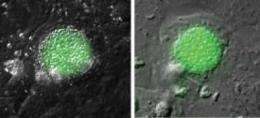
(PhysOrg.com) -- Researchers at the University of Pennsylvania have discovered that parasites hijack host-cell proteins to ensure their survival and proliferation, suggesting new ways to control the diseases they cause. The study, appearing this week online in Science, was led by Doron Greenbaum, PhD, Assistant Professor of Pharmacology in the Penn School of Medicine.
"Researchers can now develop ways to kill parasites by placing roadblocks in the path they use to destroy their victims," says Greenbaum. The team discovered that malaria parasites depend upon an enzyme stolen from the host cell for successful infection. Historically, many researchers have focused on developing ways to keep parasites from entering host cells, but Greenbaum's group was curious about an alternative route of attack: locking the parasites inside the host cell.
These studies began with Plasmodium falciparum, which causes the most deadly form of human malaria. Each year, the Centers for Disease Control and Prevention report 350 million cases of malaria occur worldwide, killing more than a million people. In collaboration with the laboratory of Penn biologist David Roos, PhD, the work was broadened to include Toxoplasma gondii, which causes a parasitic disease called toxoplasmosis, the leading cause of birth defects worldwide and harmful to people with compromised immune systems. The CDC estimates more than 60 million people living in the U.S. carry T. gondii.
"We always suspected that enzymes called proteases might be required to help parasites escape from the infected cell, but had assumed that these enzymes were produced by the parasites themselves. We had never considered that parasites might instead hijack host cell proteases. It's an ingenious system," says Greenbaum. "Our findings open up whole new window for drug discovery."
"This work is a triumph of integrative science, combining modern techniques in chemistry, biology, genetics, pharmacology, and genomics," says Roos, the E. Otis Kendal Professor of Biology and Ellison Medical Foundation Senior Scholar of Global Infectious Diseases. Collaborations between the Greenbaum and Roos laboratories have been facilitated by proximity, as these researchers are housed in adjacent space, under the auspices of the Penn Genome Frontiers Institute.
Because Plasmodium and Toxoplasma kill infected cells, they must constantly hop from cell to cell to survive. When parasites burst out of an infected cell, they leave a mess behind, shredding the dense meshwork of proteins comprising the host cell cytoskeleton and breaking the cell apart, causing cell death. But researchers were unsure what proteins the parasites were using as tools to help them break through the walls of the cell.
To observe the behavior of P. falciparum parasites, the team infected human red blood cells, using pharmacological and biochemical evidence to discover that parasites activate the host protease calpain-1. Blocking or removing calpain-1, a calcium regulated protease, left parasites trapped inside the host cell. By adding calpain-1 back into the cell, parasites were able to once again blast free.
Curious to know if the distantly related parasite T. gondii might use the same process, Greenbaum worked with Roos, who has pioneered the use of T. gondii for a wide range of molecular genetic and cellular studies. Infecting mouse fibroblasts with T. gondii, the team used genetic techniques to remove, and restore, calpain activity. They found that in the absence of calpain, parasites could not escape the infected cell, just as they had observed for malaria parasites.
Over the past 40 years, malaria has become increasingly resistant to drugs that once controlled this devastating disease, leading to an alarming increase in deaths. Targeting host proteins rather than the parasite itself might give the parasite less scope to develop resistance, since the parasite doesn't have genetic control over host proteins. Greenbaum plans to continue to explore the viability of calpain as a drug target for antiparasitic drugs.
Source: University of Pennsylvania School of Medicine (news : web)


