Sun Dial uses mobile phones to alert Muslims to prayer (w/Video)
April 6, 2009
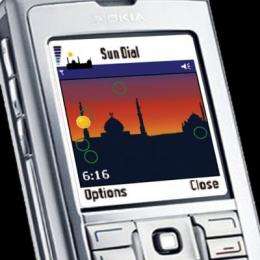
Sun Dial is a mobile application that uses images to alert users to the five daily prayers of Islam. Credit: Susan Wyche
Religious technology may seem like an oxymoron, but as more people obtain mobile phones, iPhones and other devices to help them manage their lives, it's only natural that many of them will be using their gadgets to help them enrich their spiritual life as well. Researchers at the Georgia Institute of Technology have developed a mobile application known as Sun Dial, which alerts Muslim users when it's time to perform the five daily prayers known as salat. The device is currently being discussed this week at the human-computer interaction conference, CHI, in Boston.
"We have to understand religion because it's such a central part of peoples lives," explained Susan Wyche, doctoral candidate in the College of Computing and GVU Center at Georgia Tech.
Designing technological devices for religious use may be very different from designing devices for traditional uses in office settings.
"Efficiency and productivity tend to be driving forces when designing technology for offices, but these are not as central when designing applications for the home or religious settings. Why would you design a device that makes someone pray faster?," said Wyche.
This video is not supported by your browser at this time.
Sun Dial is a mobile phone application that alerts Muslims when it's time for one of their five daily prayers. Credit: Susan Wyche
Wyche, along with her research team, chose to focus on Islam for this study, partially because of the religion's popularity worldwide and partially because Muslims have historically used technology such as compasses and telescopes to help them determine the direction to face during prayer.Working with seven focus groups, they determined that the greatest interest from the participants lay in prompting them when it was time to pray — not by using text, which some commercial applications use, but through imagery combined with audible alerts.
Sun Dial tells users that the time to pray is approaching by using an image of the sun lining up with a green circle. When the sun lines up with the circle, it's time to pray.
"Unlike similar systems, ours relies on graphics rather than text and graphs to communicate prayer times. Users drove this choice by telling us that tracking the sun was the most religiously valued method to determine prayer times."
Wyche and colleagues tested their application with Muslims from Georgia Tech and the greater Atlanta area for two weeks with favorable reaction. They're currently working on implementing a few design changes such as a digital clock and a vibration alert. Eventually, they plan on making the application available for download.
"Sun Dial provided more than functionality or a prompt to the prayer times; it also contributed to users' religious experience by reminding them they were part of a larger community. More broadly, carefully considering imagery is important when developing mobile phone applications, particularly ones that support personal and emotional activities, which may be sacred or secular."
Source: Georgia Institute of Technology
-
A book of common prayers
Dec 04, 2008 |
not rated yet |
0
-
Power of prayer to help heal studied
Mar 24, 2006 |
not rated yet |
0
-
Collective religious rituals, not religious devotion, spur support for suicide attacks
Feb 18, 2009 |
not rated yet |
0
-
Wireless World: Religious ringtones
Mar 31, 2006 |
not rated yet |
0
-
Prayers don't help heart surgery patients; Some fare worse when prayed for
Apr 06, 2006 |
not rated yet |
0
-
Engineers build first sub-10-nm carbon nanotube transistor
Feb 01, 2012 |
4.9 / 5 (33) |
30
-
Something old, something new: Evolution and the structural divergence of duplicate genes
Jan 31, 2012 |
4.6 / 5 (7) |
1
-
The hidden nanoworld of ice crystals: Revealing the dynamic behavior of quasi-liquid layers
Jan 30, 2012 |
5 / 5 (4) |
1
-
Stock market network reveals investor clustering
Jan 27, 2012 |
3.9 / 5 (23) |
8
-
Of microchemistry and molecules: Electronic microfluidic device synthesizes biocompatible probes
Jan 26, 2012 |
5 / 5 (2) |
0
-
How to calculate total compressibility in liquid porous solid system
2 hours ago
-
Need help reading 3-D
21 hours ago
-
A way to send and receive wireless data
Feb 11, 2012
-
Calling function with no input argument
Feb 10, 2012
-
Force free body diagram problem on gym equipment
Feb 10, 2012
-
Empirical data regarding shower heads and water
Feb 10, 2012
- More from Physics Forums - General Engineering
More news stories
Google might launch Drive for cloud storage soon
(PhysOrg.com) -- Google's next big move, according to the Wall Street Journal, is a cloud storage service called Drive. Hardly first to the plate, Google is simply catching up to introducing its cloud reposi ...
Iran blocks email, restricts net access: reports
Iran has further restricted access to the Internet and blocked popular email services for the past few days, in a move a top lawmaker said could "cost the regime dearly," media reports said on Sunday.
3 hours ago |
5 / 5 (1) |
3
Love a click away in Indonesia's Twitter Republic
He was a geeky kid from Yogyakarta, she a glamorous city girl in Jakarta. In a country with one of the world's most vibrant social networking scenes they fell in love on Twitter.
11 hours ago |
4 / 5 (1) |
0
Walney offshore wind farm is world's biggest (for now)
(PhysOrg.com) -- The Walney wind farm on the Irish Sea--characterized by high tides, waves and windy weather--officially opened this week. The farm is treated in the press as a very big deal as the Walney ...
Navy to begin tests on electromagnetic railgun prototype launcher
The Office of Naval Research (ONR)'s Electromagnetic (EM) Railgun program will take an important step forward in the coming weeks when the first industry railgun prototype launcher is tested at a facility ...
Feb 06, 2012 |
4.5 / 5 (17) |
94
|
Scientists discover molecular secrets of 2,000-year-old Chinese herbal remedy
For roughly two thousand years, Chinese herbalists have treated Malaria using a root extract, commonly known as Chang Shan, from a type of hydrangea that grows in Tibet and Nepal. More recent studies suggest that halofuginone, ...
New method to examine batteries -- MRI from the inside
There is an ever-increasing need for advanced batteries for portable electronics, such as phones, cameras, and music players, but also to power electric vehicles and to facilitate the distribution and storage of energy derived ...
Lab study raises questions over nano-particle impact
Tests involving chickens have raised questions about the impact on health from engineered nano-particles, the ultra-fine grains commonly used in drugs and processed foods, scientists said on Sunday.
Injured boomers beware: Know when to see doctor
(AP) -- It happened to nurse Jane Byron years after an in-line skating fall, business owner Haralee Weintraub while doing "men's" push-ups, and avid cyclist Gene Wilberg while lifting a heavy box.
A mitosis mystery solved: How chromosomes align perfectly in a dividing cell
Although the process of mitotic cell division has been studied intensely for more than 50 years, Whitehead Institute researchers have only now solved the mystery of how cells correctly align their chromosomes during symmetric ...
Starve a virus, feed a cure? Findings show how some cells protect themselves against HIV
A protein that protects some of our immune cells from the most common and virulent form of HIV works by starving the virus of the molecular building blocks that it needs to replicate, according to research published online ...