Volunteers help salamanders avoid roadway massacre
April 6, 2009 By LISA RATHKE , Associated Press Writer
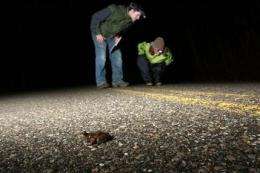
Martin Lee, left, and Tori Cleiland check the roadway in New Haven, Vt., Sunday, March 22, 2009. They volunteered on a recent night to carry salamanders, frogs and newts across the road during their annual migration to mate. On rainy nights in early spring, roads between forests and vernal pools are hopping and crawling with activity. On some nights, hundreds of amphibians cross small stretches of roads to mate. But many don't make it, getting squashed by cars. (AP Photo/Alden Pellett)
(AP) -- The black salamander with yellow spots sat on the roadside in the dark, ready to make a go of it.
But it was not on its own. It got help from an escort - one of 45 people who volunteered on a recent night to carry salamanders, frogs and newts across the road during their annual migration to mate.
On rainy nights in early spring, roads between forests and vernal pools are hopping and crawling with activity. On some nights, hundreds of amphibians cross small stretches of asphalt to mate. But many don't make it.
From rural Vermont to urban centers like Philadelphia, human escorts, called bucket brigades in some places, help amphibians make it to their mating areas without getting squashed by cars. It's part education, part conservation, and part science.
"It's an extraordinary thing and people deserve to know about it," said Warren King, a member of the Otter Creek Audubon Society, who organizes a crossing in Salisbury. "And it needs to be protected. There are sites where many of the critters that are crossing never make it."
On a recent night, University of Vermont student Kaitlin Friedman walked with other volunteers along the asphalt with flashlights and clipboards, moving wood frogs, peepers, blue-spotted, red-backed and four-toed salamanders across the road, while jotting down how many they saw. They also kept count of vehicles, and the amphibians that didn't make it, trying to identify the flattened carcasses.
"It's pretty much the one time of year where you get to see a lot of salamanders in abundance and it's just really cool," said Friedman, 20, of Long Island, New York. "Plus, you know you help them across the road, you feel like maybe you're making a small reduction in their mortality rates, maybe, just for that hour or so."
John Kart, of Richmond, and his family have been helping salamanders cross the road for five years. On a recent evening, he said his 5-year-old daughter and two friends were as excited as the salamanders as they peered into a watery ditch.
"We're a little early this year but often you come and it is just loud as all get out from all the peepers and wood frogs screaming down in the pond below," he said.
The half dozen cars that passed in an hour slowed down through the stretch of road dotted with flashlights, some stopping to ask what was going on. After two hours, the group had spotted 589 amphibians, and 97 dead ones.
But a few miles ahead, on a busier road in Monkton, the scene wasn't pretty. It was more of a slaughter. The escorts were finding more dead amphibians than live ones.
Within the first half hour they counted 20 dead spotted salamanders and 18 live ones, eight dead and four live wood frogs, seven dead peepers and one live one, four dead and one live eft or immature newt and 23 cars, said Steve Parren, a member of the Monkton Planning Commissioner, who works for the Vermont Fish and Wildlife Department.
Two and half hours later, the tide turned - they had counted 205 live and 98 dead amphibians - but the numbers still troubled Parren.
"I don't think the area can persist with the level of mortality that we're seeing," Parren said.
The state is considering installing tunnels under the road for amphibians and other animals to use. The town has received a $25,000 grant to pay for the engineering. The full project could cost up to $350,000, said Parren.
Similar tunnels were installed in Amherst, Mass., in 1987, and have proved 70 to 80 percent effective, said Scott Jackson, a wildlife biologist at the University of Massachusetts.
But some wonder why anyone would go to such lengths to help salamanders.
The red-backed salamanders are the most abundant backboned animal in the forest, said Jackson.
"Even if don't know what would happen if they all died out at once, we could imagine some kind of ripple effect on the rest of the ecosystem because they serve as both predator and prey and are probably very important in terms of nutrient cycling in the forest floor," he said.
For Parren it's about preserving what is there.
"For me it's more we're losing the national heritage that belongs there," he said.
©2009 The Associated Press. All rights reserved. This material may not be published, broadcast, rewritten or redistributed.
-
Study rules out inbreeding as cause of amphibian deformities
Oct 28, 2008 |
not rated yet |
0
-
Appalachian salamanders' ecosystem studied
Jun 22, 2006 |
not rated yet |
0
-
Road losses add up, taxing amphibians and other animals
Apr 16, 2008 |
not rated yet |
0
-
Amphibian populations dropping in Edmonton's wetlands
Jul 10, 2008 |
not rated yet |
0
-
Amphibians respond behaviorally to impact of clear cutting
Mar 11, 2008 |
not rated yet |
0
-
Engineers build first sub-10-nm carbon nanotube transistor
Feb 01, 2012 |
4.9 / 5 (31) |
30
-
Something old, something new: Evolution and the structural divergence of duplicate genes
Jan 31, 2012 |
4.6 / 5 (7) |
1
-
The hidden nanoworld of ice crystals: Revealing the dynamic behavior of quasi-liquid layers
Jan 30, 2012 |
5 / 5 (3) |
1
-
Stock market network reveals investor clustering
Jan 27, 2012 |
3.9 / 5 (23) |
8
-
Of microchemistry and molecules: Electronic microfluidic device synthesizes biocompatible probes
Jan 26, 2012 |
5 / 5 (1) |
0
-
Stem cell question.
Feb 10, 2012
-
Protease cleavage
Feb 10, 2012
-
Pertubance in a model
Feb 10, 2012
-
Cancer drugs and Alzheimer's, Oh my!
Feb 09, 2012
-
Squishing cells
Feb 09, 2012
-
Any books/articles for evolutionary stable strategy models in humans?
Feb 09, 2012
- More from Physics Forums - Biology
More news stories
Entire genome of extinct human decoded from fossil
(PhysOrg.com) -- In 2010, Svante Pääbo and his colleagues presented a draft version of the genome from a small fragment of a human finger bone discovered in Denisova Cave in southern Siberia. The ...
Feb 07, 2012 |
4.7 / 5 (58) |
45
|
Why are there so few fish in the Earth's oceans?
(PhysOrg.com) -- A Stony Brook University researcher has found that, contrary to popular belief, there are not plenty of fish in the sea.
Feb 08, 2012 |
4.3 / 5 (17) |
26
|
Miami battling invasion of giant African snails
No one knows how they got there. But an invasion of African giant snails has southern Florida in a panic over potential crop damage, disease and general yuckiness surrounding the slimy gastropods.
Feb 10, 2012 |
4.5 / 5 (2) |
5
Deciding to go left or right: Researchers use device to determine that lower animals can navigate too
For decades, scientists have associated binary decision making opting to go left or right with higher-ranking animals, including humans. A team of Harvard researchers, however, is rewriting that ...
Feb 09, 2012 |
4 / 5 (1) |
4
|
Study shows chimps able to understand needs of others
(PhysOrg.com) -- By setting up a unique experiment, a small team of researchers has found that chimpanzees are able to understand need in other chimps, despite their general disinclination to offer aid when ...
Google might launch Drive for cloud storage soon
(PhysOrg.com) -- Google's next big move, according to the Wall Street Journal, is a cloud storage service called Drive. Hardly first to the plate, Google is simply catching up to introducing its cloud reposi ...
Latin America mining boom clashes with conservation
Latin America is experiencing a mining boom as prices rise fuelled by a hike in global demand, but the region is also being hit by a wave of violent protests, strikes and rallies by environmentalists.
Walney offshore wind farm is world's biggest (for now)
(PhysOrg.com) -- The Walney wind farm on the Irish Sea--characterized by high tides, waves and windy weather--officially opened this week. The farm is treated in the press as a very big deal as the Walney ...
Love a click away in Indonesia's Twitter Republic
He was a geeky kid from Yogyakarta, she a glamorous city girl in Jakarta. In a country with one of the world's most vibrant social networking scenes they fell in love on Twitter.
GPS court ruling leaves US phone tracking unclear
A US Supreme Court decision requiring a warrant to place a GPS device on the car of a criminal suspect leaves unresolved the bigger issue of police tracking using mobile phones, legal experts say.
Europeans protest controversial Internet pact
Tens of thousands of people marched in protests in more than a dozen European cities Saturday against a controversial anti-online piracy pact that critics say could curtail Internet freedom.