'Super Sherpa' climbs to clean up Everest
April 6, 2009 by Deepesh Shreatha
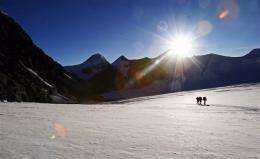
File photo shows unidentified mountaineers outside Mount Everest's advance base camp. Apa Sherpa has stood on top of the world more times than anyone in history, and now he is heading back up Mount Everest, not for the fame or glory, but in the name of environmental protection.
Apa Sherpa has stood on top of the world more times than anyone in history, and now he is heading back up Mount Everest, not for the fame or glory, but in the name of environmental protection.
Apa, 49, has become increasingly concerned about the damage inflicted on the world's highest mountain by both climate change and the waste left by careless climbers.
This spring season he hopes to conquer Everest for the 19th time, and he will use the trip to focus attention on how climate change is affecting the Himalayas -- and also bring back down as much rubbish as he can carry.
"I am not looking for recognition or doing this just to beat my own record. My objective is to highlight the environmental degradation of the mountain and draw attention to the issue of global warming," he told AFP.
Decades of expeditions have left Everest less than pristine, with discarded equipment, food containers, human excrement and even the corpses of unlucky adventurers littering its slopes.
And in one stark example of how the mountain has been hit by global warming, climbers have observed the steady break-up of the Khumbu icefall, a treacherous maze of cliffs and crevasses on the southern side of the peak.
Apa said he has experienced less snow on the mountain each time he has reached the summit since his first success in 1990.
"The snows are melting on Everest. I cannot imagine Everest turning into a naked rock," he said. "Also the beauty of Everest is deteriorating as climbers leave their garbage on the mountain. We must discourage such practices."
"For us Sherpas, Everest is not just the mountain. Everest is our god. I want to see Everest clean and safe."
As the leader of the 40-member Eco Everest expedition -- which set off from Kathmandu on Monday -- Apa will be among those picking up rubbish from the mountain.
"Bad things are happening on Everest and to Everest not only because of global warming but also because we are treating our god badly," said Apa.
He also said the tourism industry was taking its toll on the 8,848-metre (29,028-foot) peak, which was first climbed by Edmund Hillary and Sherpa Tenzing Norgay in 1953.
"Due to heavy commercialisation of Everest, the sacred spiritual aspect of the mountain is fading away and this has become very worrying for the mountain people," he said.
The communities living around the mountain are essential to the climbing business, which rests -- literally -- on the backs of indigenous Sherpas like Apa who work as support climbers for foreign expeditions.
They lay out kilometres (miles) of ropes and fix ladders across crevasses on the route to the top during the climbing season that starts later this month.
A successful ascent for Apa would take his own record to 19 summits but he cautioned that every attempt on Everest was fraught with danger.
"You never know when the weather turns bad there but the mountain needs care and the risk I am taking is worth it," he said.
(c) 2009 AFP
-
Russians look for safer route to Everest
Mar 26, 2007 |
not rated yet |
0
-
Global warming reaches Mount Everest
Mar 05, 2007 |
not rated yet |
0
-
Older climbers face uphill battle on Mount Everest
Aug 15, 2007 |
not rated yet |
0
-
Italy plans monitor high on Everest
Oct 04, 2006 |
not rated yet |
0
-
Research team explores causes of death on Mount Everest
Dec 10, 2008 |
not rated yet |
0
-
Engineers build first sub-10-nm carbon nanotube transistor
Feb 01, 2012 |
4.9 / 5 (31) |
30
-
Something old, something new: Evolution and the structural divergence of duplicate genes
Jan 31, 2012 |
4.6 / 5 (7) |
1
-
The hidden nanoworld of ice crystals: Revealing the dynamic behavior of quasi-liquid layers
Jan 30, 2012 |
5 / 5 (3) |
1
-
Stock market network reveals investor clustering
Jan 27, 2012 |
3.9 / 5 (23) |
8
-
Of microchemistry and molecules: Electronic microfluidic device synthesizes biocompatible probes
Jan 26, 2012 |
5 / 5 (1) |
0
-
Do some geologists actually act a lot like Randy Marsh?
23 hours ago
-
Discrepancy between oxygen and carbon-dioxide levels
Feb 09, 2012
-
where gems are found in the world
Feb 09, 2012
-
Wind Waves in Reservoir ~ Wind run-up and Wind set-up
Feb 08, 2012
-
Balance of oxygen in the atmosphere
Feb 01, 2012
-
The case for a methanol-based economy
Jan 30, 2012
- More from Physics Forums - Earth
More news stories
Latin America mining boom clashes with conservation
Latin America is experiencing a mining boom as prices rise fuelled by a hike in global demand, but the region is also being hit by a wave of violent protests, strikes and rallies by environmentalists.
2 hours ago |
not rated yet |
0
Europe stakes billion-dollar bet on new rocket
A pencil-slim rocket is scheduled to lift into space from South America on Monday, carrying a billion-dollar bet that Europe can grab a juicy slice of the market to place satellites in low orbit.
Space & Earth / Space Exploration
21 hours ago |
4 / 5 (3) |
0
Political leaders play key role in how worried Americans are by climate change: study
More than extreme weather events and the work of scientists, it is national political leaders who influence how much Americans worry about the threat of climate change, new research finds.
Feb 06, 2012 |
5 / 5 (6) |
72
NASA budget will axe Mars deal with Europe: scientists
US President Barack Obama's budget proposal to be submitted next week for 2013 will cut NASA's budget by 20 percent and eliminate a major partnership with Europe on Mars exploration, scientists said Thursday.
Space & Earth / Space Exploration
Feb 10, 2012 |
5 / 5 (3) |
55
Humans may have helped the decline of African rainforests 3000 years ago
(PhysOrg.com) -- Large areas of rainforests in Central Africa mysteriously disappeared over three thousand years ago, to be replaced by savannas. The prevailing theory has been that the cause was a change ...
Google might launch Drive for cloud storage soon
(PhysOrg.com) -- Google's next big move, according to the Wall Street Journal, is a cloud storage service called Drive. Hardly first to the plate, Google is simply catching up to introducing its cloud reposi ...
Love a click away in Indonesia's Twitter Republic
He was a geeky kid from Yogyakarta, she a glamorous city girl in Jakarta. In a country with one of the world's most vibrant social networking scenes they fell in love on Twitter.
Walney offshore wind farm is world's biggest (for now)
(PhysOrg.com) -- The Walney wind farm on the Irish Sea--characterized by high tides, waves and windy weather--officially opened this week. The farm is treated in the press as a very big deal as the Walney ...
GPS court ruling leaves US phone tracking unclear
A US Supreme Court decision requiring a warrant to place a GPS device on the car of a criminal suspect leaves unresolved the bigger issue of police tracking using mobile phones, legal experts say.
Europeans protest controversial Internet pact
Tens of thousands of people marched in protests in more than a dozen European cities Saturday against a controversial anti-online piracy pact that critics say could curtail Internet freedom.
Study finds that anti-diabetic medication can prevent the long-term effects of maternal obesity
In a study to be presented today at the Society for Maternal-Fetal Medicine's annual meeting, The Pregnancy Meeting, in Dallas, Texas, researchers will report findings that show that short therapy with the anti-diabetic medication ...
Apr 06, 2009
Rank: 3 / 5 (2)
Apr 06, 2009
Rank: 2 / 5 (2)
Apr 06, 2009
Rank: 4 / 5 (2)
Apr 07, 2009
Rank: 5 / 5 (1)
Apr 08, 2009
Rank: not rated yet