Keeping the heat down
April 6, 2009 Keeping the heat down

Enlarge

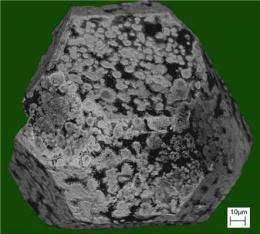
Diamond crystal with a carbide film (white). © Fraunhofer IFAM

(PhysOrg.com) -- Electronic products are having to accommodate more and more components, all of which generate heat. Too much heat could put laptops and other devices out of action, so manufacturers equip them with metal plates to discharge it. A new composite can do this better.

While portable computers were still rather cumbersome several years ago, they now easily fit inside small briefcases. This is because the components on the substrates and microchips are shrinking in size with each successive model. They are also spaced closer together, allowing more circuits to be accommodated on each chip. All of these components generate radiant , much like small power plants. The more components are packed into a limited space, the more difficult it is to dissipate the heat. And too much heat could put the electronics out of action.

The components and connecting elements can only withstand temperatures of 90 to 130 degrees Celsius. Manufacturers therefore mount a small or aluminum plate underneath them to conduct the heat away. The plate, in turn, is soldered to components or silicon (the main constituent of the chip). If this system heats up, the plate expands about three or four times as much as the silicon or the ceramics. This causes tension which can lead to cracks in the soldered joints, so there are limits to how far components can be miniaturized.

Industrial users are calling for a material with special properties that can efficiently dissipate heat even in devices with densely packed components and that can give increasingly miniaturized electronics a longer life. The material needs to be able to conduct heat even better than the aluminum or copper materials used so far, but should not expand to a greater extent than ceramics or silicon at high temperatures. Such a material has now been developed by researchers at the Fraunhofer Institute for Manufacturing Engineering and Applied Materials Research IFAM in Dresden together with industrial partners including Siemens and Plansee as part of the EU project “ExtreMat”. The researchers have even surpassed the already relatively high thermal conductivity of copper: “We did this by adding diamond powder to the copper. Diamond conducts heat roughly five times better than copper,” says IFAM project manager Dr. Thomas Schubert.

“The resulting material expands no more than ceramics when heated, but has a conductivity one-and-a-half times superior to copper. This is a unique combination of properties.” However, it isn’t easy to unite copper and diamond. The researchers had to find a third ingredient to chemically bond the two materials. “One ingredient we can use to achieve this is chrome. Even small amounts form a carbide film on the diamond surface, and this film easily bonds to copper,” Schubert explains. First demonstrators of the material have already been produced.

Provided by Fraunhofer-Gesellschaft (news : web)


print this article email this article download pdf blog this article bookmark this article     Stumble it Digg this share on Facebook retweet share on Reddit add to delicious
Rate this story - not rated yet


April 6, 2009 all stories

Comments: 0

not rated yet
  • Stumble this up

  • Digg this

  • share this

  • hide
  • Related Stories

  • Improved dielectric developed for chip-level copper circuitry
    created Mar 29, 2005 | popularity not rated yet | comments 0
  • Nanotubes could improve thermal management in electronics
    created Mar 29, 2007 | popularity not rated yet | comments 0
  • Ceramic material revs up microwaving
    created Aug 28, 2008 | popularity not rated yet | comments 0
  • Plastic as a conductor
    created Dec 02, 2008 | popularity not rated yet | comments 0
  • Printing of components with functional ink
    created Apr 08, 2005 | popularity not rated yet | comments 0


  • hide
  • Relevant PhysicsForums posts

  • Zinc Oxide reduction
    created 11 hours ago
  • depolymerization of HDPE
    created Nov 08, 2009
  • Question, whats the best chemistry software for a college student?
    created Nov 08, 2009
  • Why only opposite spin electrons in an orbital ?
    created Nov 08, 2009
  • More from Physics Forums - Chemistry

Other News

Toward home-brewed electricity with 'personalized solar energy'

Toward home-brewed electricity with 'personalized solar energy'

Chemistry / Materials Science

created Nov 04, 2009 | popularity 3.4 / 5 (9) | comments 4

New scientific discoveries are moving society toward the era of "personalized solar energy," in which the focus of electricity production shifts from huge central generating stations to individuals in their ...


Scientists Reproduce a Building Block of Life in Laboratory

Scientists Reproduce a Building Block of Life in Laboratory

Chemistry / Biochemistry

created Nov 06, 2009 | popularity 4.8 / 5 (23) | comments 0

(PhysOrg.com) -- NASA scientists studying the origin of life have reproduced uracil, a key component of our hereditary material, in the laboratory.


Newly Discovered Fat Molecule: An Undersea Killer with an Upside

Newly Discovered Fat Molecule: An Undersea Killer with an Upside

Chemistry / Biochemistry

created Nov 05, 2009 | popularity 4.8 / 5 (10) | comments 0

(PhysOrg.com) -- A chemical culprit responsible for the rapid, mysterious death of phytoplankton in the North Atlantic Ocean has been found by collaborating scientists at Rutgers University and the Woods Hole ...


CU-Boulder map of human bacterial diversity shows wide interpersonal differences

Map of Human Bacterial Diversity Shows Wide Interpersonal Differences

Chemistry / Biochemistry

created Nov 05, 2009 | popularity 4.7 / 5 (11) | comments 0

(PhysOrg.com) -- A University of Colorado at Boulder team has developed the first atlas of bacterial diversity across the human body, charting wide variations in microbe populations that live in different ...


Mimicking nature, scientists can now extend redox potentials

Mimicking nature, scientists can now extend redox potentials

Chemistry / Biochemistry

created Nov 04, 2009 | popularity 4.8 / 5 (5) | comments 0

(PhysOrg.com) -- New insight into how nature handles some fundamental processes is guiding researchers in the design of tailor-made proteins for applications such as artificial photosynthetic centers, long-range ...