UGA licenses invention that kills food-borne pathogens in minutes
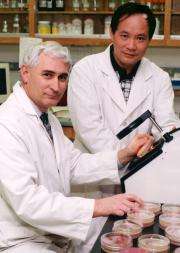
A new technology that kills dangerous pathogens on food at home and in restaurants, grocery stores, beverage-manufacturing and food-processing facilities has been licensed to the maker of FIT Fruit and Vegetable Wash™. The licensing agreement between the University of Georgia Research Foundation, Inc. and HealthPro Brands, Inc., FIT's parent company, vastly extends the range of applications for the company's current anti-microbial food wash.
The exclusive license, which includes sublicensing rights, is effective in select countries around the world, including the U.S.
The new technology, invented by scientists from the University of Georgia Center for Food Safety, can kill significant numbers of dangerous E. coli and salmonella in less than one minute, but it is recommended that the wash be applied from one to five minutes. The technology can be used as a food wash, with commercial applications for the produce, poultry, meat and egg processing industries.
"The re-formulated FIT food wash will kill more harmful microbes faster," said Mike Doyle, Center for Food Safety director, and—together with microbiologist Tong Zhao—one of the technology's inventors. "The new anti-microbial food wash is orders of magnitude more powerful and twice faster."
Doyle is an internationally recognized authority on food safety whose research focuses on developing methods to detect and control food-borne bacterial pathogens at all levels of the food continuum, from farm to table. He has served as a scientific adviser to many groups, including the World Health Organization, the Food and Drug Administration, the U.S. Department of Agriculture, the U.S. Department of Defense, and the U.S. Environmental Protection Agency.
"The new technology takes our current FIT product to a whole new level of sanitization," said Todd Wichmann, president and CEO of HealthPro Brands. "We look forward to getting our improved product into the hands of industry."
Importantly, Doyle said, the wash has no effects on smell, taste or appearance of the foods that are treated, even delicate produce. "The new product doesn't interfere with the shelf-life of sensitive foods," he said.
Like the original FIT Fruit and Vegetable Wash now used at home by consumers and by food service industry, the new antimicrobial wash uses a combination of two inexpensive components that are safe for humans and the environment. The new FIT product also will be available as a spray and immersion solution for foods ranging from fragile leafy produce, fruits and vegetables, to more robust foods such as meats and poultry, or food preparation equipment and food transportation vehicles. For the greatest efficacy, the product is used at different concentrations and different periods of exposure for different applications.
FIT will replace chlorine as the new standard for reducing harmful bacteria levels in industrial settings, said Wichmann. Chlorine's drawbacks are multiple: it is toxic at high concentrations, it may produce off-flavors and undesirable appearance in certain food products; it can damage equipment; it can only be used, stored and transported in conjunction with specialized equipment and trained personnel; and because it may be harmful to the environment, it also is subject to environmental regulations. Chlorine may also damage certain seeds and delicate sprouts.
"We can't rely on chlorine any longer," Doyle said. "In addition to being safer and more acceptable in terms of appearance and smell, our studies have shown this new technology to be considerably more effective than chlorine." The product outperforms other food sanitization technologies, such as ozone, as well. Ozone, a short-lived gas, must be produced using specialized equipment immediately upon use, thus making its use inaccessible to the majority of companies in the food industry.
Gennaro Gama, a senior technology manager with UGARF, said that the new product also could be used as an anti-microbial additive in food products such as ground meats, butters and pastes.
"We are very pleased to have established a partnership with HealthPro," Gama said. "We believe that our respective technologies interact synergistically and will lead to the short-term development of very versatile products that can be used in virtually all segments of the food industry and with considerable potential to mitigate public health issues associated with food poisoning."
Gama continued, "We are also grateful to HealthPro for agreeing with UGARF's request to retain the ability to license the technology for humanitarian purposes in Sub-Saharan Africa, where contamination of the food chain is ubiquitous and easy counter-measures are frequently unavailable to those populations."
Source: University of Georgia (news : web)


