Subterranean oceans on Saturn's moon Titan
April 6, 2009 BY LOUIS BERGERON
Subterranean oceans on Saturn's moon Titan

Enlarge

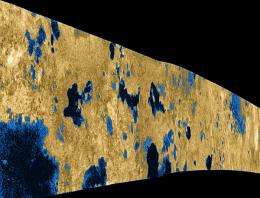
A radar image of some of the lakes of hydrocarbons spread across one of the poles of Titan, the largest of Saturn’s moons. Colors have been altered to accentuate the topographic features. Photo courtesy of NASA/JPL and the Cassini Project Office

(PhysOrg.com) -- Saturn's largest moon, Titan, may have a subterranean ocean of hydrocarbons and some topsy-turvy topography in which the summits of its mountains lie lower than its average surface elevation, according to new research.

Titan is also more squashed in its overall shape—like a rubber ball pressed down by a foot—than researchers had expected, said Howard Zebker, a Stanford geophysicist and electrical engineer involved in the work. The new findings may help explain the presence of large lakes of hydrocarbons at both of Titan's poles, which have been puzzling researchers since being discovered in 2007.

"Since the poles are squished in with respect to the equator, if there is a 'water table' that is more or less spherical in shape, then the poles would be closer down to that water table and depressions at the poles would fill up with liquid," Zebker said. The shape of the water table would be controlled by the of , which is still not fully understood.

Hydrocarbons are the only materials on Titan's that would remain liquid at minus180 degrees Celsius, the of the moon's surface. Any water would be frozen, making it plausible that instead of groundwater, Titan would have the equivalent in hydrocarbons.

The research will be published in a paper in Science and can now be read on the magazine's website.

Zebker, the lead author, and a group of colleagues have been making radar measurements of Titan's surface over the last four years using an instrument aboard the , which is orbiting Saturn. Whenever Cassini passes close enough, they sweep beams of cloud-penetrating radar through Titan's thick atmosphere and across the surface. Using the radar data, they can calculate the surface elevations along the tracks of the sweep.

Combining more than 40 tracks across the surface, the researchers were able to calculate the three-dimensional shape of Titan.

Zebker said that there were theoretical reasons to expect that Titan was not a perfect sphere, but instead probably slightly oblate, or flattened, due to the centrifugal force from its rotation while orbiting Saturn. But the degree to which Titan is flattened exceeds what would be expected, based upon how close it is to Saturn and its roughly 16-day orbit.

It also turns out that Titan is not flattened uniformly. By way of analogy, if you were to put your foot on a rubber ball and press down, the ball would bulge out equally on all sides in the directions perpendicular to the downward force from your foot.

But the bulge of Titan is asymmetrical. The longest axis is oriented so that it points toward Saturn, a result of tidal forces from the planet. The shortest axis runs through the poles. And the other axis, oriented in the direction in which Titan orbits Saturn, is intermediate in length.

"While some asymmetry is expected from Saturn's gravitational pull, there is obviously something going on that causes Titan to have a different shape than expected," Zebker said.

There are several possible explanations for Titan's deformity. It might be that when the shape of the moon was determined, it was in an orbit closer to Saturn. "Another is that there are active geophysical processes occurring inside Titan that further distort the shape," Zebker said. "There are probably many other explanations as well, but we don't have enough information from this one experiment to be able to distinguish those."

Active geophysical processes might help account for another of Titan's oddities.

Zebker said that if you look at images of the surface of Titan, you see surface features that look every bit like mountains on Earth but don't have the high elevations compared to the plains stretching out around them.

"One of the really surprising finds that we have from this, is that the largest apparent continent is lower than the average elevation on Titan, as opposed to higher than the average elevation, as we have on the Earth," Zebker said.

"My favorite explanation is that the material that forms the mountains is simply more dense than the material surrounding them," he said. That would result in the mountains pushing down the surrounding crust, effectively putting the mountains in a basin of their own creation.

On Earth, the situation is the reverse: The crust that lies under the oceans is denser than the material that makes up the continental crust, where mountain ranges are built up.

"The things that we would expect to exist on the surface of Titan would either be solid hydrocarbon materials, essentially frozen ethane and methane, and that is fairly light, and then frozen water ice, which is denser," Zebker said. "If the mountains are composed of water ice and the plain features in between are composed of these solid hydrocarbons, that could lead to this kind of a situation."

Zebker said that research currently being conducted by other scientists to decipher the gravity field of Titan should help resolve some of the questions raised by his team's latest work. But he's holding off making any predictions.

"All of it surprises me because you never know what you are going to see," he said.

Source: Stanford University (news : web)

4.3 /5 (16 votes)  

Filter


Move the slider to adjust rank threshold, so that you can hide some of the comments.


Display comments: newest first

Bonkers
Apr 06, 2009

Rank: 1 / 5 (1)
Don't tell Dubya or his cronies!
Bob_B
Apr 06, 2009

Rank: 1 / 5 (1)
Who?
LariAnn
Apr 06, 2009

Rank: 3.7 / 5 (3)
Well, I think we can safely say that a NO SMOKING sign should be posted on Titan so no visitors will set all those hydrocarbon lakes alight unintentionally.
paulthebassguy
Apr 06, 2009

Rank: 5 / 5 (1)
Haha or else, LariAnn, setting them alight may be an easy way to start off the terraform process.
Mercury_01
Apr 07, 2009

Rank: 5 / 5 (1)
Funny how hydrocarbons form naturally elsewhere in the solar system, but it's out of the question for that to have ever occurred on earth!
bluehigh
Apr 07, 2009

Rank: 3 / 5 (2)
Okay, so no dead dinosaurs or massive burials of vegetation. Earths hydrocarbon reserviors formed in a colder original environment and were trapped through terraforming as our planet warmed when the sun ignited.

Hmmm ... dig deeper?
Mercury_01
Apr 07, 2009

Rank: 3 / 5 (2)
Its true that our hydrocarbons are much longer and more complex, but we truly dont know that complex hydrocarbons do not form elsewhere. And with an entire "water table" of liquid hydrocarbon on Titan, It would seem probable that it could, under certain circumstances, form complex chains. We might be sitting on an almost limitless supply of oil. Not that we should just continue burning it, but there is some compelling evidence pointing towards oil being a product of the earth itself. Entire oil fields have been re- tapped after being sucked dry years beforehand. Sounds kind of like an "oil table" !
Rank 4.3 /5 (16 votes)
Related Stories
Relevant PhysicsForums posts
  • Scale of the Universe
    created14 hours ago
  • Titan's lack of impact craters
    createdFeb 09, 2012
  • Real pictures of black hole eating a star?
    createdFeb 08, 2012
  • Hypothetical way to travel faster than light, but not technically exceed lightspeed
    createdFeb 06, 2012
  • How do scientists monitor the Sun's activity?
    createdFeb 05, 2012
  • Search patterns in observational studies
    createdFeb 05, 2012
  • More from Physics Forums - General Astronomy

More news stories

Could Venus be shifting gear?

(PhysOrg.com) -- ESA’s Venus Express spacecraft has discovered that our cloud-covered neighbour spins a little slower than previously measured. Peering through the dense atmosphere in the infrared, the ...

Space & Earth / Space Exploration

created 21 hours ago | popularity 5 / 5 (7) | comments 8 | with audio podcast

Mars Science Laboratory computer issue resolved

(PhysOrg.com) -- Engineers have found the root cause of a computer reset that occurred two months ago on NASA's Mars Science Laboratory and have determined how to correct it.

Space & Earth / Space Exploration

created 22 hours ago | popularity 4.7 / 5 (6) | comments 4 | with audio podcast

Two new moons for Jupiter

Advances in technology have lead to the discovery of new planets outside of our Solar System, and now even new moons in our own backyard.

Space & Earth / Space Exploration

created 21 hours ago | popularity 4 / 5 (1) | comments 7

NASA sees wide-eyed cyclone Jasmine

Cyclone Jasmine's eye has opened wider on NASA satellite imagery, as it moves through the Southern Pacific Ocean.

Space & Earth / Earth Sciences

created 13 hours ago | popularity 3.5 / 5 (2) | comments 2

Clam fields found at deep, low-temperature Mariana vents

(PhysOrg.com) -- Scientists have marveled at the unusual life forms thriving at high temperature hydrothermal vents of the deep ocean.

Space & Earth / Earth Sciences

created 21 hours ago | popularity 4.3 / 5 (3) | comments 0 | with audio podcast


Anonymous knocks CIA website offline (Update)

The website of the Central Intelligence Agency was inaccessible on Friday after the hacker group Anonymous claimed to have knocked it offline.

New error-correcting codes guarantee the fastest possible rate of data transmission

Error-correcting codes are one of the triumphs of the digital age. They’re a way of encoding information so that it can be transmitted across a communication channel — such as an optical fiber o ...

Small modular reactor design could be a 'SUPERSTAR'

(PhysOrg.com) -- Though most of today's nuclear reactors are cooled by water, we've long known that there are alternatives; in fact, the world's first nuclear-powered electricity in 1951 came from a reactor ...

New power source discovered

(PhysOrg.com) -- Researchers at the Massachusetts Institute of Technology (MIT) and RMIT University have made a breakthrough in energy storage and power generation.

The power of estrogen -- male snakes attract other males

A new study has shown that boosting the estrogen levels of male garter snakes causes them to secrete the same pheromones that females use to attract suitors, and turned the males into just about the sexiest ...

Advanced power-grid model finds low-cost, low-carbon future in West

(PhysOrg.com) -- The least expensive way for the Western U.S. to reduce greenhouse gas emissions enough to help prevent the worst consequences of global warming is to replace coal with renewable and other ...